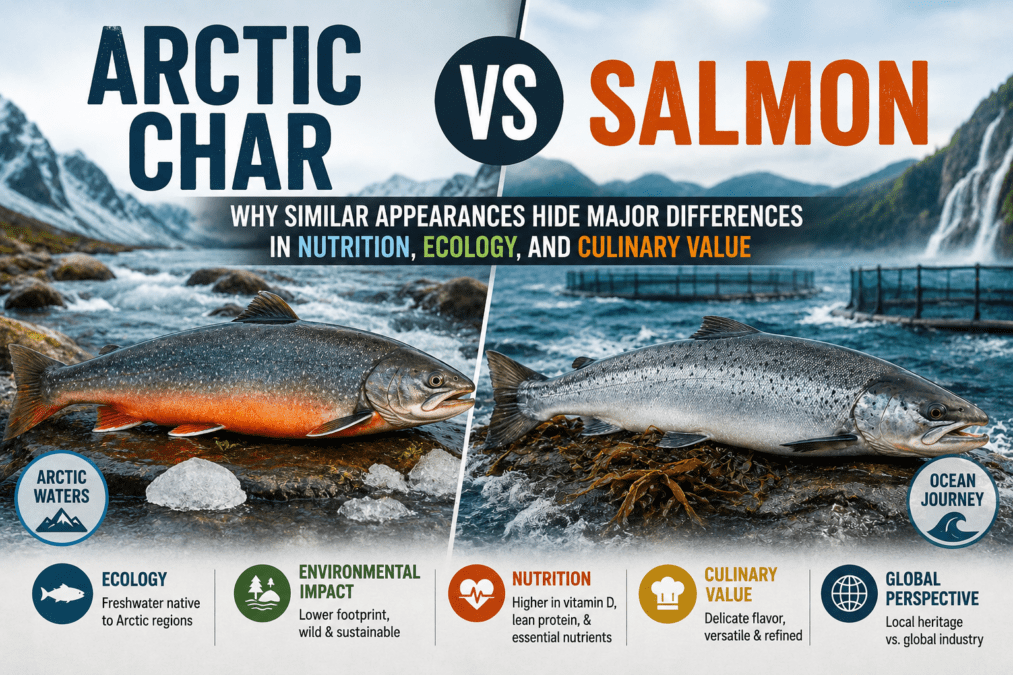

Arctic char and salmon are two of the most respected cold-water fish species in the world. Both belong to the Salmonidae family, share a similar appearance, and are prized for their flavor, nutritional value, and commercial importance. Because of these similarities, many consumers, anglers, and even culinary professionals often compare them directly. Yet beneath their comparable pink-orange flesh lies a set of important biological, ecological, and nutritional distinctions.
This arctic char vs salmon analysis examines the two species through multiple scientific and practical lenses. Rather than focusing solely on taste or appearance, the comparison evaluates anatomy, habitat adaptation, feeding behavior, sustainability, nutritional composition, commercial production, and consumer preferences. Such a framework provides a deeper understanding of why each fish excels in different contexts.
The central insight emerging from the arctic char vs salmon debate is that neither fish is universally superior. Instead, each evolved to solve different environmental challenges. Arctic char demonstrates remarkable adaptability to extreme northern ecosystems, while salmon evolved as one of nature’s most successful migratory fish. Understanding those evolutionary pathways helps explain differences in texture, flavor, health benefits, and market value.
Essential Comparative Metrics
| Comparison Factor | Arctic Char | Salmon |
|---|---|---|
| Scientific Name | Salvelinus alpinus | Multiple species within Salmo and Oncorhynchus |
| Family | Salmonidae | Salmonidae |
| Primary Habitat | Arctic and sub-Arctic lakes, rivers, and coastal waters | North Atlantic and North Pacific rivers and oceans |
| Geographic Distribution | Northern Europe, Canada, Greenland, Iceland, Alaska | North America, Europe, Russia, Japan, and aquaculture worldwide |
| Migration Behavior | Variable; many populations remain freshwater residents | Typically anadromous, migrating between freshwater and ocean |
| Average Adult Length | 20–30 inches (50–75 cm) | 24–40 inches (60–100 cm), depending on species |
| Average Adult Weight | 4–15 pounds (1.8–6.8 kg) | 8–30 pounds (3.6–13.6 kg), depending on species |
| Growth Rate | Moderate | Generally faster in commercial production systems |
| Body Coloration | Silvery sides with pink or orange undertones | Silver body with species-specific coloration patterns |
| Flavor Profile | Mild, delicate, slightly sweet | Richer, stronger, and more pronounced |
| Texture | Tender and fine-flaked | Firm, dense, and meaty |
| Fat Content | Moderate | Moderate to high |
| Omega-3 Fatty Acids | High | Very high |
| Protein Content | High-quality complete protein | High-quality complete protein |
| Vitamin D Content | Excellent source | Excellent source |
| Vitamin B12 Content | High | High |
| Selenium Content | High | High |
| Mercury Levels | Typically low | Generally low to moderate depending on source |
| Commercial Farming Scale | Relatively small and specialized | Large global industry |
| Market Availability | Limited in many regions | Widely available worldwide |
| Average Consumer Awareness | Moderate | Very high |
| Culinary Uses | Pan-searing, roasting, baking, poaching | Grilling, roasting, smoking, sushi, baking |
| Sustainability Potential | Often favorable in controlled aquaculture systems | Varies significantly by fishery and farming method |
| Price Range | Often premium-priced due to lower production volumes | Varies widely by species and origin |
| Best For | Consumers seeking mild flavor and culinary versatility | Consumers seeking rich flavor and broad availability |
A direct answer to the arctic char vs salmon question depends on the intended use. Arctic char generally offers a milder flavor, excellent sustainability potential, and versatile cooking characteristics, while salmon provides broader availability, richer taste, and often higher market familiarity. For nutrition, both are outstanding choices, making the better option largely dependent on personal preference and sourcing quality.
Arctic char is a cold-water fish species closely related to trout and salmon that thrives in some of the planet’s northernmost aquatic environments.
Salmon is a group of migratory fish species known for traveling between freshwater and marine ecosystems during their life cycle.
While both fish share evolutionary ancestry and similar nutritional profiles, their ecological adaptations and culinary characteristics differ substantially.
Structural And Biological Foundations
The arctic char vs salmon comparison begins with evolutionary biology. Although both belong to the Salmonidae family, they occupy different branches within that family tree. Arctic char belongs to the genus Salvelinus, which also includes brook trout and lake trout. Salmon encompasses multiple species across the genera Salmo and Oncorhynchus.
Arctic char evolved in extremely cold northern environments where seasonal food shortages and prolonged ice coverage shaped its physiology. As a result, many populations developed exceptional flexibility in growth rates, body size, and life-history strategies. Some remain entirely within freshwater lakes, while others migrate to marine environments.
Salmon evolved around large-scale migrations between rivers and oceans. Their anatomy supports long-distance travel, powerful swimming, and complex navigation abilities. These migratory demands contributed to greater average body size and muscular development in many salmon species.
The biological foundation of the arctic char vs salmon discussion reveals that each fish reflects a different evolutionary solution to survival in cold aquatic systems.
Behavioral Patterns And Social Intelligence
Behavioral differences further distinguish the arctic char vs salmon relationship. Salmon are among the most famous migratory fish on Earth. Their ability to locate natal rivers after years at sea represents one of nature’s most remarkable navigational achievements.
Research suggests salmon rely on multiple sensory systems, including magnetic orientation, olfactory memory, and environmental cues. This combination enables precise return migrations across thousands of kilometers. Such behavior requires sophisticated biological coordination rather than social intelligence in the mammalian sense.
Arctic char display a different behavioral strategy. Many populations exhibit partial migration, meaning some individuals migrate while others remain resident. This flexibility allows populations to adapt rapidly to local environmental conditions. In ecosystems where marine feeding opportunities are limited, freshwater residency may provide a survival advantage.
The arctic char vs salmon comparison therefore highlights specialization versus flexibility. Salmon demonstrate extraordinary consistency in migratory behavior, whereas Arctic char excel through ecological adaptability and behavioral diversity.
Habitat Adaptations And Environmental Resilience
One of the most fascinating dimensions of arctic char vs salmon involves habitat adaptation. Arctic char possess the northernmost natural distribution of any freshwater fish. They survive in environments characterized by extreme seasonal fluctuations, low temperatures, and limited productivity.
These conditions shaped a species capable of thriving where relatively few competitors can persist. Arctic char often inhabit remote lakes, fjords, and coastal systems that experience extended periods of ice cover.
Salmon occupy a broader range of ecosystems but depend heavily on the connectivity between freshwater and marine environments. Their life cycles require healthy rivers, spawning grounds, estuaries, and ocean feeding areas. Because multiple ecosystems influence survival, salmon populations are particularly sensitive to barriers such as dams, habitat degradation, and climate-driven changes in water temperature.
In the arctic char vs salmon comparison, Arctic char generally demonstrate stronger tolerance for extremely cold environments, while salmon show exceptional capacity to exploit diverse ecosystems connected through migration.
Nutritional Composition And Human Health
Consumers frequently approach the arctic char vs salmon debate from a nutritional perspective. Both fish rank among the healthiest protein sources available. They provide high-quality protein, omega-3 fatty acids, vitamin D, selenium, vitamin B12, and other essential nutrients.
Salmon is often celebrated for its exceptionally high omega-3 content. Depending on species and production method, salmon may provide greater concentrations of EPA and DHA fatty acids than many other fish.
Arctic char, however, remains highly competitive nutritionally. It typically offers an impressive balance of healthy fats and lean protein while maintaining lower levels of environmental contaminants in some farming systems. Many nutrition experts consider Arctic char an excellent alternative for individuals seeking similar benefits to salmon with a somewhat lighter flavor profile.
When evaluating arctic char vs salmon solely through health outcomes, both fish support cardiovascular health, cognitive function, muscle maintenance, and overall dietary quality. Differences exist, but they are often smaller than consumers expect.
Flavor, Texture, And Culinary Performance
Culinary performance plays a major role in the ongoing arctic char vs salmon discussion. Although visually similar, the eating experience differs noticeably.
Arctic char is frequently described as occupying a middle ground between trout and salmon. Its flesh tends to be delicate, moist, and mildly sweet. The flavor is subtle enough to pair with diverse ingredients while still retaining distinctive character.
Kodiak vs Grizzly: Why Island Evolution Created One of Nature’s Most Powerful Predator Divides
Salmon generally delivers a richer and more assertive flavor. Higher fat levels in certain species contribute to a fuller mouthfeel and stronger taste profile. This richness explains salmon’s popularity in cuisines that emphasize grilling, smoking, roasting, and raw preparations.
Chefs often appreciate Arctic char because it accepts seasonings gracefully without overwhelming them. Salmon, meanwhile, provides a stronger centerpiece capable of standing up to bold sauces and cooking methods.
The culinary dimension of arctic char vs salmon demonstrates that preference frequently depends more on desired flavor intensity than objective quality.
Arctic Char: Strengths And Constraints
Examining Arctic char independently reveals several strengths that often influence the arctic char vs salmon choice.
Its primary advantage is environmental adaptability. Arctic char can flourish in cold-water aquaculture systems with relatively efficient resource utilization. This characteristic has attracted attention from sustainability-focused producers.
Another strength lies in flavor versatility. The mild taste appeals to consumers who find salmon overly rich or dominant. Arctic char also cooks evenly and performs well across numerous preparation methods.
Nutritionally, Arctic char provides substantial omega-3 content and premium-quality protein. It offers many of the benefits commonly associated with salmon while maintaining a distinctive identity.
However, Arctic char faces limitations. Consumer awareness remains lower, resulting in reduced market availability. Production volumes are significantly smaller than salmon, which can increase prices and limit accessibility. In many regions, consumers simply encounter salmon more frequently in restaurants and supermarkets.
These factors shape the strengths and constraints side of the arctic char vs salmon equation.
Salmon: Strengths And Constraints
Salmon’s strengths explain its dominant position in the global seafood market and heavily influence perceptions in the arctic char vs salmon comparison.
The most obvious advantage is availability. Salmon is produced and distributed at massive scale, making it accessible in countless markets worldwide. Consumers are familiar with its flavor, preparation methods, and nutritional reputation.
Salmon also offers exceptional versatility. Different species provide varying textures, fat levels, and culinary applications. This diversity supports a broad range of consumer preferences.
Nutritionally, salmon remains one of the most respected seafood choices. Its omega-3 concentrations contribute significantly to its popularity among health-conscious consumers.
Yet salmon faces challenges. Sustainability varies substantially among fisheries and farming systems. Some operations achieve excellent environmental outcomes, while others face criticism regarding ecosystem impacts, disease management, and resource use.
Because of these complexities, the arctic char vs salmon discussion increasingly includes questions about sourcing quality rather than species characteristics alone.
Sustainability And Aquaculture Considerations
Sustainability has become a defining factor in the modern arctic char vs salmon conversation. Consumers increasingly evaluate seafood choices according to environmental performance.
Arctic char farming often receives attention because many systems operate in land-based or carefully managed cold-water environments. Lower production volumes can allow greater control over environmental conditions and waste management.
Salmon aquaculture represents one of the world’s largest seafood industries. Its scale enables efficient protein production but also introduces environmental challenges that require careful regulation and innovation. Advances in feed technology, disease control, monitoring systems, and closed-containment methods continue to improve performance.
Wild fisheries present another layer of complexity. Some salmon populations are managed sustainably, while others face pressure from habitat loss, climate change, and overexploitation.
Within the arctic char vs salmon framework, sustainability outcomes depend heavily on production methods, geographic location, and management quality rather than species identity alone.
Economic Importance And Global Market Influence
The economic dimension of arctic char vs salmon reveals substantial differences in scale. Salmon represents one of the most valuable seafood commodities globally. Entire regional economies depend on salmon fishing, farming, processing, and export.
This extensive infrastructure supports research, marketing, transportation networks, and consumer familiarity. Consequently, salmon enjoys strong market recognition and demand.
Arctic char occupies a more specialized niche. Production remains relatively limited, and marketing often emphasizes premium quality, sustainability, and culinary distinction. Rather than competing directly on volume, Arctic char frequently competes on uniqueness and perceived value.
These economic realities influence pricing, availability, and consumer awareness. For many buyers, the arctic char vs salmon choice may ultimately depend on local market access rather than biological or nutritional differences.
Comparative Advantages In Real-World Scenarios
The most practical way to approach arctic char vs salmon is through real-world applications.
For consumers seeking a mild flavor and refined texture, Arctic char often provides the better experience. Its subtle profile works especially well in lightly seasoned dishes where ingredient balance matters.
For individuals prioritizing familiarity and broad availability, salmon remains the logical choice. Its consistent presence in supermarkets and restaurants simplifies purchasing decisions.
Athletes and health-focused consumers can benefit from either fish. Both supply premium protein and valuable omega-3 fatty acids.
For sustainability-conscious buyers, the answer depends on sourcing. Responsibly farmed Arctic char may outperform some salmon products, while certified sustainable salmon may outperform poorly managed alternatives.
The practical conclusion from the arctic char vs salmon comparison is that context matters more than general reputation.
Scientific And Expert Consensus (2026)
Current scientific understanding supports a balanced interpretation of arctic char vs salmon rather than declaring a universal winner.
Nutrition researchers consistently rank both fish among the healthiest seafood options available. Evidence strongly supports their role in heart health, cognitive function, and overall dietary quality.
Marine biologists emphasize that Arctic char and salmon represent different evolutionary strategies rather than superior or inferior species. Arctic char exemplifies adaptability to extreme northern environments, whereas salmon exemplifies migratory specialization and ecosystem connectivity.
Aquaculture experts increasingly recognize Arctic char as a promising species for sustainable cold-water production. Simultaneously, innovation within salmon farming continues to improve environmental performance and operational efficiency.
The emerging consensus is that both species deserve prominent roles in sustainable food systems. The arctic char vs salmon debate therefore reflects diversity within successful cold-water fish rather than competition between unequal alternatives.
Final Synthesis And Verdict
After examining biology, behavior, nutrition, sustainability, economics, and culinary performance, the arctic char vs salmon comparison reveals a nuanced conclusion.
Arctic char excels in adaptability, delicate flavor, and potential sustainability advantages. Its ability to thrive in harsh northern environments demonstrates extraordinary evolutionary flexibility. For consumers seeking a refined eating experience and an alternative to mainstream seafood choices, Arctic char offers compelling benefits.
Salmon excels in availability, nutritional reputation, market familiarity, and ecological significance. Its remarkable migrations and global economic importance have made it one of the most influential fish species on Earth.
The final verdict in the arctic char vs salmon discussion is not that one species defeats the other. Rather, each succeeds according to different criteria. Arctic char may be preferable for culinary subtlety and specialized sustainability goals, while salmon remains unmatched in accessibility, recognition, and global impact.
For most consumers, choosing high-quality, responsibly sourced examples of either fish will deliver excellent nutritional value and culinary satisfaction.
Frequently Asked Questions
Is Arctic char healthier than salmon?
Both fish are exceptionally nutritious. Salmon often contains slightly higher omega-3 levels, while Arctic char provides a similar combination of protein, vitamins, minerals, and healthy fats. Neither species holds a decisive health advantage for most people.
Why does Arctic char taste different from salmon?
Arctic char generally has a milder, sweeter, and more delicate flavor. Salmon typically possesses a richer taste and fuller mouthfeel because of species-specific fat distribution and biological differences.
Is Arctic char more sustainable than salmon?
Not necessarily. Sustainability depends heavily on farming methods, fishery management, feed sourcing, and environmental practices. Some Arctic char operations perform exceptionally well, but responsibly managed salmon systems can also achieve strong sustainability outcomes.
Which fish is better for cooking at home?
The answer depends on preference. Arctic char works well for gentle preparations that highlight subtle flavors, whereas salmon is ideal for grilling, roasting, smoking, and dishes requiring a richer flavor profile. Both are highly versatile and beginner-friendly options.