
The comparison of flannel vs plaid is one of the most misunderstood discussions in fashion, textile manufacturing, and everyday clothing terminology. Many people use the two words interchangeably, assuming they describe the same thing. In reality, they refer to entirely different characteristics of a textile. One describes a fabric construction method, while the other describes a visual pattern.
Understanding flannel vs plaid requires examining textiles from both structural and aesthetic perspectives. Rather than comparing two competing fabrics, this comparison explores how material composition, weaving techniques, cultural associations, functionality, and design influence how these terms are used. The distinction becomes especially important when evaluating clothing performance, warmth, durability, and style.
The most surprising insight in the flannel vs plaid debate is that a garment can be flannel without being plaid, and it can be plaid without being flannel. This seemingly simple fact explains why confusion persists across retail marketing, consumer conversations, and even fashion journalism. The real difference lies beneath the surface of the cloth rather than in the visible design alone.
Understanding the Core Difference
A flannel is a soft woven fabric traditionally made from wool, cotton, or synthetic fibers and often brushed to create a fuzzy texture.
A plaid is a pattern consisting of intersecting horizontal and vertical bands that create a recognizable checked design.
While flannel refers to fabric construction and texture, plaid refers to visual appearance and pattern arrangement.
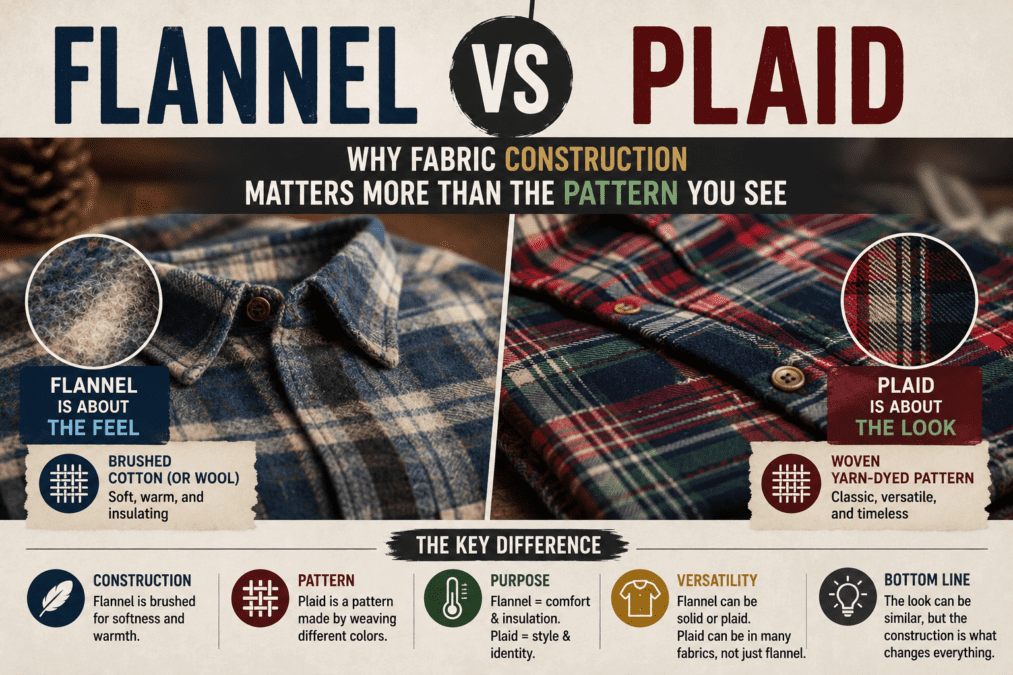
When discussing flannel vs plaid, the shortest accurate answer is this: flannel is a fabric, plaid is a pattern. A flannel shirt may feature a plaid design, but the two terms describe different attributes of the garment. This distinction explains why some plaid shirts are not flannel and why some flannel garments contain no plaid pattern at all.
Essential Comparative Metrics
| Attribute | Flannel | Plaid |
|---|---|---|
| Primary Classification | Fabric type | Pattern type |
| Defines | Material structure and texture | Visual design |
| Origin | Textile manufacturing tradition | Pattern and cultural design tradition |
| Can Exist Without the Other? | Yes | Yes |
| Associated With Warmth | Strongly associated | Not necessarily |
| Typical Fibers | Cotton, wool, and blended fibers | Can appear on virtually any fabric material |
| Primary Function | Comfort, insulation, and softness | Decoration, visual identity, and styling |
| Common Garments | Shirts, pajamas, jackets, blankets | Shirts, skirts, scarves, suits, accessories |
| Texture | Usually soft, brushed, and warm | Depends entirely on the underlying fabric |
| Fashion Role | Performance, comfort, and practicality | Visual styling, symbolism, and cultural expression |
Historical Origins And Cultural Development
The history behind flannel vs plaid reveals why confusion developed over time. Flannel originated as a textile associated with warmth and durability. Historical versions were commonly woven from wool and used in cooler climates where insulation was valuable. Over centuries, cotton flannel became increasingly popular because it offered similar comfort with reduced weight and easier maintenance.
Plaid emerged through a different pathway. Rather than representing a fabric category, plaid evolved as a pattern system. It became especially associated with Scottish tartans, where specific arrangements of colored stripes represented clans, regions, and cultural identities. Over time, plaid expanded far beyond Scotland and became one of the most recognizable patterns in global fashion.
Because plaid designs frequently appeared on flannel shirts, consumers gradually began treating the terms as interchangeable. This historical overlap remains one of the primary reasons discussions about flannel vs plaid continue today.
Structural And Biological Foundations
From a material science perspective, flannel vs plaid is not a direct comparison because one concerns textile structure while the other concerns visual arrangement. Flannel fabrics are produced through weaving methods designed to create softness, flexibility, and insulation. Many flannel textiles undergo brushing processes that raise fine fibers from the surface, trapping air and increasing warmth.
Plaid, by contrast, possesses no inherent physical structure. The pattern can be printed, dyed, woven, or digitally created on virtually any fabric type. Cotton, silk, polyester, linen, wool, and even technical performance fabrics can all display plaid designs.
This distinction highlights a fundamental principle in textile analysis. Flannel influences how a garment feels and performs against the body. Plaid influences how the garment looks. Therefore, evaluating flannel vs plaid requires recognizing that one affects tactile performance while the other affects visual perception.
Behavioral Patterns And Social Intelligence
Fashion functions as a social language, and the flannel vs plaid discussion illustrates how people communicate identity through clothing. Flannel often signals comfort, practicality, ruggedness, and seasonal readiness. It is commonly associated with outdoor activities, casual workwear, and relaxed lifestyles.
Plaid communicates different messages depending on color combinations, scale, and cultural context. A bold plaid pattern may project confidence and individuality, while a muted plaid may convey sophistication and tradition. In some settings, plaid can appear formal; in others, it represents casual or alternative fashion.
Consumers frequently recognize plaid more quickly than flannel because visual patterns are processed immediately by the human brain. Texture, warmth, and material quality become apparent only after closer inspection or physical contact. Consequently, many shoppers mistakenly identify a plaid shirt as flannel solely because the pattern resembles familiar flannel garments.
This perceptual shortcut is central to understanding why flannel vs plaid remains a widespread source of confusion.
Manufacturing Processes And Textile Engineering
The manufacturing differences in flannel vs plaid are substantial. Producing flannel requires decisions regarding fiber selection, yarn construction, weaving density, finishing treatments, and brushing techniques. Textile engineers carefully balance softness, durability, breathability, and insulation.
Creating plaid involves color planning and pattern arrangement. Designers determine stripe widths, color relationships, symmetry, and repeat sequences. The pattern may be woven directly into the fabric or applied afterward through printing technologies.
A manufacturer can produce hundreds of plaid variations using the same base fabric. Likewise, a flannel producer can manufacture solid-color flannel without any plaid pattern whatsoever.
This separation between construction and decoration further reinforces that flannel vs plaid compares two fundamentally different dimensions of textile design.
Velour vs Velvet: Why Construction Method Matters More Than Surface Appearance
Subject A: Strengths And Constraints
Strengths of Flannel
Flannel excels in comfort. The brushed surface creates a soft hand feel that many consumers associate with coziness and warmth. It offers excellent insulation while remaining breathable enough for everyday wear.
Another major advantage is versatility. Flannel appears in shirts, blankets, pajamas, jackets, bedding, and numerous cold-weather products. Its adaptability makes it one of the most enduring textile categories in global apparel markets.
Flannel also performs well across diverse climates. Lightweight versions work in transitional seasons, while heavier constructions provide substantial warmth during winter.
Constraints of Flannel
The primary limitation of flannel is that softness may decline after extensive wear if the fabric quality is poor. Lower-quality flannel can pill over time.
Flannel is also sometimes perceived as informal, limiting its use in highly formal professional environments.
Within the broader flannel vs plaid discussion, another limitation is semantic confusion. Consumers often misunderstand flannel’s identity because they focus on visible patterns rather than fabric structure.
Subject B: Strengths And Constraints
Strengths of Plaid
Plaid’s greatest strength is visual versatility. Designers can create endless combinations of colors, scales, and arrangements. The pattern works across traditional, contemporary, minimalist, and experimental fashion categories.
Plaid also carries rich cultural significance. Scottish tartans, academic styles, punk fashion, grunge aesthetics, and luxury tailoring have all incorporated plaid in distinctive ways.
Another advantage is adaptability across fabrics. Plaid can appear on lightweight summer garments, heavy winter coats, accessories, and formalwear.
Constraints of Plaid
Because plaid is purely a pattern, it provides no inherent performance benefits. Warmth, durability, breathability, and comfort depend entirely on the underlying fabric.
Plaid can also become visually overwhelming if color contrasts or scale choices are poorly executed. Certain combinations may appear dated more quickly than neutral fabric constructions.
Within the context of flannel vs plaid, plaid’s biggest limitation is that it is often mistaken for a fabric category despite being solely a design characteristic.
Comparative Advantages In Real-World Scenarios
The practical value of flannel vs plaid becomes clear when examining real-world use cases.
For warmth and comfort, flannel has the advantage. A brushed cotton flannel shirt provides insulation and softness regardless of pattern.
For visual impact and styling flexibility, plaid dominates. The pattern creates immediate visual interest and can transform otherwise ordinary garments.
For outdoor recreation, flannel often performs better due to its thermal properties. Hiking, camping, and cool-weather activities frequently favor flannel fabrics.
For fashion experimentation, plaid offers broader possibilities. Designers can manipulate scale, color, and arrangement to create dramatically different visual effects.
For professional environments, the outcome depends on execution. Subtle plaid patterns can appear highly refined, while premium flannel fabrics can deliver sophisticated seasonal style.
Ultimately, the winner in flannel vs plaid depends on whether the objective is functional performance or visual expression.
Fashion Industry Usage And Consumer Confusion
Retail terminology contributes significantly to misunderstandings surrounding flannel vs plaid. Many stores market plaid shirts as flannel shirts because consumers recognize the association. In some cases, garments labeled as flannel may not even use traditional flannel fabric constructions.
This marketing shortcut reinforces public confusion. A consumer sees a red-and-black checked shirt and assumes it is both plaid and flannel. Sometimes that assumption is correct. Sometimes it is not.
Industry professionals generally distinguish between fabric and pattern categories because the difference affects sourcing, production costs, performance expectations, and garment labeling.
As fashion education becomes more accessible through digital media, awareness of the true flannel vs plaid distinction continues to grow among consumers.
Environmental And Sustainability Considerations
Sustainability discussions add another layer to flannel vs plaid analysis. Environmental impact is largely determined by fiber composition and production methods rather than pattern design.
A cotton flannel made with responsible agricultural practices may have a significantly different environmental profile than a synthetic flannel produced from petroleum-based materials.
Similarly, a plaid pattern woven into organic wool may carry different sustainability implications than a printed plaid applied to synthetic fabric.
Because plaid is merely a pattern, sustainability assessments must focus primarily on the underlying textile. Flannel, as a fabric category, allows more direct evaluation of resource consumption, durability, repairability, and lifespan.
Long-lasting garments generally produce lower environmental burdens because they reduce replacement frequency. High-quality flannel often performs well in this regard due to its durability and enduring popularity.
Scientific And Expert Consensus (2026)
The expert consensus regarding flannel vs plaid is remarkably clear. Textile scientists, apparel designers, fashion historians, and manufacturing specialists agree that the two terms describe separate concepts.
Flannel refers to a fabric characterized by softness, often achieved through brushing processes and specific fiber constructions.
Plaid refers to a patterned arrangement of intersecting colored bands that create checked visual structures.
Experts also recognize that overlapping usage in consumer culture has blurred distinctions. Because plaid patterns commonly appear on flannel garments, public language frequently merges the terms.
Nevertheless, professional textile classification systems maintain a clear separation between fabric construction and pattern design. From an analytical standpoint, this distinction remains the foundation of modern textile education and apparel development.
Common Misconceptions About Flannel And Plaid
Several myths dominate discussions of flannel vs plaid.
One misconception is that all plaid shirts are flannel. In reality, many plaid shirts are made from lightweight cotton, polyester blends, linen, or other materials.
Another misconception is that all flannel garments feature plaid patterns. Solid-color flannel shirts, blankets, and sleepwear demonstrate otherwise.
A third misunderstanding assumes plaid automatically indicates warmth. Warmth depends on material properties, not visual design.
Correcting these misconceptions improves purchasing decisions and enhances textile literacy among consumers.
Final Synthesis And Verdict
The comparison of flannel vs plaid ultimately reveals a category error rather than a traditional rivalry. Flannel and plaid do not compete because they describe different aspects of a garment. Flannel explains what the fabric is. Plaid explains what the pattern looks like.
If the goal is comfort, warmth, softness, and functional performance, flannel deserves attention. If the goal is visual character, cultural symbolism, and design versatility, plaid becomes the more relevant consideration.
The most accurate conclusion is that the strongest garments often combine both characteristics. A high-quality flannel fabric paired with a well-designed plaid pattern delivers the comfort benefits of one and the aesthetic advantages of the other.
Understanding this distinction transforms the entire flannel vs plaid discussion from a confusing debate into a clear lesson in how textiles and design interact. Once consumers recognize that one refers to fabric and the other to pattern, the comparison becomes far easier to understand and apply in real-world clothing choices.
Frequently Asked Questions
Is flannel the same thing as plaid?
No. In the flannel vs plaid comparison, flannel is a fabric type while plaid is a pattern. They can appear together on the same garment, but they are not the same concept.
Can a shirt be plaid without being flannel?
Yes. Many plaid shirts are made from cotton poplin, polyester blends, linen, or other fabrics. The plaid design does not determine the fabric type.
Can flannel exist without a plaid pattern?
Absolutely. Solid-color flannel shirts, blankets, pajamas, and jackets are common examples of flannel products without plaid designs.
Which is warmer, flannel or plaid?
Flannel is associated with warmth because it is a fabric with insulating properties. Plaid is merely a pattern and does not affect temperature regulation by itself.