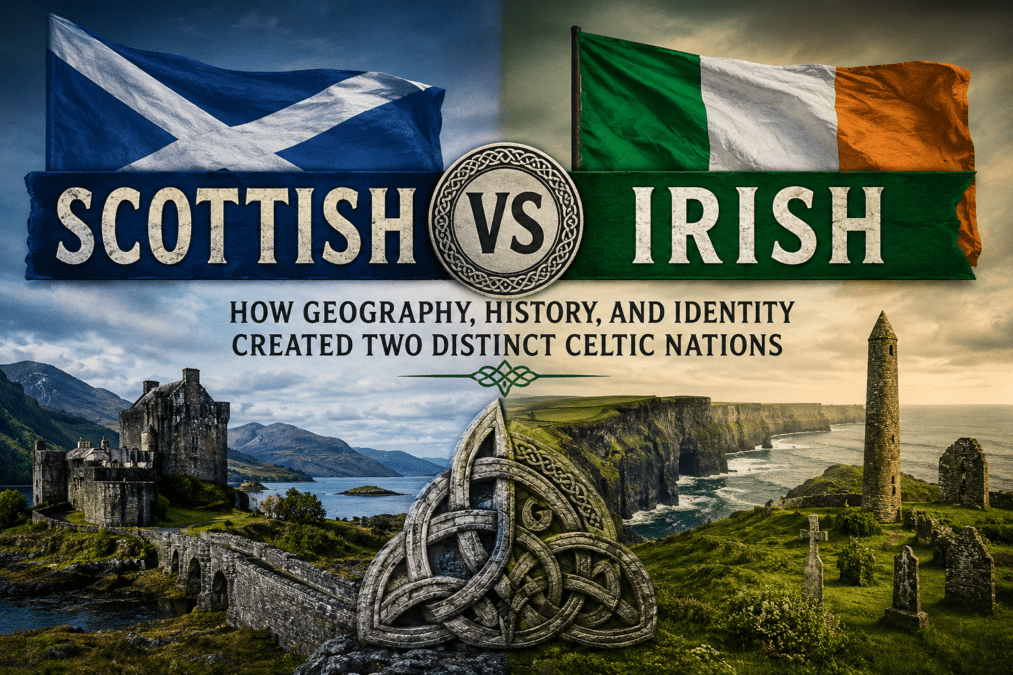

The scottish vs irish comparison is often simplified into stereotypes involving accents, music, or ancestry. In reality, the relationship between Scotland and Ireland represents one of the most fascinating cultural comparisons in Europe. Both societies share ancient Celtic roots, deep historical connections, and centuries of interaction, yet they evolved into distinct nations with different political structures, social identities, and cultural traditions.
A meaningful scottish vs irish analysis requires examining more than national symbols or popular perceptions. Geography, language evolution, religious developments, migration patterns, economic transformation, and political history all contributed to shaping separate national identities. Understanding these factors reveals why similarities coexist alongside significant differences.
The central insight of the scottish vs irish debate is that common ancestry does not guarantee identical development. Although Scotland and Ireland emerged from related Celtic traditions, different historical pressures, political institutions, and geographic realities produced two unique societies that continue to influence global culture in distinct ways.
Comparative Metrics Overview
A Scottish person is someone whose national identity originates from Scotland, a constituent nation of the United Kingdom.
An Irish person is someone whose national identity originates from Ireland, whether from the Republic of Ireland or Northern Ireland.
While both groups share Celtic heritage and overlapping historical experiences, their political evolution and cultural development followed different paths.
For those seeking a concise answer, the scottish vs irish comparison shows that both peoples share ancient Celtic origins and strong cultural traditions, but Scotland developed within the framework of the United Kingdom while Ireland experienced a separate path that eventually produced an independent republic. These differing historical trajectories shaped language, religion, politics, and national identity in distinctive ways.
Structural And Biological Foundations
When examining scottish vs irish origins, the first observation is that both populations descend from a mixture of prehistoric hunter-gatherers, Neolithic farmers, Bronze Age migrants, and later Celtic-speaking groups. Modern genetic research consistently demonstrates substantial overlap between populations in Scotland and Ireland.
Geography played a critical role in this shared development. The Irish Sea, rather than acting as a complete barrier, functioned as a cultural bridge for thousands of years. Migration occurred in both directions, particularly between northeastern Ireland and western Scotland. The kingdom of Dál Riata, which existed across both regions during the early medieval period, illustrates this interconnected history.
However, Scotland’s position on the British mainland exposed it to stronger influence from neighboring England, Scandinavia, and continental Europe. Ireland’s island geography encouraged a somewhat different pattern of cultural development. Thus, the scottish vs irish relationship reflects shared ancestry combined with divergent geographic influences.
Behavioral Patterns And Social Intelligence
The cultural dimension of scottish vs irish identity extends far beyond genetics. Social values, communication styles, humor, and community traditions have evolved through centuries of historical experience.
Scottish culture often emphasizes resilience, pragmatism, education, and civic institutions. Historical experiences involving industrialization, Enlightenment philosophy, and political union contributed to a strong tradition of intellectual achievement and public administration. Scotland produced influential thinkers, scientists, and engineers whose impact extended globally.
Irish culture is frequently associated with storytelling, literary creativity, community connection, and expressive communication. Historical experiences involving colonization, migration, and national independence helped cultivate a strong narrative tradition. Irish writers, poets, and musicians have exerted extraordinary cultural influence far beyond the island itself.
In the broader scottish vs irish discussion, neither approach represents superiority. Instead, each reflects adaptation to different historical circumstances and social environments.
Historical Evolution And Identity Formation
A major factor in understanding scottish vs irish differences lies in political history. Scotland maintained its own monarchy for centuries before entering political union with England in 1707. This union created Great Britain while preserving many uniquely Scottish institutions.
Ireland followed a more turbulent path. Centuries of English involvement eventually led to direct governance, political conflict, and independence movements. The establishment of the Irish Free State in 1922 marked a defining moment in Irish national development.
These contrasting experiences influenced national identity in profound ways. Scottish identity developed partly within a multinational state structure, while Irish identity became closely linked with independence and self-determination.
Consequently, modern scottish vs irish perspectives often reflect differing relationships with sovereignty, governance, and historical memory.
Language And Cultural Expression
Language provides one of the most revealing dimensions of the scottish vs irish comparison. Both societies possess Gaelic traditions, but the languages evolved separately.
Irish Gaelic developed throughout Ireland and remains an official language of the Republic of Ireland. Although English dominates everyday communication, efforts to preserve Irish continue through education, media, and cultural initiatives.
Scotland developed Scottish Gaelic alongside the Scots language. Scottish Gaelic became concentrated primarily in the Highlands and Islands, while Scots evolved as a distinct Germanic language influenced by Old English and regional development.
Music, literature, and folklore further illustrate the distinction. Scottish traditions prominently feature bagpipe music, clan histories, and Highland cultural symbols. Irish traditions emphasize folk storytelling, dance traditions, and literary expression.
The scottish vs irish cultural landscape demonstrates how closely related societies can generate unique artistic identities over time.
Subject A: Strengths And Constraints
Scotland possesses several significant strengths that influence its national profile. The country combines rich cultural heritage with advanced educational institutions, strong scientific traditions, and globally recognized achievements in engineering, medicine, and philosophy.
A major strength in the scottish vs irish comparison is Scotland’s role in the intellectual history of Europe. The Scottish Enlightenment helped shape modern economics, political theory, and scientific inquiry. Institutions of higher learning continue to contribute substantially to research and innovation.
Scotland also benefits from extensive energy resources, particularly in offshore sectors. Its tourism industry attracts visitors seeking historical sites, natural landscapes, and distinctive cultural experiences.
Constraints include demographic challenges in certain regions, economic dependence on broader UK structures, and ongoing debates regarding constitutional arrangements. Questions surrounding autonomy and governance continue to shape political discourse.
Nevertheless, Scotland remains one of Europe’s most influential nations relative to its population size.
Subject B: Strengths And Constraints
Ireland’s strengths emerge from a different historical and economic trajectory. The nation has transformed dramatically over recent decades, evolving into one of Europe’s most dynamic economies.
Within the scottish vs irish framework, Ireland’s success in attracting international investment stands out as a defining achievement. Technology, pharmaceuticals, finance, and advanced services have contributed to substantial economic growth.
Ireland also enjoys remarkable cultural influence. Irish literature, music, and artistic traditions command global recognition. The country’s diaspora extends across multiple continents, creating extensive cultural and economic networks.
Challenges remain. Housing pressures, infrastructure demands, regional disparities, and the complexities associated with rapid growth present ongoing policy concerns. The relationship between the Republic of Ireland and Northern Ireland also continues to require careful political management.
Despite these challenges, Ireland’s adaptability and international engagement represent major national advantages.
Religion, Society, And Community Development
Religion has historically played a major role in the scottish vs irish story. Although modern societies in both countries have become increasingly secular, religious traditions continue to influence historical identity.
Scotland’s religious landscape was profoundly shaped by the Protestant Reformation. Presbyterian traditions became deeply integrated into national institutions and social structures.
Ireland’s history, by contrast, became strongly associated with Roman Catholicism. Religious identity often intersected with questions of politics, culture, and national self-determination.
Today, both societies are considerably more diverse than in previous centuries. Immigration, globalization, and social change have broadened cultural perspectives and reduced the dominance of traditional religious affiliations.
The modern scottish vs irish comparison therefore reflects societies that honor historical traditions while adapting to contemporary realities.
Comparative Advantages In Real-World Scenarios
Analyzing scottish vs irish performance in practical contexts reveals that advantages depend largely on the criteria being measured.
For academic and scientific heritage, Scotland possesses a particularly strong historical record. Its universities, intellectual traditions, and research contributions remain internationally respected.
For global diaspora influence, Ireland enjoys extraordinary reach. Irish communities across North America, Australia, Europe, and elsewhere have amplified Irish cultural visibility worldwide.
In tourism, both countries excel but attract visitors for somewhat different reasons. Scotland is renowned for dramatic Highlands, castles, lochs, and clan heritage. Ireland is celebrated for coastal scenery, literary history, vibrant cities, and community-centered hospitality.
Economically, Ireland has experienced exceptional growth in recent decades, while Scotland benefits from integration within a larger UK economic framework.
The key lesson from the scottish vs irish comparison is that strengths are context-dependent rather than universally hierarchical.
Economic And Global Influence
Modern discussions of scottish vs irish identity increasingly involve economics and international influence. Both nations have leveraged education, innovation, and cultural capital to establish significant global presence.
Scotland’s contributions include energy production, financial services, engineering expertise, and higher education. Its cities maintain important roles in research, technology, and international commerce.
Ireland has become a major hub for multinational corporations and technology firms. Strategic economic policies, a skilled workforce, and international connectivity contributed to rapid development during the late twentieth and early twenty-first centuries.
Both nations benefit from strong global reputations. Scottish branding is associated with quality, heritage, and innovation, while Irish branding often emphasizes creativity, hospitality, and international engagement.
Thus, the scottish vs irish debate extends beyond cultural identity into broader questions of economic competitiveness and global influence.
Scientific And Expert Consensus (2026)
The prevailing expert consensus in 2026 rejects simplistic assumptions regarding Scottish and Irish identity. Historians, geneticists, sociologists, and cultural researchers generally agree that both populations share substantial historical connections while maintaining distinct national characteristics.
Research consistently shows considerable genetic overlap between Scotland and Ireland. At the same time, scholars emphasize that culture and identity cannot be reduced to genetics alone.
Experts increasingly view the scottish vs irish relationship as an example of parallel development. Shared Celtic origins provided a common foundation, but differing political institutions, economic environments, religious histories, and geographic circumstances produced separate national trajectories.
Modern scholarship therefore focuses less on determining which society is “more Celtic” or “more authentic” and more on understanding how interconnected histories generated diverse outcomes.
This perspective provides a more accurate and nuanced understanding than traditional stereotypes.
Final Synthesis And Verdict
The scottish vs irish comparison reveals two nations connected by ancestry yet distinguished by history. Shared Celtic roots created foundational similarities in language, folklore, and cultural memory. However, geography, religion, politics, and economic development gradually shaped separate identities.
Scotland’s strengths lie in intellectual tradition, institutional continuity, scientific achievement, and cultural resilience. Ireland’s strengths emerge through global diaspora influence, literary prominence, economic transformation, and powerful national storytelling.
Neither side “wins” the scottish vs irish debate because the comparison is not fundamentally a competition. Instead, it demonstrates how related societies can evolve into distinct yet equally influential nations.
The most important conclusion is that similarity and difference coexist. Scotland and Ireland remain connected through history and heritage, but their unique journeys created identities that deserve to be understood on their own terms rather than viewed as interchangeable expressions of Celtic culture.
Frequently Asked Questions
Are Scottish and Irish people genetically the same?
No. Scottish and Irish populations share substantial genetic overlap because of common ancestry and historical migration, but neither population is genetically identical. Both contain diverse regional influences accumulated over thousands of years.
Which is older, Scottish culture or Irish culture?
Both cultural traditions have ancient roots stretching back well before recorded history. Rather than one being older, scholars generally view them as related cultural traditions that evolved in parallel across neighboring regions.
Why are Scotland and Ireland often confused?
The confusion arises from shared Celtic heritage, geographic proximity, similar surnames, overlapping folklore, and historical migration. Despite these similarities, each developed distinct languages, political institutions, and national identities.
Is Gaelic the same in Scotland and Ireland?
No. Scottish Gaelic and Irish Gaelic are closely related but separate languages. Speakers may recognize similarities, yet differences in pronunciation, vocabulary, and usage have developed over centuries of independent evolution.