
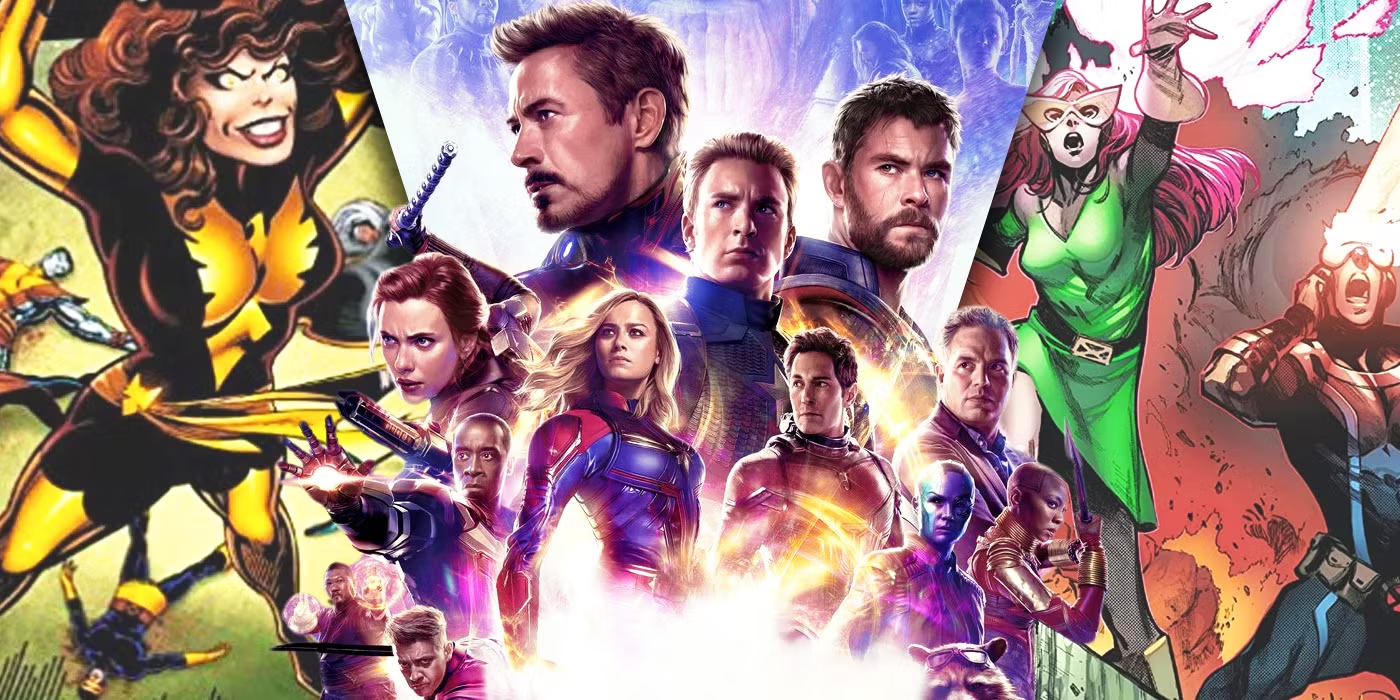

The phrase “avengers vs x men movie fancast” has evolved far beyond simple fan speculation. In modern franchise culture, fancasting functions as a form of narrative engineering where audiences evaluate not only actors, but also emotional range, cinematic continuity, demographic representation, and long-term franchise sustainability. Fans are no longer merely asking who should play Wolverine or Iron Man. They are asking how different acting philosophies reshape entire cinematic ecosystems.
This comparison examines two fundamentally different superhero storytelling architectures. The Avengers model is built around large-scale spectacle, centralized leadership, and escalating external threats, while the X-Men structure depends on ideological conflict, emotional trauma, and interpersonal fragmentation. Because of that distinction, the ideal avengers vs x men movie fancast cannot rely solely on celebrity status. It requires alignment between actor psychology and narrative structure.
The most surprising insight emerging from modern fan discourse is that X-Men fancasts often prioritize emotional volatility and character nuance, while Avengers fancasts emphasize charisma, cohesion, and audience familiarity. In other words, successful casting for Avengers usually depends on collective chemistry, while successful X-Men casting depends on internal tension. That single difference explains why the avengers vs x men movie fancast debate remains one of the most complex conversations in blockbuster filmmaking.
Defining The Modern Avengers And X-Men Casting Philosophy
An Avengers ensemble is typically structured around coordinated personalities working toward unified objectives. An X-Men ensemble, by contrast, is designed around ideological fractures, generational trauma, and identity conflict.
While Avengers casting rewards broad audience accessibility and mainstream charisma, X-Men casting often succeeds when actors can portray psychological instability, outsider identity, and philosophical contradiction simultaneously.
A modern avengers vs x men movie fancast therefore becomes less about “who looks the part” and more about which performers can sustain long-form emotional architecture across interconnected films.
Essential Comparative Metrics
| Category | Avengers Fancast Philosophy | X-Men Fancast Philosophy |
|---|---|---|
| Narrative Structure | Team unity against external threats | Internal ideological conflict and identity struggle |
| Preferred Actor Traits | Charisma, humor, mainstream appeal | Emotional depth, intensity, unpredictability |
| Leadership Dynamic | Centralized around iconic leaders | Fragmented among competing ideologies |
| Tonal Balance | Adventure-driven spectacle | Political and psychological drama |
| Audience Expectation | Consistency and continuity | Character reinvention and complexity |
| Casting Risk Tolerance | Moderate risk with bankable stars | Higher acceptance of unconventional choices |
| Emotional Core | Collective heroism | Alienation and belonging |
| Performance Style | Collaborative ensemble rhythm | Intense character-centric acting |
| Franchise Expansion Strategy | Cross-film synergy | Faction-based storytelling branches |
| Fan Debate Focus | Power hierarchy and chemistry | Character authenticity and emotional realism |
Structural And Biological Foundations
The structural foundation of the avengers vs x men movie fancast conversation begins with how each team functions narratively. The Avengers operate like a strategic alliance. Even when conflict emerges, their stories generally move toward coordination and synthesis. This framework naturally favors actors capable of projecting authority, reliability, and crowd-pleasing charisma. A successful Avengers actor must maintain audience trust while supporting ensemble balance.
The X-Men system functions almost inversely. Mutant narratives are rooted in exclusion, identity instability, prejudice, and ideological fragmentation. As a result, X-Men fancasting often rewards actors who can portray contradiction. A convincing Cyclops requires suppressed emotional intensity. A compelling Magneto demands both menace and moral legitimacy. A memorable Rogue depends on vulnerability mixed with emotional isolation.
This distinction fundamentally changes casting logic. In avengers vs x men movie fancast discussions, Avengers roles are frequently judged by external performance energy, while X-Men roles are judged by emotional internalization. That difference affects everything from dialogue delivery to screen presence and long-term audience attachment.
Behavioral Patterns And Social Intelligence
Behavioral dynamics are central to why the avengers vs x men movie fancast debate produces radically different fan preferences. Avengers teams traditionally reward cooperative performance rhythm. Characters interrupt each other, exchange humor, and establish rapid interpersonal familiarity. This style demands actors with exceptional timing and social fluidity.
X-Men films rely more heavily on emotional friction. Their narratives gain strength from unresolved tension between mentors, students, radicals, and institutions. Performers therefore need the ability to communicate emotional distance without weakening audience engagement. Silence, restraint, and suppressed emotion become as important as dialogue.
This creates a major difference in fancast evaluation. Fans discussing Avengers often prioritize whether actors feel believable together in public-facing heroism. X-Men discussions instead focus on emotional realism during conflict. Could a Professor X actor genuinely command moral authority? Could a Storm actress project both compassion and suppressed fury? Could a Wolverine actor appear emotionally damaged rather than simply aggressive?
In many avengers vs x men movie fancast analyses, viewers unconsciously judge whether actors fit the social psychology of the team rather than just the visual appearance of the character. That is why unconventional casting choices sometimes outperform physically accurate ones.
Subject A: Strengths And Constraints
The Avengers casting ecosystem possesses several major advantages. First, it allows broader stylistic flexibility. Characters such as Iron Man, Thor, Spider-Man, and Doctor Strange can coexist despite vastly different tonal foundations because the franchise emphasizes spectacle integration. This means actors with diverse styles can still function cohesively within a shared cinematic framework.
Another strength is commercial familiarity. Audiences often associate Avengers casting with accessible charisma and blockbuster momentum. That makes fan enthusiasm easier to generate. In avengers vs x men movie fancast communities, Avengers selections frequently trend toward globally recognizable performers because viewers instinctively connect celebrity presence with franchise scale.
However, this structure also introduces limitations. Excessive star power can destabilize ensemble balance. If one performer dominates public attention, supporting characters may lose narrative importance. Avengers films also risk tonal uniformity when humor becomes over-centralized.
Another constraint involves emotional depth. Because Avengers stories often prioritize large-scale conflict escalation, individual psychological arcs can become compressed. An actor capable of subtle emotional layering may receive fewer opportunities to demonstrate complexity. This sometimes produces fancasts based more on marketability than character authenticity.
As the avengers vs x men movie fancast conversation evolves, many fans increasingly criticize purely commercial casting logic in favor of emotionally aligned performances.
Subject B: Strengths And Constraints
The X-Men casting philosophy offers deeper psychological storytelling potential. Mutant narratives inherently explore prejudice, alienation, generational division, and identity politics. This gives actors room to construct layered performances with significant emotional resonance.
A major strength of X-Men fancasting lies in tonal elasticity. Characters can exist within political drama, horror, romance, tragedy, or philosophical science fiction simultaneously. That flexibility allows casting directors to consider performers outside conventional superhero molds. Many of the most praised avengers vs x men movie fancast concepts involve actors known for dramatic rather than blockbuster work.
The X-Men structure also rewards ensemble asymmetry. Characters are not required to feel socially harmonious. In fact, emotional incompatibility often improves authenticity. A tense relationship between Cyclops and Wolverine or ideological friction between Magneto and Professor X strengthens the narrative rather than weakening it.
Yet X-Men casting has constraints as well. Excessive seriousness can alienate broader audiences. Films that lean too heavily into trauma or political metaphor risk sacrificing entertainment accessibility. Another challenge is tonal inconsistency. Because mutant stories span many emotional registers, a single miscast role can destabilize the ensemble’s credibility.
This is why the avengers vs x men movie fancast debate remains unusually demanding. X-Men roles require emotional precision, not just visual resemblance or mainstream popularity.
Comparative Advantages In Real-World Scenarios
When examining real-world blockbuster performance, the avengers vs x men movie fancast framework reveals two different approaches to cinematic longevity. Avengers-style casting performs exceptionally well in serialized franchise ecosystems built around event storytelling. Actors capable of maintaining audience familiarity across multiple films strengthen commercial continuity and merchandising stability.
X-Men-style casting excels in prestige-oriented storytelling where character evolution matters more than spectacle escalation. Mutant narratives can sustain darker emotional themes because audiences expect ideological complexity. This gives filmmakers greater freedom to experiment with tone, pacing, and moral ambiguity.
Consider hypothetical casting priorities. If a studio intends to maximize global crossover appeal, Avengers casting logic is generally more efficient. The franchise structure supports recognizable personalities who can transition across genres and demographics. If the objective is emotional reinvention and thematic maturity, X-Men casting logic often produces richer long-term storytelling outcomes.
The avengers vs x men movie fancast discussion also reveals how streaming culture has changed audience expectations. Modern viewers spend more time analyzing character psychology and less time focusing exclusively on physical resemblance. Performance authenticity increasingly outweighs cosmetic accuracy.
This shift explains why fan discussions now emphasize emotional compatibility with source material rather than simplistic visual imitation.
The Evolution Of Fan Culture And Digital Casting Communities
One reason the avengers vs x men movie fancast phenomenon has become so influential is the transformation of participatory fandom. In earlier decades, casting discussions were limited to magazines, conventions, or niche online forums. Today, fancasting operates as a large-scale collaborative cultural activity across social platforms, video essays, and AI-assisted visual edits.
Fans now create full cinematic ecosystems complete with trailers, poster concepts, dialogue readings, and continuity mapping. This changes the function of fancasting entirely. It is no longer passive speculation. It has become a form of decentralized creative development.
Avengers-oriented fan communities often emphasize crossover excitement and crowd reaction potential. Their fancasts typically focus on energy, spectacle, and mainstream recognizability. X-Men communities, meanwhile, frequently prioritize emotional accuracy and thematic fidelity. Debates about Magneto, Jean Grey, or Rogue often become discussions about trauma representation, identity politics, and philosophical nuance.
The avengers vs x men movie fancast trend therefore reflects broader cultural shifts in media literacy. Audiences increasingly analyze acting through psychological frameworks rather than celebrity fascination alone.
Why Character Archetypes Demand Different Acting Styles
A critical issue often ignored in superficial fancast discussions is archetype compatibility. Avengers archetypes are generally aspirational. Captain America represents moral certainty. Thor embodies mythic confidence. Spider-Man channels youthful resilience. Even flawed Avengers are designed to inspire collective optimism.
X-Men archetypes operate differently. Many mutant characters symbolize fragmentation, fear, social exclusion, or radicalization. Wolverine is compelling because of emotional damage, not emotional stability. Magneto resonates because his worldview contains painful historical logic. Mystique gains power through identity ambiguity.
This creates different performance requirements. Avengers actors must project cohesion and accessibility. X-Men actors must communicate psychological tension and emotional contradiction.
A successful avengers vs x men movie fancast therefore depends on understanding archetypal function rather than merely comparing popularity levels. An actor brilliant in an Avengers role may fail completely in an X-Men role because the emotional architecture differs fundamentally.
This is one reason some dramatic actors receive overwhelming support for mutant roles despite lacking traditional superhero aesthetics.
Scientific And Expert Consensus (2026)
Entertainment industry analysis in 2026 increasingly supports the idea that ensemble chemistry predicts franchise longevity more reliably than isolated star power. Audience retention studies consistently show that viewers form deeper attachment to relational dynamics than individual spectacle moments.
Casting researchers also note that superhero audiences have become more psychologically sophisticated. Modern viewers evaluate sincerity, emotional coherence, and interpersonal realism at far higher levels than audiences from the early comic-book film era. This trend significantly affects the avengers vs x men movie fancast landscape.
Industry consensus suggests that Avengers casting succeeds best when performers create a believable cooperative ecosystem. X-Men casting succeeds when actors sustain emotional friction without undermining audience empathy. These are fundamentally different acting ecosystems.
Another major conclusion involves narrative elasticity. Analysts increasingly argue that X-Men properties may possess greater long-term thematic adaptability because mutant stories naturally align with evolving social anxieties and identity debates. Avengers properties, meanwhile, maintain unmatched event-film scalability and mainstream commercial momentum.
The avengers vs x men movie fancast discussion therefore mirrors broader industry tensions between prestige storytelling and mass-market spectacle. Neither model is inherently superior. Their effectiveness depends on narrative objectives and casting alignment.
The Most Important Casting Variable: Emotional Credibility
One of the clearest lessons emerging from decades of superhero cinema is that audiences forgive physical deviations more easily than emotional dishonesty. Viewers may accept a shorter Wolverine or a younger Magneto if the emotional performance feels authentic. They are far less forgiving when performances appear emotionally disconnected from the character’s thematic purpose.
This principle dominates serious avengers vs x men movie fancast analysis. Fans increasingly ask deeper questions. Does the actor understand the character’s emotional wounds? Can they embody ideological conflict? Can they sustain vulnerability without weakening authority?
Avengers casting typically rewards emotional transparency. X-Men casting rewards emotional complexity. That single contrast explains why fancasting debates around mutants often become more divisive and intellectually detailed.
It also explains why certain actors repeatedly appear in fan discussions despite lacking obvious visual resemblance. Emotional compatibility has become more influential than cosmetic precision.
Final Synthesis And Verdict
The avengers vs x men movie fancast debate ultimately reveals two competing philosophies of superhero storytelling. Avengers narratives prioritize cohesion, accessibility, spectacle, and collaborative heroism. Their ideal actors project charisma that unifies audiences around collective optimism.
X-Men narratives prioritize fragmentation, identity conflict, psychological realism, and ideological tension. Their strongest performers succeed not through universal likability, but through emotional authenticity and internal contradiction.
That distinction changes everything about casting strategy. A successful Avengers ensemble depends on social chemistry and rhythmic collaboration. A successful X-Men ensemble depends on dramatic tension and philosophical credibility.
The deeper conclusion is that modern fancasting has matured into a sophisticated form of narrative analysis. Fans are no longer simply choosing celebrities for costumes. They are evaluating emotional architecture, thematic alignment, and long-term cinematic sustainability.
In the end, the avengers vs x men movie fancast conversation persists because both franchises represent different emotional needs within superhero mythology. Avengers stories reassure audiences that cooperation can overcome chaos. X-Men stories remind audiences that conflict, exclusion, and identity struggle are inseparable from the human experience.
Neither philosophy replaces the other. Together, they define the full emotional spectrum of modern superhero cinema.
Frequently Asked Questions
Why is the avengers vs x men movie fancast debate so popular?
The avengers vs x men movie fancast debate remains popular because the two franchises represent fundamentally different storytelling systems. Fans enjoy comparing how actors would perform within contrasting emotional, ideological, and cinematic frameworks.
What makes X-Men casting more difficult than Avengers casting?
X-Men casting is often considered more difficult because mutant characters depend heavily on emotional contradiction and psychological realism. Avengers characters generally function through ensemble charisma, while X-Men characters require deeper internal conflict.
Do audiences care more about actor appearance or acting ability?
Modern audiences increasingly prioritize emotional credibility over exact physical resemblance. In many avengers vs x men movie fancast discussions, strong acting alignment consistently outweighs cosmetic accuracy.
Why do Avengers films often feel tonally different from X-Men films?
Avengers films are typically structured around collaborative spectacle and unified heroism, while X-Men films emphasize alienation, ideology, and interpersonal tension. These foundations naturally produce different casting styles and tonal outcomes.