
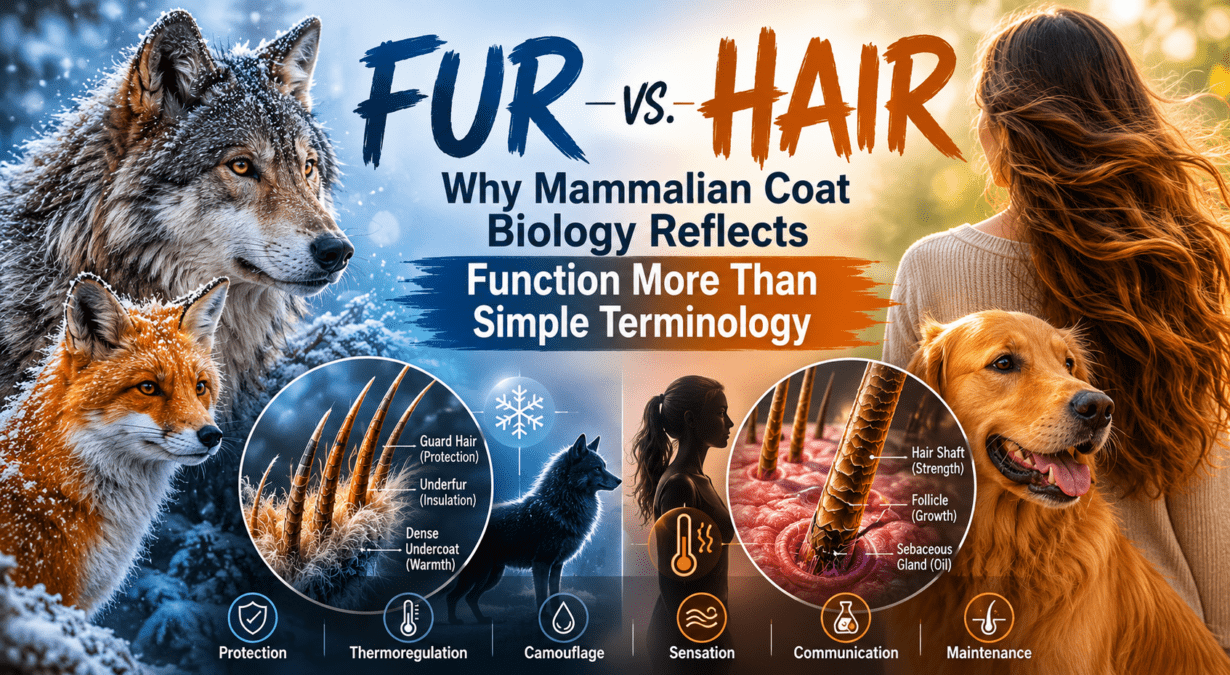

The debate surrounding fur vs hair is far more complex than a vocabulary distinction. In biological science, both fur and hair are composed primarily of keratin, emerge from follicles, and follow similar growth cycles. Yet the way mammals use these structures reveals major differences in thermoregulation, sensory adaptation, environmental survival, and evolutionary specialization. What humans casually label as “fur” or “hair” often reflects density, growth behavior, and ecological function rather than separate biological materials.
Modern zoology approaches the fur vs hair comparison through anatomy, follicle distribution, growth duration, texture variation, and adaptive purpose. Hair generally refers to finer, continuously growing strands with individualized growth patterns, while fur describes dense body coverings optimized for insulation and environmental defense. The distinction becomes especially important in veterinary science, anthropology, textile industries, evolutionary biology, and dermatology.
The surprising insight emerging from contemporary research is that the difference in fur vs hair is not fundamentally chemical. Instead, the distinction is functional and evolutionary. Fur evolved primarily as a thermal survival system for mammals living within ecological pressures, while hair increasingly became associated with sensory signaling, sexual selection, and localized protection in species like humans. The terminology persists because function shapes perception more strongly than microscopic structure.
Essential Comparative Metrics
| Category | Fur | Hair |
|---|---|---|
| Primary Biological Composition | Keratin protein fibers | Keratin protein fibers |
| Typical Growth Pattern | Seasonal or cycle-limited | Continuous or prolonged growth |
| Density | Usually very dense | Often less dense |
| Main Biological Purpose | Insulation and environmental protection | Sensory signaling and localized protection |
| Common Species Association | Dogs, cats, bears, foxes | Humans, horses, primates |
| Shedding Frequency | Typically seasonal | More gradual shedding |
| Texture Variation | Undercoat and guard hair layers | More uniform strand structure |
| Thermal Efficiency | Extremely high | Moderate to localized |
| Average Strand Lifespan | Shorter growth cycles | Longer anagen phase |
| Evolutionary Priority | Environmental survival | Communication and specialization |
Structural And Biological Foundations
At the microscopic level, the fur vs hair comparison becomes surprisingly subtle. Both structures contain keratinized cells arranged in layers known as the cuticle, cortex, and sometimes medulla. Both emerge from follicles nourished by blood vessels and regulated through hormonal signaling. This shared architecture is why many biologists argue that fur is technically a type of hair rather than a separate substance.
The distinction arises from growth behavior and distribution. Fur usually develops as a multi-layered coat system containing dense underfur beneath longer guard hairs. This arrangement traps air efficiently, allowing mammals to regulate temperature even in freezing environments. Hair, particularly in humans, tends to grow in more isolated follicular units with extended growth phases. Human scalp hair can continue growing for years because its anagen cycle is unusually prolonged.
A direct answer to the fur vs hair question is this: fur generally refers to dense mammalian body covering optimized for insulation, while hair describes strands with longer growth duration and more individualized distribution patterns. Although chemically similar, their biological roles differ significantly.
Behavioral Patterns And Social Intelligence
The role of fur vs hair extends beyond physical protection into communication and social behavior. Fur often functions as a dynamic signaling system in animals. Mammals raise fur during threat displays, territorial aggression, fear responses, or courtship rituals. Piloerection—commonly called raised fur—creates the illusion of larger body size and improves defensive intimidation.
Hair in humans and certain primates evolved toward social identity and symbolic communication. Hairstyles, grooming rituals, facial hair patterns, and scalp hair preservation became linked to social status, attraction, tribal identity, and cultural expression. Unlike fur, which primarily serves environmental adaptation, human hair became partially detached from survival necessity and integrated into psychological and social signaling systems.
This distinction highlights an important evolutionary transition. While fur remains tightly connected to thermal ecology, hair increasingly participates in communication complexity. In primates, reduced body fur coincided with increased sweating efficiency and enhanced endurance activity. Simultaneously, scalp hair remained because it protected against solar radiation while preserving heat dissipation across the body.
The broader fur vs hair discussion therefore reflects how mammalian evolution balances environmental survival against social sophistication.
Fur: Strengths And Constraints
Fur remains one of evolution’s most successful insulation systems. Dense fur traps microscopic layers of air close to the body, creating thermal barriers that reduce heat loss. Arctic mammals such as foxes, wolves, and polar bears survive extreme cold largely because layered fur structures minimize conductive heat transfer. Water-resistant guard hairs further improve survival in wet environments by protecting insulating undercoats.
Another advantage in the fur vs hair comparison is defensive adaptability. Fur can camouflage animals seasonally, reduce UV exposure, and protect against abrasions or insect bites. Some species possess fur capable of changing thickness depending on seasonal daylight and temperature shifts. This dynamic adaptation is biologically efficient and energetically economical.
However, fur also creates limitations. Dense coats can trap parasites, restrict cooling efficiency, and require substantial metabolic resources to maintain. In hot climates, excessive fur becomes a thermal liability. Many mammals compensate through nocturnal behavior, panting systems, or seasonal shedding cycles.
Fur additionally limits evaporative cooling compared to minimally covered skin. Humans, by losing most dense body fur over evolutionary time, gained improved endurance capacity in hot environments. This tradeoff demonstrates that the fur vs hair distinction is fundamentally linked to ecological priorities rather than aesthetic appearance alone.
Hair: Strengths And Constraints
Hair excels where flexibility, specialization, and long-term signaling matter more than insulation. Human scalp hair protects the head from ultraviolet radiation while helping regulate localized temperature. Eyelashes, eyebrows, nasal hair, and body hair all serve highly targeted functions involving filtration, moisture control, tactile sensing, and facial communication.
One major strength in the fur vs hair comparison is growth longevity. Human hair can reach extraordinary lengths because follicles remain in active growth phases for years rather than months. This prolonged cycle enables cultural modification, social identity signaling, and sexual selection mechanisms that are rare in heavily furred mammals.
Hair also allows superior cooling efficiency. Reduced body hair exposes sweat glands, improving evaporative heat loss during endurance activity. Anthropologists widely associate this adaptation with early human persistence hunting and long-distance movement in warm African climates.
Yet hair provides weaker environmental protection than fur. Humans compensate through clothing, shelter construction, and artificial heating systems. Hair is therefore less effective as a standalone survival mechanism in harsh climates. It also offers limited defense against moisture and extreme cold compared to layered fur systems.
The fur vs hair distinction ultimately demonstrates how evolutionary success depends on context. Fur maximizes environmental resilience, while hair supports adaptability through behavioral intelligence and technological compensation.
Comparative Advantages In Real-World Scenarios
The practical implications of fur vs hair become obvious across environmental conditions. In cold ecosystems, fur provides unmatched survival efficiency. Species living in tundra, alpine, or marine climates depend on dense fur structures to preserve metabolic heat. Otters, for example, rely on extraordinarily dense fur because they lack the thick blubber layers found in seals.
Hair performs better in scenarios involving thermoregulatory flexibility and sustained activity. Humans can run long distances under high temperatures because reduced body hair enables efficient sweating. Fur-covered mammals often overheat rapidly during prolonged exertion unless environmental temperatures remain low.
In domestic settings, the fur vs hair distinction also affects allergen exposure and grooming requirements. Animals described as having “hair,” such as poodles or Yorkshire terriers, usually shed less because their growth cycles resemble prolonged human hair growth. Fur-bearing breeds often shed seasonally due to synchronized follicular cycling.
From a textile perspective, fur provides superior insulation but requires ethical and environmental scrutiny. Human hair, meanwhile, has found applications in forensic science, biomaterial research, and even oil spill cleanup technologies because keratin fibers absorb hydrocarbons effectively.
While fur emphasizes passive environmental defense, hair supports adaptive versatility. That contrast explains why the fur vs hair comparison remains scientifically and culturally relevant.
Scientific And Expert Consensus (2026)
Current scientific consensus increasingly treats the fur vs hair distinction as semantic rather than strictly biological. Mammalian integument researchers generally agree that fur is technically hair. The difference lies in density, growth synchronization, texture variation, and ecological function.
Dermatologists classify human hair by follicular activity and hormonal responsiveness rather than by any unique material composition. Veterinary scientists similarly evaluate fur through shedding cycles, undercoat density, and thermoregulatory efficiency. The terminology persists because language evolved around visible function rather than microscopic anatomy.
Evolutionary biology also reframes the fur vs hair debate through adaptation theory. Early mammals developed dense coats primarily for insulation during nocturnal activity. Over millions of years, selective pressures shaped coat variation according to habitat, locomotion, and social behavior. Humans represent an unusual branch in which technological intelligence reduced dependence on dense body covering.
Experts in anthropology frequently emphasize that human hair became culturally amplified after biological necessity diminished. Hairstyles, grooming practices, and facial hair traditions transformed into social markers once clothing replaced fur-like insulation. This shift illustrates how biological structures can acquire symbolic meaning far beyond their original survival role.
The 2026 research perspective therefore views fur vs hair not as separate substances, but as different expressions of mammalian adaptation.
Fur vs Hair In Veterinary And Human Health
Medical science approaches fur vs hair through health diagnostics and skin interaction. In animals, fur condition often reveals nutritional status, hormonal balance, immune health, and environmental stress. Dull or patchy fur may indicate thyroid dysfunction, parasitic infection, or metabolic disease.
Human hair serves similar diagnostic functions. Hair analysis can identify nutritional deficiencies, chronic stress markers, exposure to toxins, and endocrine disorders. Because hair preserves biochemical information over time, forensic laboratories frequently use it in toxicology investigations.
The grooming dimension of fur vs hair also differs substantially. Fur typically requires seasonal management because synchronized shedding produces dense coat turnover. Double-coated breeds may experience matting if underfur becomes trapped. Human hair maintenance instead focuses more on breakage prevention, scalp health, and cosmetic conditioning.
Allergen misconceptions further complicate public understanding. People are rarely allergic to fur or hair itself. Most allergies originate from proteins in dander, saliva, or skin secretions attached to coat fibers. Animals marketed as “hypoallergenic” generally produce less airborne dander because their hair-like coats shed less frequently.
These medical and practical differences reinforce why the fur vs hair discussion remains relevant outside academic biology.
Evolutionary Adaptation And Environmental Pressures
The evolutionary story behind fur vs hair reveals how mammals adapted to radically different ecological pressures. Fur emerged during early mammalian evolution as insulation for small nocturnal creatures needing stable body temperatures. This adaptation allowed mammals to maintain metabolic activity independent of ambient temperature.
Over time, coat specialization diversified dramatically. Desert mammals evolved lighter, thinner fur to reflect heat, while arctic species developed multi-layer insulation systems. Aquatic mammals faced different pressures entirely. Sea otters retained dense fur, whereas whales largely abandoned it in favor of blubber-based insulation.
Human evolution introduced one of the most unusual transitions in mammalian history. Reduced body fur improved sweat evaporation and endurance capacity under hot climates. Scalp hair persisted because it shielded the brain from solar radiation while still permitting cooling through exposed skin.
The fur vs hair distinction therefore mirrors environmental tradeoffs. Fur prioritizes passive protection and heat retention. Hair supports flexibility, endurance, and increasingly social functions. Neither adaptation is universally superior; each reflects ecological optimization within specific evolutionary pathways.
Final Synthesis And Verdict
The most important conclusion in the fur vs hair discussion is that the distinction is functional rather than chemical. Both are keratin-based mammalian structures produced by follicles, yet evolution shaped them toward different priorities. Fur became a dense environmental defense system optimized for insulation, camouflage, and survival under harsh ecological conditions. Hair evolved toward flexibility, prolonged growth, specialized protection, and social signaling.
While fur excels in thermal efficiency and passive environmental adaptation, hair supports cooling performance, endurance activity, and cultural expression. Humans compensated for reduced fur through intelligence, clothing, and technology, transforming hair into a partially symbolic trait rather than a purely survival-driven structure.
The broader scientific insight is that mammals do not evolve features in isolation. Coat biology reflects climate, metabolism, behavior, communication, and ecological niche simultaneously. Understanding fur vs hair therefore provides a window into how evolution balances survival needs with social and environmental complexity.
In practical terms, fur is generally denser, shorter-cycled, and insulation-focused, while hair tends to grow longer, shed gradually, and support specialized or communicative functions. The terminology may appear simple, but the biology behind it reveals one of mammalian evolution’s most sophisticated adaptive systems.
Frequently Asked Questions
Is fur technically the same as hair?
Yes. Scientifically, fur is considered a form of hair because both are made from keratin and grow from follicles. The distinction mainly relates to density, growth behavior, and functional purpose rather than chemical composition.
Why do humans have hair instead of fur?
Humans evolved reduced body fur to improve sweating efficiency and endurance in warm climates. Hair remained concentrated in areas where localized protection and social signaling provided advantages, especially on the scalp and face.
Which provides better insulation: fur or hair?
Fur generally provides much better insulation because it forms dense multi-layer systems that trap air close to the skin. Human hair is less dense and therefore less effective at retaining body heat.
Why do some dog breeds have hair instead of fur?
Breeds commonly described as having hair usually possess longer growth cycles and reduced shedding patterns similar to human scalp hair. This creates finer strands and lower seasonal coat turnover compared to traditional fur-bearing breeds.