
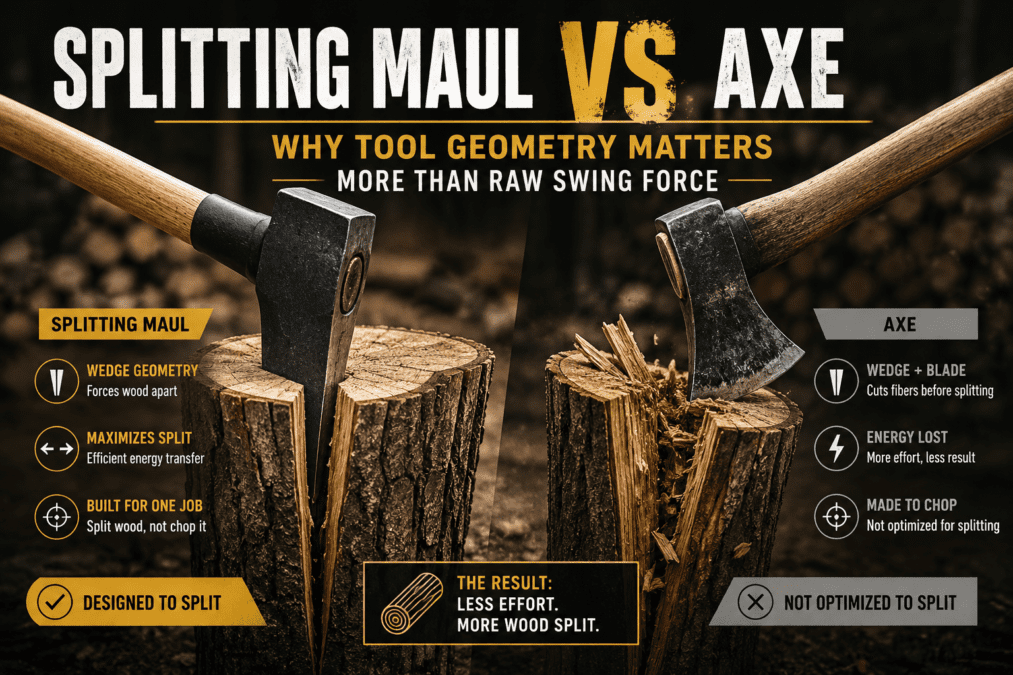

The debate surrounding splitting maul vs axe is often reduced to a simplistic question of power versus precision. In reality, the comparison is far more technical. Both tools evolved from traditional wood-processing instruments, yet modern engineering has separated their purposes into highly specialized roles. A splitting maul is optimized for force distribution and wood separation, while an axe is designed for cutting efficiency, directional control, and fiber penetration.
Understanding splitting maul vs axe requires more than examining weight or blade sharpness. The true distinction emerges through physics, ergonomics, material science, and real-world forestry applications. Handle geometry, head profile, wedge angle, impact velocity, and wood moisture content all influence how each tool performs under stress. A tool that excels in seasoned oak may underperform dramatically in green pine or frozen hardwood.
The surprising insight in the splitting maul vs axe discussion is that raw striking strength matters less than energy transfer mechanics. Many users assume heavier tools automatically outperform lighter ones, yet the interaction between head shape and wood grain frequently determines efficiency more than swing intensity alone. Modern forestry experts increasingly view these tools not as interchangeable alternatives, but as purpose-built instruments operating within different mechanical ecosystems.
Essential Comparative Metrics
| Attribute | Splitting Maul | Axe |
|---|---|---|
| Primary Function | Splitting wood fibers apart | Cutting across wood fibers |
| Typical Head Weight | 6–8 pounds | 2–5 pounds |
| Blade Geometry | Wide wedge profile | Thin sharp edge |
| Impact Style | Force dispersion | Penetrative cutting |
| Best For | Firewood processing | Tree felling and limbing |
| Swing Speed | Moderate | High |
| Precision Level | Lower | Higher |
| Energy Transfer | Vertical splitting pressure | Focused cutting force |
| User Fatigue Pattern | Shoulder and lower back strain | Forearm and wrist strain |
| Wood Interaction | Separates grain structure | Severs grain structure |
Structural And Biological Foundations
The mechanics behind splitting maul vs axe begin with the anatomy of wood itself. Wood fibers behave differently depending on moisture retention, density, species composition, and grain orientation. An axe is engineered to cut perpendicular to those fibers, concentrating energy into a narrow impact zone that slices cellular structures efficiently. A splitting maul operates differently by forcing fibers apart through expanding wedge pressure.
A splitting maul typically features a thicker head profile with substantial mass concentrated behind the striking face. That design reduces penetration depth but amplifies outward pressure after contact. In contrast, an axe relies heavily on edge sharpness and swing acceleration. Its thinner blade geometry allows deeper entry into wood before resistance increases.
Biomechanics also influence tool performance. During a swing, the user generates rotational energy through hips, shoulders, and wrists. A heavier maul stores more momentum but demands greater muscular recovery between strikes. Axes reward rhythm, coordination, and precision timing. This explains why experienced forestry workers often appear smoother rather than stronger when using cutting axes efficiently.
The splitting maul vs axe distinction therefore reflects two different philosophies of force application: separation versus penetration.
Behavioral Patterns And Social Intelligence
Human interaction with these tools has evolved alongside changing labor systems and fuel economies. Historically, axes served as multipurpose survival tools. They cleared forests, shaped shelters, processed timber, and functioned as transportable utility instruments. Splitting mauls emerged later as specialized solutions once wood heating became more standardized and large-scale firewood preparation increased.
Modern user behavior reveals an interesting pattern in the splitting maul vs axe comparison. Beginners often choose heavier tools believing greater mass guarantees better results. Experienced users, however, prioritize control, recovery efficiency, and strike consistency. Over extended sessions, rhythm frequently outperforms brute force.
There is also a psychological element tied to tool identity. Axes are culturally associated with craftsmanship, wilderness survival, and precision forestry. Splitting mauls represent industrial practicality and repetitive productivity. This influences purchasing behavior, especially among recreational users who may prioritize aesthetics or tradition over actual performance requirements.
Professional wood processors increasingly adopt hybrid workflows where axes handle directional cuts and limbing while mauls perform bulk splitting operations. Rather than competing directly, the tools complement one another within efficient wood management systems.
What Is The Difference Between A Splitting Maul And An Axe?
A splitting maul is a heavy wedge-shaped tool designed to split logs apart along the wood grain. An axe is a sharper, lighter cutting tool designed to chop across wood fibers for felling, trimming, and shaping wood.
While a splitting maul uses weight and wedge pressure to force wood apart, an axe relies on sharpness and swing speed to penetrate deeply into timber.
In the splitting maul vs axe debate, the most important difference is purpose-specific geometry. A maul sacrifices cutting precision to maximize splitting efficiency, whereas an axe prioritizes penetration, accuracy, and versatility. Choosing the wrong tool often increases fatigue, reduces safety, and dramatically lowers work efficiency.
Subject A: Strengths And Constraints
The primary advantage of a splitting maul lies in its exceptional ability to process dense firewood with minimal blade sticking. Because the wedge expands aggressively after impact, the tool naturally pushes fibers apart instead of becoming trapped inside resistant grain patterns. This is especially valuable when splitting seasoned hardwoods such as oak, hickory, elm, or maple.
Another strength in the splitting maul vs axe comparison is durability. Mauls generally tolerate overstrikes and imperfect technique better than thinner cutting axes. Many models also include reinforced poll ends that can function similarly to sledgehammers when driving wedges into oversized logs.
However, these advantages come with substantial limitations. The heavy head increases user fatigue during prolonged use. Swing recovery is slower, making repetitive work physically demanding for inexperienced users. Precision also suffers. A splitting maul is inefficient for limbing, carving, trail clearing, or directional tree work.
Transportability presents another weakness. Because of their mass and balance profile, mauls are less practical for wilderness mobility or compact tool kits. Their specialized design excels within stationary firewood environments but becomes inefficient outside that niche.
The splitting maul vs axe debate often overlooks this critical point: specialization creates both superiority and limitation simultaneously.
Subject B: Strengths And Constraints
Axes possess remarkable versatility. A quality axe can fell small trees, remove branches, shape timber, clear brush, and even perform emergency survival functions. This adaptability explains why axes maintained dominance across centuries of forestry and frontier history.
In the splitting maul vs axe discussion, the axe gains major advantages in speed and control. Its lighter weight allows rapid swing cycles with less cumulative exhaustion. Skilled users can place strikes precisely along grain weaknesses, increasing efficiency despite lower head mass.
Cutting axes also produce cleaner penetrative action. Rather than explosively separating fibers, they slice through them with reduced shock transfer into the user’s arms. This often creates smoother operational flow during technical woodwork.
Yet axes struggle under certain splitting conditions. Wet wood, twisted grain, knot-heavy logs, and large-diameter hardwoods frequently trap thin axe heads. Once embedded, extraction wastes time and energy. Excessively sharp profiles can also chip or deform if used improperly against dense seasoned timber.
Safety considerations matter as well. Axes rebound differently due to their thinner geometry and higher swing velocity. Poor strike angles may glance unpredictably, increasing injury risk.
Thus, the splitting maul vs axe comparison reveals a tradeoff between versatility and optimized splitting performance.
Comparative Advantages In Real-World Scenarios
The practical realities of splitting maul vs axe become clearer when analyzing actual work environments rather than theoretical specifications.
For residential firewood preparation, splitting mauls dominate efficiency metrics. Their wedge-driven separation mechanics reduce repeated strikes on medium and large logs. Users processing several cords annually typically benefit more from mauls than standard axes.
Camping and survival situations produce different outcomes. An axe provides broader functionality with lower carried weight. A camper can process kindling, clear branches, and shape stakes using one compact tool. Carrying a full splitting maul during mobile outdoor travel rarely makes sense.
Cold-weather performance also shifts the balance. Frozen wood becomes brittle, which can enhance axe penetration while simultaneously reducing the need for extreme wedge expansion. Conversely, wet spring timber often favors mauls because fiber elasticity resists clean axe cuts.
Urban users with limited storage frequently prefer shorter axes because maneuverability matters in confined spaces. Rural users processing high firewood volumes generally prioritize maul productivity.
Another overlooked factor in splitting maul vs axe is user body type. Smaller individuals often maintain better endurance with lighter axes, whereas stronger users may exploit maul momentum more effectively. Tool selection should therefore account for biomechanics, not just material performance.
The Physics Behind Energy Transfer
The physics of splitting maul vs axe centers on how kinetic energy interacts with wood grain structures. Both tools convert human muscular effort into rotational momentum, yet their head designs alter how that energy disperses after impact.
A splitting maul generates large amounts of momentum because of its greater mass. Upon striking wood, the wedge shape converts downward force into lateral pressure. This expanding action separates fibers outward from the impact line. The objective is not deep penetration but controlled grain fracture.
Axes function differently. Their thinner profile channels energy into a narrow cutting edge, maximizing pressure concentration. Since pressure equals force divided by area, the smaller edge surface produces intense localized stress. That allows deeper penetration with less total mass.
The splitting maul vs axe comparison becomes especially interesting when efficiency is measured over time. A maul may require fewer strikes per log but consume more energy per swing. An axe may require additional strikes yet allow faster recovery and smoother rhythm.
This explains why elite wood processors often emphasize technique over strength. Efficient body mechanics preserve energy better than excessive force generation. Swing angle, timing, and grain reading frequently matter more than muscular power alone.
Handle Design And Ergonomic Evolution
Modern handle engineering has dramatically reshaped the splitting maul vs axe landscape. Traditional hickory handles remain respected for vibration absorption and natural flexibility, but composite materials now dominate many professional-grade tools.
Fiberglass and polymer-core handles reduce shock transmission into joints, particularly during repeated splitting sessions. For mauls, this matters significantly because heavier impacts generate stronger rebound forces. Poor vibration management can contribute to wrist fatigue, elbow stress, and shoulder discomfort over time.
Axes benefit from ergonomic curvature and balance optimization. Because they rely heavily on precision placement, handle shape directly influences directional control. Subtle contour adjustments can improve swing alignment and reduce rotational instability during impact.
Grip texture has also become increasingly important in the splitting maul vs axe market. Sweaty or cold conditions reduce handling security, particularly when using high-velocity cutting axes. Anti-slip coatings and widened grip zones improve operational safety.
Length matters as well. Longer handles increase leverage and head velocity but reduce maneuverability. Shorter handles enhance control while sacrificing power generation. Manufacturers now tailor dimensions for specialized applications instead of pursuing one-size-fits-all solutions.
This ergonomic evolution demonstrates that tool efficiency increasingly depends on human-tool interaction rather than raw material strength alone.
Safety Considerations And Risk Profiles
Safety differences between splitting maul vs axe are often underestimated. Although both tools carry inherent hazards, their injury patterns differ because of their operating mechanics.
Axes present greater risks related to glancing blows and overstrikes. The sharper edge and higher swing speed can redirect unpredictably after angled contact. This becomes especially dangerous when working on unstable surfaces or uneven logs. Precision mistakes carry immediate consequences.
Splitting mauls produce fewer glancing impacts because their wedge geometry stabilizes contact. However, their heavier mass introduces different concerns. Missed strikes place greater stress on wrists, shoulders, and lower backs. Over time, repetitive heavy swinging may contribute to chronic strain injuries.
Another issue in the splitting maul vs axe debate involves fatigue-induced errors. Exhaustion significantly increases accident probability. Because mauls demand greater physical output per strike, prolonged sessions may compromise form and concentration more rapidly.
Protective equipment matters for both tools. Eye protection prevents injury from flying wood fragments or metal chips. Gloves improve grip stability. Steel-toe footwear reduces severe injury risk from dropped tools or rolling logs.
Proper maintenance also influences safety outcomes. Dull axes rebound unpredictably, while damaged maul heads may fracture under repeated impact stress. Tool inspection should therefore be considered part of operational safety rather than optional maintenance.
Wood Species Performance Analysis
Not all wood responds equally in the splitting maul vs axe comparison. Species characteristics dramatically alter performance outcomes.
Straight-grained softwoods such as pine and cedar split relatively easily. Under these conditions, a sharp axe often performs efficiently because penetration resistance remains low. Lightweight tools can process large volumes quickly without excessive fatigue.
Hardwoods create different dynamics. Oak, beech, ash, and hickory possess dense fiber structures that resist deep penetration. Here, splitting mauls frequently outperform axes because wedge expansion overcomes fiber cohesion more effectively.
Elm represents one of the most difficult species for traditional splitting. Its interlocked grain structure traps thin axe heads and absorbs impact energy inefficiently. Mauls, especially when paired with wedges, generally achieve superior results.
Moisture content further complicates the splitting maul vs axe equation. Green wood retains elasticity, allowing fibers to bend rather than fracture cleanly. Seasoned wood becomes more brittle and predictable. Frozen wood behaves differently again, sometimes favoring sharper penetration.
Knots and twisted grain patterns also influence tool selection. Axes excel on clean grain lines but struggle when fiber direction changes abruptly. Mauls tolerate irregularities better because they depend less on cutting continuity.
These variables explain why professional wood processors rarely rely on simplistic “best tool” assumptions.
Scientific And Expert Consensus (2026)
Current expert consensus surrounding splitting maul vs axe increasingly rejects the idea of universal superiority. Forestry instructors, arborists, survival trainers, and tool engineers generally agree that intended application determines optimal tool choice.
Biomechanical studies show that excessive tool weight can reduce long-term productivity despite increasing single-strike force. This challenges the traditional assumption that heavier automatically means better. Controlled rhythm and efficient energy transfer often outperform maximal impact intensity.
Ergonomic research also emphasizes injury prevention through proper tool matching. Users selecting tools inconsistent with body size or task requirements experience higher fatigue rates and reduced precision. Modern recommendations therefore prioritize contextual optimization rather than generalized rankings.
Industry trends reveal growing interest in hybrid designs that combine splitting efficiency with moderate cutting versatility. These tools attempt to bridge the gap within the splitting maul vs axe spectrum, though specialists argue compromises inevitably reduce peak performance.
Professional consensus can be summarized simply:
- Use a splitting maul for high-volume firewood processing and resistant hardwoods.
- Use an axe for versatility, mobility, precision cutting, and mixed outdoor tasks.
- Avoid expecting one tool to dominate every environment.
This nuanced perspective reflects a broader shift toward evidence-based tool selection rather than tradition-driven assumptions.
Why Many Beginners Choose The Wrong Tool
One of the most persistent issues in the splitting maul vs axe conversation is consumer misunderstanding. Marketing language often exaggerates universal capability, leading beginners to purchase tools mismatched to their actual needs.
Many first-time users select axes because they appear more versatile and visually familiar. After encountering dense hardwood rounds, they become frustrated when the blade sticks repeatedly. Others buy oversized mauls assuming maximum weight equals maximum performance, only to discover rapid fatigue and poor accuracy.
Another mistake involves ignoring wood volume expectations. Someone splitting occasional campfire logs has radically different requirements than a homeowner processing multiple winter cords. Tool selection should reflect workload frequency, not isolated demonstrations.
Technique misconceptions compound the problem. Beginners frequently attempt to overpower wood rather than read grain patterns and exploit natural fracture lines. This creates the illusion that the tool itself is inadequate.
The splitting maul vs axe decision becomes far easier when users first define the actual task environment:
- Firewood production
- Tree maintenance
- Wilderness mobility
- Survival utility
- Recreational chopping
- Precision woodworking
Once the operational context becomes clear, the correct tool usually becomes obvious as well.
Environmental And Sustainability Implications
The environmental dimension of splitting maul vs axe rarely receives attention, yet it carries meaningful implications. Manual wood processing tools represent low-emission alternatives to gas-powered splitters and chainsaw-heavy workflows in certain contexts.
Axes historically supported sustainable forestry practices because they enabled selective cutting rather than large-scale mechanized clearing. Skilled axe work can minimize unnecessary tree damage and reduce fuel consumption.
Splitting mauls contribute differently by improving firewood preparation efficiency. Well-split wood dries faster, burns cleaner, and produces more efficient heat output. Properly processed firewood reduces smoke particulates and incomplete combustion.
Tool longevity also matters environmentally. High-quality forged steel tools often last decades with proper maintenance. Disposable low-grade products increase material waste and manufacturing demand.
Within the broader splitting maul vs axe discussion, sustainability increasingly intersects with craftsmanship culture. Many users now value repairability, durable materials, and long-term ownership rather than disposable consumer cycles.
This shift reflects growing recognition that manual forestry tools occupy both practical and ecological roles in modern outdoor life.
Final Synthesis And Verdict
The most important conclusion in the splitting maul vs axe debate is that these tools are not true replacements for one another. They operate according to different mechanical principles and solve different operational problems.
A splitting maul dominates when the objective is high-efficiency firewood processing, especially with dense or resistant hardwoods. Its wedge geometry converts impact force into outward grain separation, minimizing blade trapping and maximizing splitting power.
An axe excels when versatility, mobility, precision, and cutting efficiency matter more than raw splitting capability. Its lighter profile rewards rhythm, control, and technical skill across a wider range of outdoor tasks.
The deeper insight is that tool effectiveness depends less on advertised strength and more on alignment between geometry and intended function. In the splitting maul vs axe comparison, success emerges from choosing the correct energy-delivery system for the material conditions involved.
For most dedicated firewood users, a splitting maul remains the superior primary tool. For campers, survivalists, trail workers, and multipurpose outdoor users, an axe offers broader practical value.
The smartest long-term approach is not choosing one universally, but understanding precisely where each tool achieves mechanical superiority.
Frequently Asked Questions
Is a splitting maul better than an axe for firewood?
For large-scale firewood processing, a splitting maul is generally more efficient. Its wedge-shaped head separates wood fibers more effectively, especially in dense hardwoods. An axe can still split smaller logs, but it often becomes trapped in difficult grain patterns.
Can you cut down a tree with a splitting maul?
Technically yes, but it is highly inefficient. A splitting maul is designed to force wood apart rather than slice across fibers. Tree felling requires penetration and directional cutting, which are strengths of a proper axe.
Why does an axe get stuck in logs?
Axes become stuck because their thinner blades penetrate deeply before generating enough lateral pressure to split the grain. Logs with knots, twisted fibers, or high moisture content increase this problem significantly.
Which tool is safer in the splitting maul vs axe comparison?
Both tools require careful handling, but they produce different risks. Axes are more likely to glance unpredictably due to sharper cutting geometry, while splitting mauls generate greater fatigue-related strain because of their heavier weight.
Do professional woodworkers use both tools?
Yes. Many professionals combine axes and splitting mauls within the same workflow. Axes handle cutting, shaping, and limbing tasks, while mauls process firewood and split resistant hardwood rounds more efficiently.