
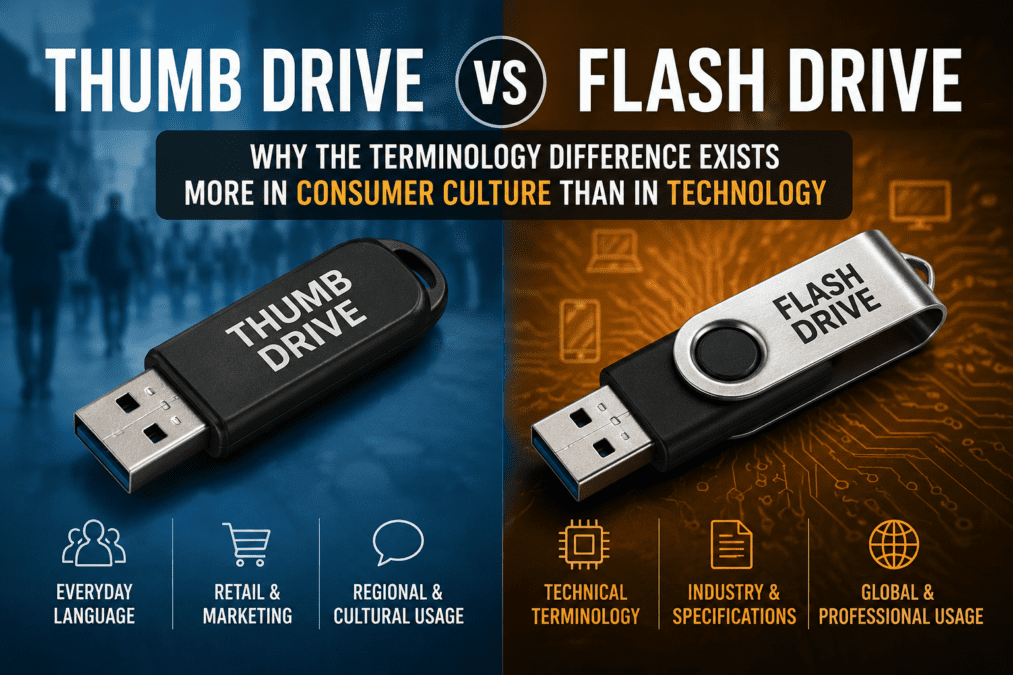

The phrase “thumb drive vs flash drive” has become one of the most searched storage-device comparisons despite the fact that both terms are frequently used to describe the same portable data-storage technology. In modern computing culture, a thumb drive typically refers to a compact USB storage device small enough to fit in a pocket or attach to a keychain, while a flash drive refers more broadly to any storage device that uses flash memory technology. The distinction appears semantic on the surface, yet the terminology evolved from different technological and marketing origins.
This comparison examines the issue through technical architecture, consumer usage patterns, storage engineering, interface evolution, durability, portability, and industry terminology. Instead of treating the discussion as a simple synonym debate, the analysis explores how naming conventions shape consumer understanding of technology products. The “thumb drive vs flash drive” conversation persists because language in technology rarely evolves with perfect precision. Manufacturers, retailers, IT professionals, and consumers often adopt different naming standards simultaneously.
The central insight is surprisingly straightforward: in practical consumer environments, thumb drives and flash drives are usually the same device, but the terminology reflects different priorities. “Thumb drive” emphasizes physical size and portability, while “flash drive” emphasizes memory architecture. Understanding that distinction reveals why the market continues using both names interchangeably even as storage technology itself becomes more advanced, faster, and increasingly cloud-connected.
Essential Comparative Metrics
| Comparison Factor | Thumb Drive | Flash Drive |
|---|---|---|
| Primary Definition | A small portable USB storage device designed for carrying files | A storage device that uses flash memory technology to store data |
| Technical Meaning | Refers mainly to physical form factor and portability | Refers mainly to the underlying NAND flash memory architecture |
| Common Consumer Usage | Popular in schools, offices, and everyday conversation | More common in technical, retail, and manufacturing contexts |
| Underlying Storage Technology | NAND flash memory | NAND flash memory |
| Connection Interface | Usually USB-A or USB-C | Usually USB-A, USB-C, or other flash-compatible interfaces |
| Physical Design Focus | Compact, lightweight, thumb-sized portability | Broader category that may include multiple storage designs |
| Performance Determinants | USB standard, controller quality, NAND type | USB standard, controller quality, NAND type |
| Typical Storage Capacity | 8GB to 2TB | 8GB to 2TB or higher |
| Data Retention Method | Electronic non-volatile memory storage | Electronic non-volatile memory storage |
| Mechanical Components | No moving parts | No moving parts |
| Durability | Resistant to shock and vibration | Resistant to shock and vibration |
| Portability Level | Extremely high | High, depending on design |
| Professional Terminology Accuracy | Less technically precise | More technically accurate |
| Typical Marketing Style | Convenience-oriented branding | Technology-oriented branding |
| Security Features | May include password or biometric protection | May include encryption and enterprise-grade security |
| Common Use Cases | Schoolwork, office documents, quick transfers | Professional storage, backups, secure transfers, technical workflows |
| Industry Interpretation | Specific portable USB device category | Broader flash-memory storage category |
| Consumer Perception | Simple and user-friendly storage tool | More advanced or technical storage device |
| Relationship Between Terms | Usually considered a type of flash drive | Broader term that often includes thumb drives |
| Overall Verdict | Consumer-focused naming convention | Technology-focused naming convention |
A thumb drive is a compact USB storage device designed primarily for portability and quick file transfer. A flash drive is a storage device that uses flash memory technology to store data without moving mechanical components.
While a thumb drive usually refers to the physical USB stick consumers carry in pockets or attach to keychains, a flash drive can technically describe a broader family of flash-memory-based storage products.
In practical consumer electronics, the thumb drive vs flash drive debate is mostly about terminology rather than functional differences. Nearly every thumb drive sold today is also a flash drive because it uses NAND flash memory for non-volatile storage. The distinction survives because one term describes form factor and portability, while the other describes storage technology and engineering architecture.
Structural And Biological Foundations
Unlike biological comparisons where anatomy drives behavioral outcomes, the thumb drive vs flash drive discussion centers on storage architecture and industrial design. Both devices rely on NAND flash memory, a non-volatile semiconductor technology capable of retaining information even when disconnected from power. This architecture replaced older magnetic storage systems in portable devices because it eliminated moving parts, reduced heat production, and dramatically improved durability.
The internal structure of a modern USB storage device includes a USB controller, NAND flash memory chips, firmware logic, and a printed circuit board enclosed within a protective shell. Whether marketed as a thumb drive or flash drive, the core engineering remains nearly identical. Differences usually emerge in branding, casing style, transfer-speed optimization, encryption capability, or ruggedization.
The phrase “thumb drive” became popular because early USB storage devices were approximately thumb-sized. Meanwhile, “flash drive” emerged from the underlying flash-memory technology itself. This linguistic split created a long-lasting consumer distinction even though the devices converged technologically almost immediately. Today, the thumb drive vs flash drive conversation resembles the way people distinguish “cell phone” from “smartphone” even when both terms increasingly overlap.
Behavioral Patterns And Social Intelligence
Consumer behavior reveals why the thumb drive vs flash drive terminology continues surviving across generations of computer users. Casual consumers often prefer descriptive language based on physical appearance and convenience. That explains why “thumb drive” gained traction in office culture, schools, and households. The term communicates portability instantly without requiring technical literacy.
Technology professionals, however, frequently prefer “flash drive” because it aligns more closely with engineering terminology. Flash memory is a recognized semiconductor category used not only in USB drives but also in SSDs, memory cards, smartphones, tablets, and embedded computing systems. From an industry perspective, “flash drive” therefore sounds more technically accurate and future-proof.
Interestingly, search-engine behavior shows that consumers often use both terms interchangeably depending on purchasing context. Someone searching for quick file transfer solutions may type “thumb drive,” while users comparing speed specifications or storage standards may prefer “flash drive.” This behavioral distinction demonstrates how language adapts according to perceived expertise levels.
The thumb drive vs flash drive terminology gap also reflects broader technology-marketing psychology. Consumers often adopt friendly, visual names, while manufacturers and engineers adopt functional or architectural names. Similar patterns exist with “hard drive,” “SSD,” “graphics card,” and “GPU,” where overlapping terminology coexists because different user groups prioritize different forms of understanding.
Historical Evolution Of Portable Flash Storage
To understand the thumb drive vs flash drive distinction fully, it is necessary to examine the historical evolution of portable storage technology. Before USB flash storage became mainstream, floppy disks dominated portable computing. These disks were lightweight and inexpensive but fragile, slow, and extremely limited in capacity. As file sizes increased with digital photography, multimedia content, and software distribution, floppy technology became inadequate.
The emergence of flash-memory-based USB devices in the late 1990s and early 2000s transformed personal data portability. Early manufacturers marketed the devices using several names simultaneously, including USB key, jump drive, memory stick, pen drive, thumb drive, and flash drive. Some names originated from trademarks, while others emerged organically through consumer adoption.
The phrase “flash drive” derived directly from flash memory technology, named because the memory cells could be erased rapidly in blocks or “flashes.” Meanwhile, “thumb drive” reflected industrial design and ergonomics. Devices became small enough to hold comfortably between fingers, reinforcing the portable identity consumers valued.
This naming fragmentation explains why the thumb drive vs flash drive debate never truly disappeared. The technology standardized faster than the terminology. Consumers inherited multiple valid names for essentially the same category of product, and retailers continued supporting all of them because search demand remained diversified.
Storage Technology And NAND Flash Architecture
At the engineering level, the thumb drive vs flash drive discussion becomes even clearer. Both devices rely on NAND flash memory, which stores data electronically rather than magnetically. NAND architecture organizes memory cells into pages and blocks, enabling efficient data retention without continuous power supply.
Modern flash storage devices commonly use one of several NAND configurations:
- SLC (Single-Level Cell)
- MLC (Multi-Level Cell)
- TLC (Triple-Level Cell)
- QLC (Quad-Level Cell)
Higher-density configurations reduce manufacturing costs but may sacrifice endurance and write performance. Premium enterprise-grade drives typically use more durable memory configurations, while consumer devices prioritize affordability and storage capacity.
USB controllers play a crucial role in managing wear leveling, error correction, caching, and communication between the storage device and host computer. These controllers determine real-world speed performance far more than marketing terminology does. In practical terms, a high-performance “thumb drive” and a high-performance “flash drive” can be internally identical.
The thumb drive vs flash drive comparison therefore reveals an important reality about consumer electronics terminology: names rarely define performance. Specifications such as USB generation, read/write speed, controller quality, and NAND type matter substantially more than branding language.
Subject A: Strengths And Constraints
In the thumb drive vs flash drive comparison, the “thumb drive” label carries several practical strengths rooted in consumer usability and portability perception.
The most obvious advantage is clarity in everyday conversation. When someone says “thumb drive,” most consumers immediately visualize a compact USB stick designed for file transport. The term is intuitive, informal, and accessible across age groups and technical backgrounds. Educational institutions and workplaces frequently use the phrase because it reduces communication ambiguity for non-technical users.
Thumb drives are also strongly associated with convenience. Their compact dimensions, plug-and-play compatibility, and low power requirements make them ideal for quick file transfers, temporary backups, presentations, and offline media storage. Modern designs include retractable connectors, waterproof casings, biometric encryption, and dual USB-A/USB-C interfaces.
However, the thumb drive label also introduces limitations. Technically speaking, the term lacks precision because it describes form factor rather than architecture. A storage engineer discussing flash-memory ecosystems would rarely use “thumb drive” in professional documentation. Additionally, the phrase may imply smaller, lower-capacity devices even though many modern units exceed one terabyte.
Another constraint is generational perception. Younger users increasingly rely on cloud storage and wireless transfer systems, making the traditional “thumb drive” concept feel tied to older desktop-centric workflows.
Subject B: Strengths And Constraints
The “flash drive” side of the thumb drive vs flash drive comparison benefits from greater technical accuracy and broader industry applicability. Because flash memory powers numerous storage products, the phrase aligns naturally with semiconductor terminology and modern storage ecosystems.
One major strength is scalability. Flash-drive terminology accommodates technological evolution more effectively than “thumb drive.” A USB storage stick, encrypted enterprise drive, rugged industrial module, or hybrid portable SSD may all reasonably fall under the broader flash-storage category. This flexibility makes the term valuable in professional environments.
Flash drives are also associated with performance discussions. Consumers researching transfer speeds, endurance ratings, or controller technologies often encounter technical documentation using “flash drive” rather than “thumb drive.” As a result, the phrase tends to carry a more advanced or professional tone.
Still, the terminology has drawbacks. For non-technical consumers, “flash drive” may sound less descriptive or intuitive than “thumb drive.” The word “flash” itself does not inherently communicate portability, size, or USB functionality. Some users may even confuse flash drives with memory cards or SSD technologies because all use flash memory.
The thumb drive vs flash drive debate therefore illustrates how technical precision and consumer clarity do not always align perfectly. The technically broader term may actually create more ambiguity for casual users.
Performance Differences: Myth Versus Reality
One persistent misconception in the thumb drive vs flash drive conversation is the belief that the terms describe different performance classes. In reality, performance depends almost entirely on hardware specifications rather than terminology.
Several factors determine actual speed:
- USB interface generation
- NAND flash quality
- Controller efficiency
- Thermal management
- File size behavior
- Random vs sequential transfer patterns
A USB 3.2 Gen 2 flash drive may outperform an older USB 2.0 thumb drive by enormous margins, but that difference has nothing to do with the name itself. Similarly, two products marketed differently may share identical internals from the same manufacturer.
Marketing language can nevertheless influence consumer expectations. Products labeled “flash drive” are sometimes presented with more technical emphasis, including transfer-speed ratings and endurance benchmarks. “Thumb drive” branding, meanwhile, often emphasizes portability, affordability, or everyday simplicity.
This creates a psychological effect where users may assume flash drives are inherently faster. From an engineering standpoint, that assumption is incorrect. The thumb drive vs flash drive distinction remains linguistic rather than performance-based.
Modern premium USB storage devices can reach transfer speeds exceeding 1,000 MB/s when paired with advanced USB standards and SSD-like internal architectures. At that level, traditional naming conventions become increasingly irrelevant compared to measurable hardware capability.
Durability, Lifespan, And Reliability
Durability represents another important dimension in the thumb drive vs flash drive comparison. Flash memory storage offers several reliability advantages over older magnetic storage systems because it contains no moving mechanical components. That makes portable USB storage far more resistant to vibration, drops, and travel-related stress.
However, flash memory does have finite write-cycle limitations. Each NAND cell can endure only a certain number of program-and-erase cycles before degradation begins affecting reliability. Wear-leveling algorithms inside the controller distribute writes evenly to extend operational lifespan.
Consumer-grade USB storage devices typically last for years under normal usage conditions. Failure usually occurs because of:
- Physical connector damage
- Poor controller quality
- Heat exposure
- Moisture intrusion
- Excessive rewrite cycles
- Sudden electrical interruption
The thumb drive vs flash drive terminology itself has no effect on reliability outcomes. Instead, build quality, manufacturing standards, and usage patterns determine long-term durability.
Ruggedized enterprise-oriented models increasingly include shock resistance, waterproofing, hardware encryption, and tamper protection. These features matter substantially more than naming conventions. In many cases, manufacturers alternate freely between “thumb drive” and “flash drive” across marketing materials for the exact same product line.
Comparative Advantages In Real-World Scenarios
Real-world usage patterns reveal why the thumb drive vs flash drive terminology persists despite technological overlap. Different environments prioritize different aspects of portable storage functionality.
In education, “thumb drive” remains dominant because the phrase communicates simplicity and portability. Students transporting assignments, presentations, and research documents typically use everyday terminology emphasizing convenience rather than technical architecture.
Corporate IT departments often prefer “flash drive” because policy documents, procurement specifications, and cybersecurity guidelines reference flash-memory-based removable storage more formally. In these contexts, terminology influences compliance language and infrastructure management.
For photographers and media professionals, high-speed USB flash storage becomes increasingly important for handling large RAW image files and video assets. These users focus more on throughput, endurance, and interface standards than on casual terminology.
The thumb drive vs flash drive distinction also appears in cybersecurity discussions. Security professionals frequently discuss risks associated with removable flash storage, including malware transmission, unauthorized data transfer, and firmware attacks. Technical documentation therefore gravitates toward “flash drive” terminology because it aligns with broader storage-device classification systems.
Consumers shopping online demonstrate mixed terminology behavior. E-commerce platforms deliberately optimize listings using both keywords simultaneously because search trends show sustained demand for both phrases. That commercial reality reinforces the coexistence of the two terms.
USB Standards And Interface Evolution
The evolution of USB standards significantly changed portable storage expectations over the last two decades. Early USB 1.1 devices offered extremely limited transfer rates unsuitable for modern multimedia workflows. USB 2.0 improved usability dramatically, while USB 3.x and USB4 transformed portable storage into high-performance transfer platforms.
The thumb drive vs flash drive terminology persisted throughout these changes because interface evolution affected both equally. Regardless of naming preference, users benefited from:
- Faster read/write speeds
- Improved power efficiency
- Greater storage capacities
- Better backward compatibility
- Reduced latency
- Smaller connector designs
USB-C adoption further blurred traditional perceptions. Modern USB-C flash storage devices often resemble miniature SSDs more than classic thumb-sized sticks. Some models support direct smartphone connectivity, video recording workflows, and operating-system boot environments.
As portable storage becomes more integrated into multi-device ecosystems, the phrase “flash drive” may gradually gain dominance because it adapts more naturally to evolving hardware formats. Nevertheless, “thumb drive” retains strong cultural familiarity, especially among general consumers.
The thumb drive vs flash drive debate therefore reflects technological continuity combined with linguistic inertia. Users continue employing legacy terminology even as device capabilities evolve dramatically.
Security And Data Protection Considerations
Security has become increasingly important in portable storage technology. USB-based removable storage devices present substantial cybersecurity challenges because they enable rapid offline data movement beyond cloud-monitoring systems.
Modern secure flash-storage devices may include:
- AES hardware encryption
- Password authentication
- Fingerprint verification
- Secure partitioning
- Remote management
- Tamper detection
In professional cybersecurity language, “flash drive” appears more frequently because it integrates better with enterprise security terminology. Threat assessments, compliance frameworks, and endpoint-protection systems generally categorize removable media under broader flash-storage definitions.
Still, consumer behavior continues favoring familiar language. Employees may report losing a “thumb drive” even when internal IT documentation refers to removable flash media. This terminology mismatch illustrates how consumer vocabulary and institutional vocabulary coexist simultaneously.
The thumb drive vs flash drive conversation also intersects with privacy culture. As cloud storage adoption grows, many users continue preferring offline portable storage for sensitive files because it reduces dependence on internet-connected infrastructure. In that sense, flash-based removable storage remains strategically relevant despite advances in wireless synchronization systems.
Market Economics And Consumer Psychology
The persistence of the thumb drive vs flash drive terminology divide also reflects economic incentives and retail psychology. Retailers optimize product descriptions around search behavior rather than strict technical accuracy. If consumers search both phrases frequently, manufacturers incorporate both into packaging and online listings.
This creates a self-reinforcing cycle:
- Consumers see both terms used interchangeably
- Search behavior diversifies further
- Retailers continue supporting both terms
- Terminology convergence never fully occurs
The psychological framing differs subtly between the two names. “Thumb drive” sounds personal, compact, and easy to use. “Flash drive” sounds technological, advanced, and specification-oriented. Marketing departments exploit these associations depending on target demographics.
Budget-oriented retail products often emphasize convenience and portability using “thumb drive” language. Professional-grade storage solutions may lean toward “flash drive” branding alongside technical specifications like USB generation, encryption support, and sustained write speeds.
The thumb drive vs flash drive discussion therefore demonstrates how technology vocabulary evolves through consumer behavior as much as engineering logic.
Environmental Impact And Sustainability Trends
Portable flash storage devices contribute to broader discussions about electronic waste and sustainability. As capacities increase and prices decline, consumers frequently replace storage devices instead of maintaining older units for long-term usage.
Manufacturers increasingly explore:
- Recyclable materials
- Reduced packaging waste
- Lower power consumption
- Longer endurance designs
- Modular storage concepts
Because flash memory lacks moving components, energy consumption remains relatively low compared with older mechanical storage systems. However, NAND manufacturing involves resource-intensive semiconductor fabrication processes with environmental implications.
The thumb drive vs flash drive terminology itself has little sustainability relevance, but evolving storage habits do matter. Cloud-based workflows reduce some dependency on removable media while simultaneously increasing reliance on energy-intensive data centers. Portable flash storage therefore remains environmentally competitive in certain offline or low-power scenarios.
As edge computing and offline data mobility continue expanding, compact flash-based storage devices will likely maintain relevance despite the growth of cloud ecosystems.
Scientific And Expert Consensus (2026)
By 2026, consensus among computing professionals, storage engineers, and consumer-technology analysts is clear: the thumb drive vs flash drive distinction is primarily terminological rather than technological.
Industry experts generally agree on several points:
- Nearly all thumb drives are flash drives
- Flash memory defines the technology category
- Thumb drive defines a common form factor
- Performance differences depend on specifications, not terminology
- Consumer language and engineering language evolved separately
Technical publications increasingly favor “USB flash drive” because it combines architectural precision with consumer familiarity. Meanwhile, everyday users continue using “thumb drive,” “USB stick,” “pen drive,” and similar terms interchangeably.
Analysts also note that portable flash storage remains relevant despite cloud expansion because physical data portability offers advantages in offline access, security isolation, and rapid local transfer workflows. High-speed USB-C devices blur the boundary between traditional flash drives and portable SSDs, further reducing the importance of legacy naming distinctions.
The thumb drive vs flash drive debate ultimately survives because language evolves culturally, not just technically. Technology standardization rarely eliminates consumer vocabulary diversity.
Future Outlook: Will The Terminology Survive?
Looking forward, the future of the thumb drive vs flash drive terminology depends largely on interface evolution and consumer computing behavior.
Several trends are reshaping portable storage:
- Increasing cloud synchronization
- Smartphone-first workflows
- Wireless file sharing
- Portable SSD miniaturization
- USB-C standardization
- AI-assisted local storage optimization
Younger users increasingly rely less on removable storage for daily tasks. However, professionals in media production, cybersecurity, system administration, education, and enterprise deployment continue depending heavily on physical portable storage devices.
The phrase “thumb drive” may gradually decline as devices diversify beyond thumb-sized USB sticks. Meanwhile, “flash drive” possesses greater adaptability because it references underlying storage technology rather than physical design.
Still, linguistic persistence should not be underestimated. Technology history shows that consumers often retain outdated terminology for decades. People still refer to “dialing” phone numbers long after rotary phones disappeared. Similarly, the thumb drive vs flash drive distinction may continue indefinitely because convenience language tends to outlive engineering precision.
Final Synthesis And Verdict
The thumb drive vs flash drive comparison reveals far more about technological language evolution than about hardware differences. In practical terms, the two phrases usually describe the same portable USB storage device powered by NAND flash memory. The distinction exists primarily because the terms emerged from different conceptual priorities.
“Thumb drive” emphasizes portability, compactness, and user convenience. It became popular through everyday consumer adoption and workplace familiarity. “Flash drive,” by contrast, emphasizes storage architecture and semiconductor technology. It aligns more closely with technical documentation, engineering terminology, and broader storage ecosystems.
Neither term inherently indicates superior performance, durability, speed, or reliability. Those characteristics depend on controller quality, NAND architecture, USB standards, and manufacturing design rather than branding language.
The most important conclusion in the thumb drive vs flash drive debate is that terminology shapes perception more than functionality. Consumers interpret names emotionally and contextually, while engineers interpret them structurally and technically. Both perspectives are valid within their respective environments.
As storage technology continues evolving toward faster interfaces, higher capacities, and hybrid portable architectures, the linguistic distinction may matter even less technically while remaining culturally persistent. In that sense, the thumb drive vs flash drive conversation is ultimately a study in how people name technologies—not just how technologies work.
Frequently Asked Questions
Is there actually a difference between a thumb drive and a flash drive?
In most consumer contexts, no meaningful hardware difference exists. A thumb drive is usually a type of flash drive because it uses flash memory technology. The distinction mainly comes from terminology preferences rather than engineering differences.
Why do some people say thumb drive while others say flash drive?
The phrase “thumb drive” became popular because early USB storage devices were small and thumb-sized. “Flash drive” refers to the underlying flash-memory technology. Consumers often prefer descriptive physical terms, while technical users prefer architecture-based terminology.
Which is faster in the thumb drive vs flash drive comparison?
Neither term automatically indicates speed. Performance depends on factors like USB generation, NAND quality, and controller design. A high-end thumb drive can outperform a low-end flash drive if the hardware specifications are superior.
Are thumb drives still relevant in 2026?
Yes. Although cloud storage dominates many consumer workflows, portable USB flash storage remains important for offline file transfer, cybersecurity operations, media production, system recovery, enterprise deployment, and secure local backups.
Is a USB drive the same as a flash drive?
Usually, yes. Most modern USB drives use flash memory technology, making them USB flash drives. However, technically speaking, “USB drive” refers to the interface type, while “flash drive” refers to the storage technology itself.