
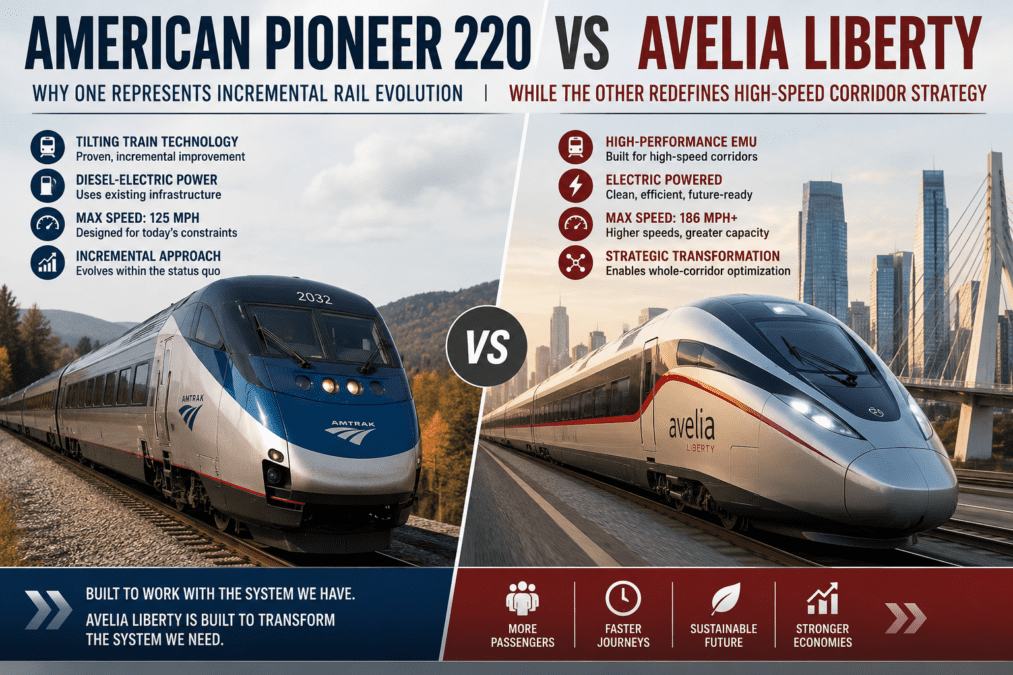

The debate surrounding american pioneer 220 vs avelia liberty reflects a broader transformation occurring across North American passenger rail systems. Both train concepts are associated with modernization, speed optimization, and infrastructure adaptation, yet they represent very different philosophies in rail engineering and operational strategy. One is framed around practical integration into existing rail ecosystems, while the other is engineered specifically for next-generation high-speed performance within constrained corridor environments.
Understanding american pioneer 220 vs avelia liberty requires more than comparing top speeds or aesthetics. The comparison must include infrastructure compatibility, tilting technology, power distribution, maintenance economics, passenger throughput, acceleration efficiency, and long-term corridor scalability. Modern rail systems succeed not only because they move quickly, but because they balance operational reliability with real-world transportation constraints.
The surprising insight in the american pioneer 220 vs avelia liberty discussion is that outright speed is no longer the only benchmark for rail superiority. In dense transportation corridors, adaptability and network integration increasingly matter more than theoretical maximum velocity. While one platform emphasizes evolutionary modernization, the other is built around transformative corridor optimization and future-proof engineering.
Understanding the Core Difference Between Both Train Platforms
The american pioneer 220 vs avelia liberty comparison centers on two fundamentally different design philosophies. American Pioneer 220 is generally conceptualized as a next-generation American high-speed platform emphasizing compatibility with existing rail infrastructure and gradual modernization. Avelia Liberty, by contrast, is a commercially deployed semi-high-speed trainset engineered by Alstom specifically for the Northeast Corridor.
Avelia Liberty is a high-speed passenger train designed to replace older Acela trainsets through improved tilting systems, enhanced acceleration, and greater passenger capacity. The American Pioneer 220 concept represents a broader ambition for ultra-modern American rail capable of competing with European and Asian high-speed systems.
While American Pioneer 220 emphasizes scalable national deployment potential, Avelia Liberty prioritizes corridor-specific optimization under infrastructure limitations. That distinction defines nearly every technical and operational contrast in american pioneer 220 vs avelia liberty discussions.
In practical terms, Avelia Liberty is engineered around existing realities, whereas American Pioneer 220 symbolizes what a more aggressive American rail future could look like under expanded investment conditions.
Essential Comparative Metrics
Structural And Biological Foundations
Although trains are mechanical systems rather than biological organisms, the phrase “structural foundations” in american pioneer 220 vs avelia liberty refers to the engineering architecture that defines performance capabilities. American Pioneer 220 is envisioned around lightweight aerodynamic construction, advanced composite integration, and infrastructure synergy designed for sustained ultra-high-speed travel. Such systems would likely depend on dedicated track geometry with broader turning radii and advanced signaling networks.
Avelia Liberty operates within a much more constrained environment. The Northeast Corridor contains aging tunnels, sharp curves, mixed traffic operations, and legacy infrastructure. As a result, Avelia Liberty prioritizes adaptive engineering rather than pure speed maximization. Its articulated trainset design improves stability, while active tilting technology enables faster cornering without excessive passenger discomfort.
This difference is crucial in understanding american pioneer 220 vs avelia liberty. American Pioneer 220 theoretically benefits from cleaner design assumptions because it imagines future infrastructure conditions. Avelia Liberty must succeed within existing operational complexity. Consequently, one platform optimizes idealized efficiency while the other optimizes survivability inside a difficult rail ecosystem.
Behavioral Patterns And Social Intelligence
Rail systems exhibit operational “behavior” through scheduling flexibility, passenger flow efficiency, maintenance responsiveness, and corridor interaction. In american pioneer 220 vs avelia liberty, behavioral intelligence becomes especially important because modern transportation systems must function as adaptive networks rather than isolated machines.
Avelia Liberty demonstrates strong operational social intelligence because it was engineered specifically for one of the busiest rail corridors in North America. It manages frequent station stops, varying track conditions, and high passenger density while attempting to preserve reliable scheduling. Its operational behavior emphasizes consistency and adaptability over spectacle.
American Pioneer 220 represents a more ambitious behavioral model. The concept assumes future rail ecosystems with dedicated high-speed pathways, reduced interference from freight systems, and more automated traffic management. Under such conditions, train behavior could become more synchronized, efficient, and predictable.
The key insight in american pioneer 220 vs avelia liberty is that adaptability may currently matter more than theoretical optimization. Avelia Liberty succeeds because it understands the “social environment” of American rail infrastructure. American Pioneer 220 would require the environment itself to evolve before its full potential could be realized.
Subject A: Strengths And Constraints
The strengths associated with American Pioneer 220 stem primarily from its visionary potential. In the american pioneer 220 vs avelia liberty debate, proponents of American Pioneer 220 often emphasize future readiness. A 220 mph operational framework could drastically reduce travel times between major metropolitan regions and create meaningful competition with domestic air travel.
Another major advantage is design freedom. Because American Pioneer 220 is not entirely constrained by legacy assumptions, engineers could optimize aerodynamics, energy distribution, passenger comfort, digital automation, and modular expansion simultaneously. Such a system could integrate predictive maintenance AI, advanced regenerative braking, and highly efficient energy transfer systems.
However, these strengths introduce equally significant constraints. Ultra-high-speed systems require extremely expensive infrastructure upgrades. Existing American rail corridors were not designed for sustained 220 mph operation. Curvature, signaling systems, bridge limitations, and mixed freight usage create severe barriers.
Economic viability also becomes a central issue in american pioneer 220 vs avelia liberty. Large-scale national high-speed deployment would demand extraordinary public investment and long-term political consistency. The challenge is not only engineering feasibility but institutional continuity. Visionary systems often struggle when funding cycles and political priorities shift unpredictably.
Subject B: Strengths And Constraints
Avelia Liberty’s primary strength lies in realism. Unlike conceptual ultra-high-speed systems, it was engineered around actual operational conditions. In american pioneer 220 vs avelia liberty, Avelia Liberty frequently appears less revolutionary on paper, but significantly more practical in deployment strategy.
Its active tilt technology allows trains to navigate curves at higher speeds without requiring entirely new track geometry. This is especially valuable on the Northeast Corridor, where urban density and historical infrastructure make complete redesign economically difficult. Increased passenger capacity also improves revenue potential and corridor efficiency.
Avelia Liberty additionally benefits from proven European high-speed engineering lineage. Alstom leveraged decades of experience in trainset stability, articulated design, crash safety, and energy optimization. That accumulated expertise reduces uncertainty compared with hypothetical next-generation systems.
Yet Avelia Liberty also faces notable constraints. The train cannot fully escape the limitations of the infrastructure it uses. Even highly advanced rolling stock cannot overcome bottlenecks caused by aging tunnels, bridge restrictions, or mixed operational traffic. In many ways, the train’s capabilities exceed what the corridor consistently allows.
This tension defines much of the american pioneer 220 vs avelia liberty conversation. Avelia Liberty is technologically sophisticated, but its environment limits the full expression of that sophistication.
Comparative Advantages In Real-World Scenarios
The most meaningful evaluation of american pioneer 220 vs avelia liberty occurs when examining actual transportation scenarios rather than abstract specifications. Different operational contexts favor different rail philosophies.
In densely populated corridors with legacy infrastructure, Avelia Liberty possesses major advantages. It can integrate into existing systems without requiring total reconstruction. That makes deployment faster, politically easier, and economically more manageable. For regions prioritizing incremental improvement, Avelia Liberty is strategically effective.
In newly developed high-speed corridors, however, American Pioneer 220 could theoretically outperform conventional semi-high-speed systems dramatically. Dedicated lines designed specifically for 220 mph operation would permit airline-competitive travel times between major cities. This could alter regional economic integration patterns and reduce short-haul aviation dependence.
Maintenance economics also shift depending on context. Avelia Liberty’s maintenance ecosystem already exists within an operational framework. American Pioneer 220 would likely require entirely new maintenance depots, workforce retraining systems, and diagnostic infrastructure.
Another important distinction in american pioneer 220 vs avelia liberty concerns scalability. Avelia Liberty is optimized for a particular corridor. American Pioneer 220 implies broader national ambitions. One solves an immediate regional problem; the other attempts to redefine the national transportation paradigm.
Passenger Experience And Interior Engineering
Passenger experience has become central to modern rail competition. The american pioneer 220 vs avelia liberty comparison extends beyond engineering into comfort psychology, spatial design, and travel perception.
Avelia Liberty emphasizes smoother cornering, quieter cabin environments, and improved seating layouts relative to earlier Acela trainsets. The articulated design reduces vibration while maintaining stability at higher speeds. For business travelers on the Northeast Corridor, reliability and comfort matter nearly as much as speed itself.
American Pioneer 220, by contrast, would likely prioritize a futuristic passenger environment built around extended high-speed travel. Potential design features could include advanced noise isolation, adaptive lighting systems, real-time digital integration, modular seating arrangements, and enhanced pressure stabilization for sustained ultra-fast operation.
Interestingly, passenger psychology changes depending on speed thresholds. Once trains exceed certain velocity ranges, cabin stability and noise management become increasingly important. Travelers perceive comfort differently at 220 mph than at 150–160 mph. Therefore, the passenger engineering demands in american pioneer 220 vs avelia liberty differ substantially.
Avelia Liberty focuses on enhancing an already familiar corridor experience. American Pioneer 220 symbolizes a shift toward redefining how Americans perceive rail travel altogether.
Infrastructure Compatibility And National Rail Strategy
Infrastructure compatibility may be the single most important factor in american pioneer 220 vs avelia liberty. Transportation systems rarely fail because of isolated engineering flaws; they fail because infrastructure ecosystems cannot support them efficiently.
Avelia Liberty’s greatest strategic advantage is compatibility with existing Northeast Corridor conditions. Although upgrades are still required, the train does not depend on completely new national rail construction. This reduces deployment friction and accelerates operational integration.
American Pioneer 220 faces a dramatically different reality. Sustained 220 mph operation demands dedicated track alignment, advanced signaling systems, high-grade electrification, and comprehensive safety redesign. Freight interference becomes especially problematic because ultra-high-speed passenger systems perform poorly on mixed-use infrastructure.
The broader implication is that american pioneer 220 vs avelia liberty reflects two competing national strategies. One strategy prioritizes incremental modernization of current infrastructure. The other seeks transformational replacement through entirely new investment frameworks.
Countries with successful high-speed rail systems often committed to decades-long infrastructure continuity. The United States historically struggles with long-term transportation consistency, which explains why adaptive systems like Avelia Liberty may currently possess stronger institutional viability.
Energy Efficiency And Environmental Implications
Environmental sustainability increasingly shapes transportation policy. In american pioneer 220 vs avelia liberty, energy efficiency depends not only on train design but also operational context.
Avelia Liberty benefits from electrified corridor operation and improved energy management compared with older trainsets. Because it leverages existing infrastructure, its deployment avoids some of the environmental costs associated with entirely new corridor construction. Incremental modernization can therefore generate relatively fast emissions reductions.
American Pioneer 220 potentially offers even greater long-term sustainability benefits if paired with renewable-powered electrification networks. Ultra-high-speed rail can substantially reduce short-haul aviation demand, which remains carbon-intensive per passenger mile compared with efficient rail systems.
However, higher speeds also increase aerodynamic resistance exponentially. Sustaining 220 mph requires significantly greater energy input than operating at 150–160 mph. Consequently, the environmental efficiency equation becomes more nuanced than simple speed comparisons suggest.
The environmental dimension of american pioneer 220 vs avelia liberty therefore hinges on infrastructure sourcing, electricity generation methods, passenger load factors, and corridor utilization density. Faster trains are not automatically greener unless the surrounding system architecture supports sustainable efficiency.
Economic Viability And Long-Term Investment Logic
Economic analysis is central to the american pioneer 220 vs avelia liberty comparison because transportation megaprojects succeed only when operational logic aligns with financial sustainability.
Avelia Liberty follows a lower-risk modernization model. It improves passenger throughput and service quality without requiring complete national infrastructure replacement. This approach aligns more comfortably with gradual public investment cycles and phased corridor upgrades.
American Pioneer 220 represents a higher-risk, higher-reward framework. If implemented successfully, ultra-high-speed networks could reshape regional economies, stimulate urban integration, and reduce aviation dependency. Yet the initial capital expenditures would be enormous.
Cost recovery also differs substantially. Avelia Liberty operates within already established passenger demand corridors. American Pioneer 220 would depend heavily on long-term ridership expansion assumptions. Predicting those patterns accurately becomes difficult in rapidly evolving transportation environments shaped by remote work, autonomous vehicles, and aviation innovation.
In american pioneer 220 vs avelia liberty, the economic debate ultimately reflects differing philosophies about infrastructure ambition. One seeks sustainable modernization under existing constraints. The other imagines transformative investment intended to alter national mobility behavior itself.
Safety Systems And Operational Reliability
Modern high-speed rail safety depends on predictive systems, automated monitoring, and infrastructure synchronization. The american pioneer 220 vs avelia liberty comparison highlights how safety priorities evolve with speed thresholds.
Avelia Liberty incorporates advanced braking systems, crash-energy management, and corridor-specific operational controls designed for dense passenger environments. Its safety architecture is integrated directly into Northeast Corridor operational realities.
American Pioneer 220 would require even more sophisticated systems because ultra-high-speed operation dramatically reduces tolerance for infrastructure inconsistencies. At 220 mph, track geometry precision, signaling response times, and obstacle detection systems become critically important.
Reliability also interacts with safety. Avelia Liberty benefits from operating within a mature rail environment with established maintenance culture and institutional expertise. American Pioneer 220 would likely require entirely new workforce ecosystems and specialized technical training pipelines.
The deeper lesson in american pioneer 220 vs avelia liberty is that speed amplifies every operational variable. Reliability margins narrow as velocity increases, meaning future ultra-high-speed systems would demand unprecedented coordination between infrastructure, software, and mechanical engineering.
Scientific And Expert Consensus (2026)
Transportation analysts in 2026 increasingly view the american pioneer 220 vs avelia liberty discussion as a debate between pragmatic modernization and aspirational transformation. Most rail experts acknowledge that Avelia Liberty represents the more realistic near-term model for American passenger rail improvement.
Experts generally agree that corridor-specific optimization delivers faster measurable benefits than attempting immediate nationwide ultra-high-speed deployment. The Northeast Corridor’s passenger density justifies systems like Avelia Liberty because demand already exists.
At the same time, many transportation strategists argue that incrementalism alone may not solve America’s long-term mobility challenges. Future population growth, climate objectives, and airport congestion could eventually require more ambitious systems resembling American Pioneer 220 frameworks.
Consensus also suggests that infrastructure policy continuity remains the decisive variable. Countries with successful high-speed rail systems sustained investment over multiple decades regardless of political transitions. Without that consistency, even technically superior systems struggle to mature effectively.
Thus, the prevailing expert interpretation of american pioneer 220 vs avelia liberty is not that one train is universally superior, but that each reflects different stages of transportation evolution under different institutional assumptions.
Final Synthesis And Verdict
The comparison between american pioneer 220 vs avelia liberty ultimately reveals a deeper truth about modern transportation development: engineering excellence alone does not determine success. Infrastructure compatibility, institutional stability, corridor density, maintenance ecosystems, and economic realism all shape whether advanced rail systems thrive.
Avelia Liberty represents adaptive intelligence. It accepts American infrastructure constraints and attempts to maximize performance within them. Its strengths are practicality, deployability, and corridor-specific optimization. For current American rail realities, that approach possesses immediate strategic value.
American Pioneer 220 symbolizes transformative ambition. It imagines a future where the United States commits fully to dedicated ultra-high-speed rail infrastructure capable of competing directly with aviation. Its strengths are scalability, speed potential, and long-term national integration capacity.
The most important insight in american pioneer 220 vs avelia liberty is that these systems are not necessarily enemies. They may represent sequential phases of rail evolution. Avelia Liberty demonstrates how modernization can occur today, while American Pioneer 220 reflects what becomes possible if infrastructure ambition expands tomorrow.
For the present decade, Avelia Liberty appears more operationally viable. For the long-term future of American mobility, however, the broader ambitions represented by American Pioneer 220 may eventually become increasingly difficult to ignore.
Frequently Asked Questions
Is American Pioneer 220 faster than Avelia Liberty?
Yes, in theoretical design terms, American Pioneer 220 targets significantly higher speeds than Avelia Liberty. The concept implies operation near 220 mph, while Avelia Liberty is optimized around lower corridor-compatible speeds. However, real-world infrastructure limitations often matter more than theoretical top speed.
Why was Avelia Liberty designed around existing infrastructure?
Avelia Liberty was developed specifically for the Northeast Corridor, where replacing all infrastructure would be economically and logistically difficult. Its tilting technology and adaptive engineering allow higher performance without requiring entirely new rail alignments.
Could American Pioneer 220 work on current American rail tracks?
Most existing American rail infrastructure is not suitable for sustained 220 mph operation. Dedicated upgrades, advanced signaling systems, electrification expansion, and redesigned track geometry would likely be necessary for effective deployment.
Which system is better for the future of U.S. rail transportation?
The answer depends on strategic goals. Avelia Liberty is better suited for immediate modernization within existing systems, while American Pioneer 220 represents a more transformative long-term vision for national high-speed rail expansion.