

Opening Perspective
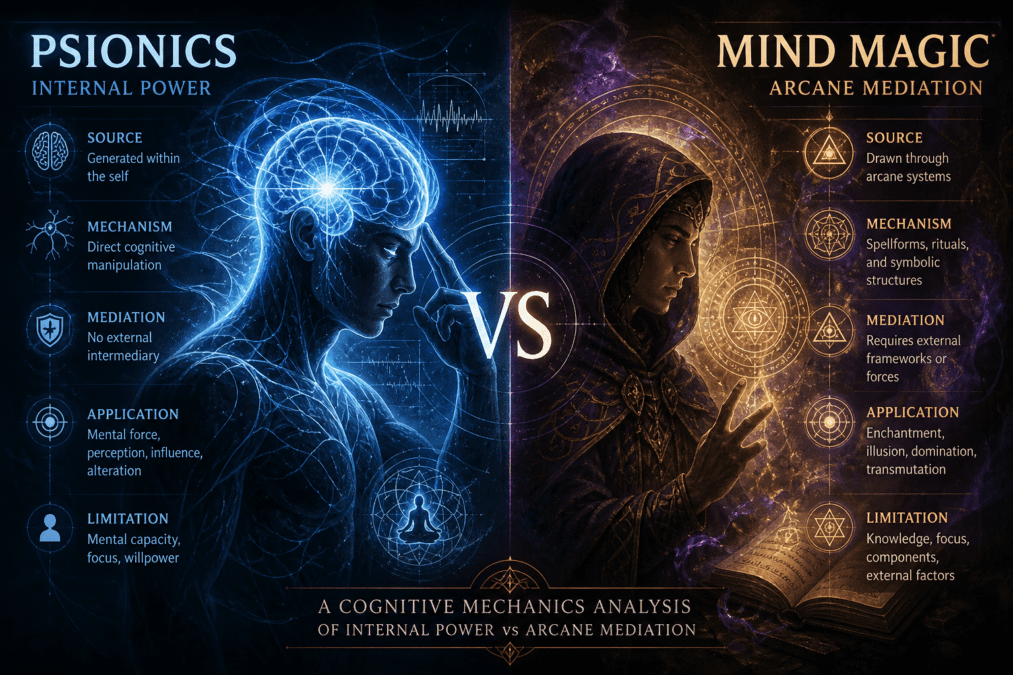
Psionics vs mind magic represents one of the most persistent conceptual divides in speculative systems of power. Psionics is typically defined as the use of mental energy generated internally by the mind—abilities like telepathy, telekinesis, and precognition arising from cognitive discipline. Mind magic, by contrast, refers to externally structured arcane systems that manipulate thought, emotion, or perception through spells, rituals, or symbolic frameworks.
This comparison examines psionics vs mind magic through a multi-layered analytical lens: biological plausibility, systemic mechanics, behavioral implications, adaptability, and applied outcomes. Rather than treating them as interchangeable fantasy tropes, this study evaluates them as distinct operational models—one endogenous and neurological, the other exogenous and symbolic.
The central thesis is this: psionics vs mind magic is not simply a difference in ability, but a difference in origin, control architecture, and failure modes. While psionics offers precision and autonomy rooted in cognitive integrity, mind magic provides scalability and versatility through structured systems—at the cost of dependency and variability.
📊 Essential Comparative Metrics
| Comparison Factor | Occultation | Eclipse |
|---|---|---|
| Definition | Occurs when one celestial body completely blocks another from the observer’s view | Occurs when one celestial body moves into the shadow of another |
| Core Mechanism | Line-of-sight obstruction | Shadow projection (umbra and penumbra) |
| Number of Bodies Involved | Usually 2 (foreground and background object) | Always 3 (light source, blocker, and target) |
| Role of Light | Light is directly blocked | Light is partially or fully shadowed |
| Alignment Precision | Extremely precise alignment required | High but less strict than occultation |
| Visibility Range | Very narrow, location-specific | Wide geographic visibility (especially partial eclipses) |
| Duration | Usually very short (seconds to minutes) | Can last from minutes to several hours |
| Common Examples | Moon occulting a distant star or planet | Solar eclipse, lunar eclipse |
| Scientific Applications | Measuring आकार, atmospheres, rings, and الدقيقة orbital data | Studying solar corona, Earth’s shadow, and orbital dynamics |
| Observation Difficulty | Harder; requires precise timing and instruments | Easier; often visible to the naked eye (with protection) |
| Frequency | More frequent but less noticeable | Less frequent but widely observed |
| Visual Impact | Subtle or invisible without उपकरण | Highly dramatic and visually striking |
| Dependence on Observer Position | Critical; small shifts change visibility | Important but covers larger regions |
Structural And Biological Foundations
At the structural level, psionics vs mind magic diverges fundamentally in how power is generated and sustained. Psionics is conceptualized as an extension of cognitive function—an amplification of neural processes into actionable force. In speculative frameworks, this often aligns with heightened brain activity, advanced neural coherence, or latent evolutionary traits.
Mind magic, in contrast, is not biologically inherent. It operates through symbolic systems—languages of power, ritualistic gestures, and codified knowledge structures. The practitioner acts as an intermediary, channeling external energies rather than producing them internally.
This distinction has significant implications. Psionics is constrained by the limits of the mind—attention span, emotional stability, and neurological endurance. Mind magic is constrained by access to knowledge, environmental conditions, and the integrity of its symbolic systems.
While psionics depends on internal cognitive architecture, mind magic relies on external frameworks that can be learned, modified, or disrupted. This makes psionics more consistent but less scalable, and mind magic more flexible but less predictable.
Behavioral Patterns And Social Intelligence
The behavioral implications of psionics vs mind magic reveal deeper differences in how practitioners interact with their environment and others. Psionic users tend to exhibit introspective, disciplined behavioral patterns. Their abilities require sustained focus, emotional regulation, and mental clarity, fostering a form of cognitive minimalism.
Mind magic practitioners, on the other hand, often engage in externalized behaviors—ritual preparation, symbolic manipulation, and collaborative learning. Their power is not tied to personal mental state alone but to their mastery of systems and their ability to navigate complex rule sets.
Socially, psionic users may develop heightened empathy or awareness due to telepathic or perceptual abilities. However, this can also lead to isolation, as constant cognitive input becomes overwhelming. Mind magic users are more likely to operate within communities—guilds, schools, or traditions—where knowledge is shared and refined.
Coupe vs Sedan: Why Body Stiffness and Rear Headroom Define Two Different Driving Philosophies
In psionics vs mind magic, the former emphasizes individual mastery and internal discipline, while the latter encourages collective knowledge and external engagement. This shapes not only how power is used but how it is understood and transmitted across generations.
Subject A: Strengths And Constraints (Psionics)
Psionics offers a unique set of strengths rooted in autonomy and precision. Because it originates internally, psionic ability is always accessible—no tools, incantations, or external energy sources are required. This makes it highly reliable in dynamic or constrained environments.
One of the key advantages in psionics vs mind magic is immediacy. Psionic actions can be executed as quickly as a thought, allowing for rapid response and fine-tuned control. This is particularly valuable in scenarios requiring stealth, subtlety, or real-time adaptation.
However, these strengths come with significant constraints. Psionics is limited by cognitive bandwidth. Prolonged use can lead to mental fatigue, decreased accuracy, or complete shutdown. Additionally, emotional instability can disrupt performance, making psychological resilience a critical factor.
Another limitation is scalability. While a psionic user may achieve remarkable feats, their power ceiling is inherently tied to their mental capacity. There is no external reservoir to draw from, no ritual to amplify output beyond personal limits.
In summary, psionics excels in precision, reliability, and independence—but struggles with endurance and expansion.
Subject B: Strengths And Constraints (Mind Magic)
Mind magic operates on a fundamentally different principle: the externalization of power through structured systems. This allows for a broader range of effects, from illusion and mind control to memory alteration and emotional manipulation.
The primary strength in psionics vs mind magic for this category is versatility. Mind magic can be scaled through knowledge—more complex spells, larger rituals, and collaborative casting can dramatically increase output. This makes it suitable for large-scale applications and long-term manipulation.
Additionally, mind magic is not limited by the practitioner’s mental endurance alone. External energy sources, artifacts, or environmental conditions can supplement or even replace personal effort.
However, this flexibility introduces vulnerability. Mind magic is dependent on correct execution. Errors in incantation, disruption of rituals, or interference with symbolic components can lead to failure or unintended consequences.
There is also a latency factor. Unlike psionics, which can be instantaneous, mind magic often requires preparation—time to cast, gather resources, or align conditions.
In psionics vs mind magic, mind magic offers breadth and amplification, but at the cost of immediacy and reliability.
Comparative Advantages In Real-World Scenarios
When applied to practical scenarios, the differences in psionics vs mind magic become more pronounced. In high-pressure environments—combat, negotiation, or crisis response—psionics holds a clear advantage. Its speed and independence allow for rapid decision-making and execution without reliance on external factors.
In contrast, mind magic excels in controlled environments. Strategic planning, long-term influence, and large-scale manipulation are domains where its structured approach provides significant leverage. A well-prepared mind magic practitioner can orchestrate outcomes far beyond the reach of a single psionic user.
In stealth operations, psionics again proves superior due to its subtlety. There are no visible cues or audible components, reducing the risk of detection. Mind magic, unless highly refined, often leaves traces—visual effects, spoken words, or ritual artifacts.
However, in scenarios requiring sustained output or area-wide effects, mind magic dominates. Its ability to draw on external resources and scale through complexity makes it more suitable for prolonged engagements.
Ultimately, psionics vs mind magic is context-dependent: one thrives in immediacy and isolation, the other in preparation and expansion.
Scientific And Expert Consensus (2026)
From a speculative science perspective, psionics vs mind magic aligns with two different models of power: endogenous cognitive extension versus exogenous symbolic manipulation. Modern interpretations often frame psionics as a hypothetical extension of neuroscience—an exploration of what the brain could achieve under extreme conditions.
Mind magic, by contrast, is increasingly analyzed through the lens of semiotics and systems theory. It represents a rule-based manipulation of reality, where symbols and structures encode functional outcomes.
Current expert consensus suggests that psionics vs mind magic should not be viewed as competing systems but as complementary paradigms. Each addresses different limitations: psionics minimizes dependency but limits scale, while mind magic maximizes potential but introduces complexity.
There is also growing interest in hybrid models—systems where internal cognitive control interfaces with external symbolic frameworks. These models aim to combine the precision of psionics with the scalability of mind magic.
Final Synthesis And Verdict
The comparison of psionics vs mind magic ultimately reveals a deeper philosophical divide: self-contained mastery versus system-mediated power.
Psionics is elegant, immediate, and self-reliant. It represents the ideal of internal perfection—power derived from discipline, clarity, and mental strength. Its limitations are personal but predictable.
Mind magic is expansive, adaptable, and collaborative. It embodies the idea that power can be constructed, shared, and amplified through knowledge. Its limitations are systemic and often unpredictable.
Direct Answer (Featured Snippet Style):
Psionics vs mind magic differs primarily in origin and execution: psionics is internally generated mental power enabling fast, precise actions, while mind magic relies on external systems like spells and rituals, offering greater versatility and scale but requiring preparation and introducing variability in outcomes.
The verdict is not a matter of superiority but suitability. In environments where speed, precision, and independence are critical, psionics is unmatched. In contexts demanding scale, flexibility, and long-term influence, mind magic becomes indispensable.
Frequently Asked Questions
Is psionics more powerful than mind magic?
Not inherently. In psionics vs mind magic, power depends on context. Psionics is more efficient in immediate, high-focus situations, while mind magic can surpass it in large-scale or prepared scenarios due to its ability to amplify effects through external systems.
Can psionics and mind magic coexist?
Yes, and many advanced frameworks explore hybrid systems. Combining internal cognitive control with external symbolic amplification allows practitioners to mitigate the weaknesses of each approach, creating a more balanced and adaptable power structure.
Which is easier to learn: psionics or mind magic?
Mind magic is generally more accessible initially because it relies on structured learning—rules, spells, and repeatable processes. Psionics requires deep mental discipline and self-awareness, making its learning curve steeper but more intuitive over time.
Why is psionics considered more reliable?
Because it is self-contained. In psionics vs mind magic, psionics does not depend on external conditions, tools, or correct execution of rituals. Its reliability stems from direct control, though it is still limited by the user’s mental state and endurance.