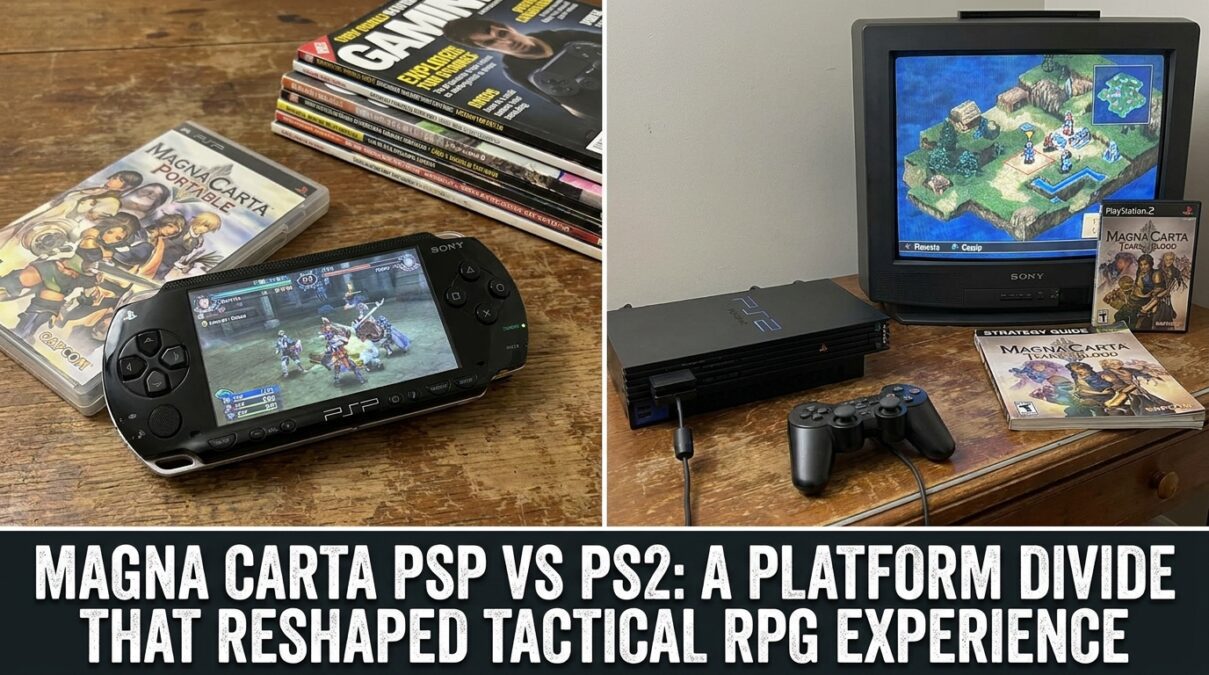

The comparison between magna carta psp vs ps2 sits at an interesting intersection of platform capability, player expectation, and evolving RPG design philosophy. Both versions stem from the same core intellectual property—Magna Carta: Tears of Blood on PlayStation 2 and Magna Carta: Portable on PlayStation Portable—yet they diverge in execution in ways that go beyond simple graphical downgrades or portability adjustments.
To analyze magna carta psp vs ps2, this study uses a multi-layered framework: technical architecture, gameplay systems, narrative delivery, and player interaction patterns. Rather than treating the PSP version as a “scaled-down” variant, this comparison evaluates both as distinct interpretations shaped by hardware limitations and user context.
The core insight is this: magna carta psp vs ps2 is not a simple case of one version being superior—it is a case of design trade-offs. The PS2 version prioritizes depth and immersion, while the PSP version emphasizes accessibility and portability. This divergence ultimately reflects two different philosophies of RPG consumption in the mid-2000s era.
📊 Essential Comparative Metrics
| Category | Magna Carta PS2 | Magna Carta PSP |
|---|---|---|
| Game Title | Magna Carta: Tears of Blood | Magna Carta: Portable |
| Platform Type | Home Console (PlayStation 2) | Handheld (PlayStation Portable) |
| Graphics Quality | Higher polygon models, detailed textures | Reduced textures, optimized visuals |
| World Design | Open-feeling zones with deeper exploration | Segmented areas with faster navigation |
| Combat System | Complex Chi-based tactical combat | Simplified and faster-paced combat |
| Learning Curve | Steep, requires system mastery | Moderate, easier to pick up |
| Storytelling Depth | More cinematic, longer cutscenes | Condensed narrative delivery |
| Session Length | Designed for long play sessions | Optimized for short sessions |
| Controls | Full controller complexity | Limited buttons, simplified controls |
| Audio Quality | Higher quality voice and sound design | Compressed audio due to hardware limits |
| Portability | Not portable | Fully portable |
| Replay Value | High due to depth and strategy | Moderate due to streamlined systems |
| Performance Stability | Stable with occasional load times | Smoother transitions, lighter load |
| Target Player Type | Hardcore RPG players | Casual to mid-core players |
| Overall Experience | Deep, immersive RPG | Accessible, flexible RPG |
Structural And Biological Foundations
In the context of magna carta psp vs ps2, “structural foundations” refer to the underlying hardware ecosystems that shaped each version. The PS2’s architecture allowed for larger environments, more detailed character models, and layered combat mechanics that required real-time decision-making across multiple variables.
The PSP, by contrast, was engineered for efficiency and portability. This meant reduced memory allocation, lower polygon counts, and simplified AI routines. However, these constraints did not merely limit the experience—they reshaped it. Developers optimized systems to ensure smoother performance within shorter play sessions.
A definition-level insight: Magna Carta PS2 is a console-based tactical RPG designed for extended, immersive sessions, while Magna Carta PSP is a handheld adaptation structured for intermittent, accessible gameplay.
While the PS2 version builds complexity through scale, the PSP version builds engagement through pacing efficiency.
Behavioral Patterns And Social Intelligence
Player behavior shifts significantly in magna carta psp vs ps2, largely due to how each platform is used. PS2 players typically engage in longer, uninterrupted sessions, allowing for deeper strategic planning and narrative absorption.
On the PSP, gameplay becomes fragmented. Players often interact with the game in transit, during short breaks, or in less controlled environments. This forces the design to adapt—menus are quicker, combat is more forgiving, and progression is streamlined.
This creates a subtle but important difference in “player intelligence expression.” On PS2, mastery comes from understanding layered mechanics over time. On PSP, mastery comes from efficiency—making optimal decisions quickly within limited windows.
The result is that magna carta psp vs ps2 reflects not just two systems, but two cognitive engagement styles: deep focus versus adaptive responsiveness.
Subject A: Strengths And Constraints (PS2 Version)
The PS2 version of magna carta psp vs ps2 excels in delivering a fully realized RPG experience. Its strengths lie in its expansive world-building, intricate combat system, and cinematic storytelling. The Chi system, which governs combat interactions, offers a level of strategic depth rarely seen in its era.
Visually, the game benefits from larger environments and more detailed character animations. This enhances immersion and allows players to feel embedded within the narrative world.
However, these strengths come with constraints. The complexity can be overwhelming for new players, and the pacing may feel slow by modern standards. Additionally, the requirement for long play sessions limits accessibility for players with time constraints.
In essence, the PS2 version prioritizes depth over convenience—a design choice that defines its identity within magna carta psp vs ps2.
Valedictorian vs Salutatorian: Why Academic Rank Alone Fails to Predict Long-Term Achievement
Subject B: Strengths And Constraints (PSP Version)
The PSP version reinterprets magna carta psp vs ps2 through the lens of portability. Its greatest strength is accessibility. Combat systems are streamlined, menus are simplified, and progression is faster, making it easier for players to engage without long commitments.
The portability factor cannot be overstated. Being able to play a narrative-driven RPG on the go was a significant advantage at the time of release. This aligns with broader trends in handheld gaming, where convenience often outweighs depth.
However, this comes at a cost. The reduction in graphical fidelity and system complexity can make the experience feel less rich. Narrative elements are condensed, and some strategic layers are removed.
Still, within its constraints, the PSP version succeeds in delivering a coherent and enjoyable RPG experience—one that complements rather than replaces the PS2 version in magna carta psp vs ps2.
Comparative Advantages In Real-World Scenarios
When evaluating magna carta psp vs ps2 in practical contexts, the choice often depends on player lifestyle.
For players seeking immersion, the PS2 version offers a more rewarding experience. Its depth allows for long-term engagement, making it ideal for dedicated gaming sessions at home.
For players with limited time or mobile lifestyles, the PSP version provides a more flexible alternative. Its design supports quick sessions without sacrificing overall progression.
A direct answer: In real-world usage, Magna Carta PS2 is better suited for deep, uninterrupted gameplay, while Magna Carta PSP is optimized for short, flexible sessions—making each version superior depending on the player’s time availability and gaming environment.
This situational superiority is what makes magna carta psp vs ps2 a uniquely balanced comparison.
Scientific And Expert Consensus (2026)
Modern retrospective analysis of magna carta psp vs ps2 tends to frame the comparison within broader industry trends. Experts generally agree that the PS2 version represents the “complete” experience, while the PSP version demonstrates effective adaptation under constraint.
Game design scholars highlight the PSP version as an early example of successful system compression—retaining core mechanics while removing non-essential complexity. Meanwhile, the PS2 version is often cited for its ambitious combat system and narrative scope.
The consensus is not about superiority but about intent. Each version achieves its design goals within its platform limitations.
This reinforces the idea that magna carta psp vs ps2 is less about competition and more about complementary design philosophies.
Final Synthesis And Verdict
The comparison of magna carta psp vs ps2 ultimately reveals a deeper truth about game design: platform defines experience. The PS2 version delivers depth, immersion, and complexity, making it the definitive choice for players seeking a traditional RPG experience.
The PSP version, however, redefines accessibility. It transforms the same core concept into a format that fits modern, mobile lifestyles—without completely sacrificing identity.
While the PS2 version offers more content and complexity, the PSP version offers more flexibility and convenience. Neither is objectively superior; each excels within its intended context.
The final verdict: magna carta psp vs ps2 is a study in adaptation rather than competition—an example of how the same game can evolve into two distinct experiences shaped by hardware, design philosophy, and player behavior.
❓ Frequently Asked Questions
Is Magna Carta PSP the same game as PS2?
Not exactly. While both share the same core narrative and characters, the PSP version modifies gameplay systems, pacing, and presentation to fit handheld limitations.
Which version is better for new players?
The PSP version is generally more approachable due to simplified mechanics and shorter session design, making it easier for beginners.
Does the PS2 version have more content?
Yes, the PS2 version offers more detailed environments, deeper combat systems, and richer narrative elements.
Why is the comparison between magna carta psp vs ps2 still relevant?
Because it highlights how game design adapts across platforms, offering insight into the evolution of RPG mechanics and player engagement strategies.