
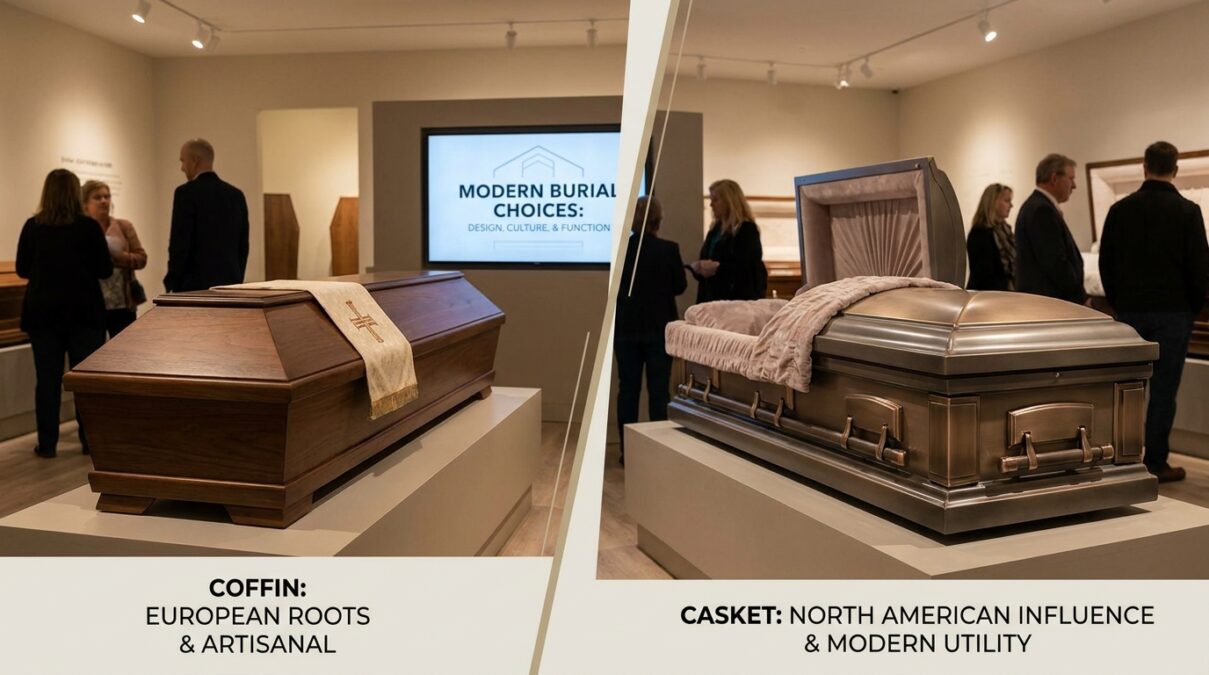

The coffin vs casket distinction is often misunderstood because many people use the two terms interchangeably. In funeral planning, however, they refer to two distinct burial container designs with different structural characteristics, cultural associations, and practical applications. A coffin traditionally features six sides with tapered contours that narrow at the head and foot, while a casket is rectangular with four straight sides and often includes split-lid construction.
Understanding the coffin vs casket comparison requires more than visual recognition. The decision often involves cultural expectations, funeral traditions, pricing structures, environmental considerations, and emotional preferences. What appears to be a simple terminology difference actually reflects centuries of shifting burial practices across societies.
The most surprising conclusion in any serious coffin vs casket analysis is that neither option is universally superior. Instead, the better choice depends on context. A coffin often aligns with tradition, simplicity, and ecological consciousness, while a casket tends to prioritize presentation, ceremonial visibility, and modern funeral customization. This comparative framework reveals why the coffin vs casket debate continues to matter for both consumers and funeral professionals.
Comparative Metrics: Coffin vs Casket Overview
| Feature | Coffin | Casket |
|---|---|---|
| Shape | Six-sided, tapered at head and foot | Rectangular, four straight sides |
| Design Purpose | Material efficiency and traditional form | Symmetry, presentation, and modern aesthetics |
| Historical Origin | Ancient burial traditions (Europe and beyond) | 19th-century North American funeral industry |
| Material Usage | Uses less wood or material | Uses more wood or metal |
| Cost Range | Lower to mid-range | Mid to high range |
| Lid Style | Single full lid | Often split lid (half-open viewing) |
| Customization | Limited customization options | Highly customizable (interior, finish, hardware) |
| Weight | Lighter | Heavier (especially metal types) |
| Environmental Impact | More eco-friendly (especially biodegradable types) | Less eco-friendly unless specially designed |
| Cultural Usage | Common globally | Common in the United States and Canada |
| Viewing Suitability | Less suited for open viewing | Designed for open-casket funerals |
| Production Style | Often handcrafted or simple builds | Industrial, standardized manufacturing |
Structural And Biological Foundations
A coffin is a burial container with six sides that taper toward the top and bottom, designed for material efficiency and historical practicality. A casket is a rectangular burial container built for visual symmetry, structural reinforcement, and ceremonial display.
The structural differences in the coffin vs casket discussion stem from practical engineering choices. Coffins evolved during periods when wood conservation was important. Their tapered shape reduces material usage while still accommodating human anatomy. This made them efficient to produce and transport.
Caskets emerged during the industrialization of funeral services, particularly in North America. Their rectangular construction allows easier manufacturing through standardized dimensions and mechanized assembly processes. This shift transformed burial containers into consumer products rather than handcrafted necessities.
From a functional perspective, caskets often provide enhanced sealing mechanisms, reinforced handles, and decorative hardware. Coffins, meanwhile, frequently emphasize simplicity and direct functionality. In modern coffin vs casket comparisons, these structural distinctions influence durability, transportation logistics, and consumer perception.
The biological considerations are minimal after burial, since decomposition depends more heavily on burial conditions, soil composition, moisture levels, and embalming practices than on container shape alone.
Behavioral Patterns And Social Intelligence
The coffin vs casket choice reflects broader human behavioral patterns concerning death rituals, symbolism, and social identity.
Burial practices serve psychological and communal functions. Families often select containers based not only on budget but also on cultural signaling. A casket may symbolize formality, dignity, and polished presentation, particularly during open-casket services. Coffins often communicate simplicity, authenticity, and closeness to traditional burial customs.
Social expectations influence decision-making significantly. In regions where caskets dominate funeral culture, selecting a coffin may appear unconventional. Conversely, in countries where coffins remain standard, choosing a casket can seem unnecessarily elaborate.
Consumer psychology research consistently shows that grief affects purchasing behavior. Under emotional stress, people often gravitate toward familiar options presented by funeral directors. This means the coffin vs casket decision is frequently shaped by presentation context rather than independent evaluation.
Interestingly, younger generations increasingly prioritize environmental sustainability and personalized ceremonies. This has revived interest in simpler coffin designs made from biodegradable materials such as bamboo, wicker, or untreated pine.
While caskets often dominate modern commercial funeral environments, coffins align more closely with emerging minimalist and ecological burial philosophies.
Coffin: Strengths And Constraints
The strongest advantage in the coffin vs casket comparison for coffins is efficiency.
Because coffins taper at both ends, they require less raw material. This often translates into lower manufacturing costs and reduced environmental impact. For families seeking affordability without sacrificing dignity, this structural efficiency can be compelling.
Coffins also carry deep historical resonance. They connect contemporary burial practices with centuries of tradition across Europe, Asia, and parts of Africa. Their familiar silhouette often evokes solemnity and authenticity.
Green burial compatibility is another major strength. Many natural burial providers recommend biodegradable coffins constructed without metal fittings, synthetic linings, or chemical treatments.
Transport efficiency also matters. Coffins’ narrower dimensions can simplify handling in constrained burial spaces.
However, the coffin format has constraints. It offers fewer customization options compared to caskets. Interior padding, split viewing lids, decorative hardware, and luxury finishes are less common.
In regions where caskets dominate funeral homes, coffin availability may be limited. This can reduce consumer choice or increase special-order costs.
Another challenge in the coffin vs casket discussion is perception. Some consumers associate coffins with austerity or lower status, despite their historical legitimacy and practical benefits.
Coupe vs Sedan: Why Body Stiffness and Rear Headroom Define Two Different Driving Philosophies
Casket: Strengths And Constraints
A casket’s primary advantage lies in presentation.
The rectangular design provides expansive interior space, enabling plush upholstery, elaborate detailing, and visually balanced arrangements during memorial viewings. In open-casket ceremonies, split-lid designs allow upper-body viewing while maintaining lower-body coverage, enhancing presentation control.
The coffin vs casket debate often favors caskets for ceremonial functionality. Funeral directors frequently prefer caskets because they integrate smoothly into standardized service workflows involving display stands, transport systems, and chapel layouts.
Customization possibilities are extensive. Buyers can select metal finishes, engraved panels, embroidered interiors, themed designs, and premium hardware. This flexibility supports personalized memorialization.
Structural rigidity is another benefit. The rectangular frame can provide increased reinforcement, particularly in premium steel or bronze models.
Yet caskets have limitations.
They generally cost more due to greater material requirements and decorative enhancements. The rectangular form uses additional wood or metal, increasing production expense.
Environmental concerns are substantial. Metal caskets and chemically treated woods may hinder natural decomposition and conflict with green burial principles.
Storage and transport also require more space.
In many coffin vs casket evaluations, caskets excel in ceremony and customization but lag behind coffins in sustainability and cost efficiency.
Comparative Advantages In Real-World Scenarios
The practical answer to coffin vs casket depends entirely on situational priorities.
For traditional family funerals emphasizing ceremony, visitation, and polished presentation, caskets often offer clear advantages. Their design supports open-viewing services and aligns with expectations in many North American funeral settings.
For environmentally conscious burials, coffins frequently outperform caskets. Simpler materials and biodegradable construction support natural burial requirements.
For budget-sensitive planning, coffins usually provide stronger value. Lower material use and simpler construction reduce costs without compromising core burial functionality.
For international transport or culturally specific rituals, local customs become decisive. In many regions, coffins remain the default standard.
When aesthetics matter most, caskets often prevail because they offer more decorative refinement.
When authenticity and historical continuity matter, coffins carry greater symbolic weight.
A direct answer to the coffin vs casket question is this: if your priority is ceremonial display and customization, choose a casket; if your priority is simplicity, sustainability, and tradition, choose a coffin.
This distinction explains why funeral planners increasingly present both as valid, context-dependent solutions.
Scientific And Expert Consensus (2026)
Professional funeral industry consensus increasingly frames the coffin vs casket decision as one of preference rather than performance.
Mortuary science experts generally agree that container shape has limited effect on decomposition timing. Soil chemistry, moisture exposure, oxygen levels, embalming, and vault use are much more significant variables.
Environmental researchers consistently identify biodegradable coffins as more compatible with ecological burial practices. This has influenced green cemetery regulations worldwide.
Funeral service organizations also note changing consumer preferences. Demand for transparency in pricing and sustainable options has grown steadily since the early 2020s.
Design experts observe that caskets represent a highly industrialized approach to memorialization, while coffins preserve artisanal and regional traditions.
There is no evidence suggesting either container offers superior long-term preservation under standard burial conditions.
The strongest consensus point in modern coffin vs casket analysis is that informed consumer choice matters more than default convention. Families increasingly benefit from understanding practical distinctions before entering emotionally charged funeral planning environments.
Historical Evolution Of Burial Containers
The coffin vs casket distinction reflects broader shifts in societal attitudes toward death.
Coffins trace back thousands of years. Ancient Egyptian, Greek, and medieval European burial traditions all used tapered or anthropoid burial forms designed around the body.
The term “casket” gained popularity in the 19th century, particularly in the United States. Funeral directors intentionally adopted the word because it sounded gentler and less directly associated with death. “Casket” originally referred to decorative boxes for valuables.
This linguistic shift reflected a cultural effort to soften funeral language and professionalize death care services.
Industrial manufacturing accelerated casket adoption. Standardized rectangular construction suited factory production and transportation systems.
Meanwhile, coffin use persisted in many global regions where burial traditions remained less commercialized.
Today’s coffin vs casket terminology therefore captures more than shape differences. It reflects cultural history, industrial economics, and evolving emotional approaches to mortality.
Environmental Implications And Sustainability
Sustainability has dramatically changed the coffin vs casket conversation.
Traditional caskets often contain metals, varnishes, synthetic fabrics, and chemical treatments that slow decomposition and increase environmental burden.
Coffins, particularly natural wood or woven biodegradable versions, generally align better with conservation burial practices.
Natural burial advocates emphasize minimal intervention. In this framework, simple coffins support ecological reintegration.
The carbon footprint of production also matters. Caskets require greater material extraction and manufacturing energy.
However, not all caskets are environmentally problematic. Some manufacturers now produce eco-certified rectangular burial containers using sustainable woods and biodegradable linings.
Likewise, not all coffins are green if they contain treated lumber or synthetic interiors.
The key environmental takeaway in coffin vs casket analysis is material composition rather than shape alone.
Still, because coffin construction often favors simplicity, it remains more naturally suited to sustainable burial objectives.
Cost Analysis And Consumer Economics
Financial considerations frequently drive the coffin vs casket decision.
Entry-level coffins often cost substantially less because they use fewer materials and involve less decorative processing.
Caskets span a wider pricing spectrum. Basic models may remain accessible, but premium steel, bronze, or hardwood versions can become exceptionally expensive.
Funeral pricing psychology complicates consumer decisions. Families under emotional strain may equate higher price with greater respect, even when practical differences are minimal.
This creates vulnerability to overspending.
Economic researchers studying funeral purchasing behavior emphasize pre-planning as the most effective strategy for rational decision-making.
Comparing itemized features rather than relying on showroom presentation helps consumers assess true value.
In most markets, the coffin vs casket price difference reflects aesthetics and customization rather than essential burial performance.
Final Synthesis And Verdict
After full analysis, the coffin vs casket comparison reveals two fundamentally different design philosophies.
Coffins prioritize efficiency, tradition, and often sustainability. Their tapered shape reflects centuries of practical burial craftsmanship.
Caskets prioritize presentation, customization, and ceremonial polish. Their rectangular form reflects industrial standardization and modern memorial service expectations.
Neither is objectively better.
If simplicity, environmental compatibility, and historical authenticity matter most, a coffin is often the stronger choice.
If visual presentation, personalization, and open-viewing functionality are top priorities, a casket offers distinct advantages.
The central lesson of the coffin vs casket debate is that informed choice matters more than convention. Understanding these distinctions empowers families to align burial decisions with values rather than assumptions.
Frequently Asked Questions
Is a coffin cheaper than a casket?
Usually yes. In most markets, coffins cost less because their tapered shape requires fewer materials and often involves simpler construction.
Why are caskets more common in the United States?
American funeral industry development favored rectangular manufacturing standardization, making caskets easier to mass-produce, display, and market.
Does a coffin decompose faster than a casket?
Not necessarily. Decomposition depends primarily on burial environment, material composition, and embalming practices rather than container shape.
Can a casket be environmentally friendly?
Yes, if constructed from biodegradable materials without chemical finishes or metal components. Shape matters less than composition.
Which is better for green burial: coffin or casket?
In most cases, coffins are preferred because they more commonly use simple biodegradable designs compatible with natural burial standards.