
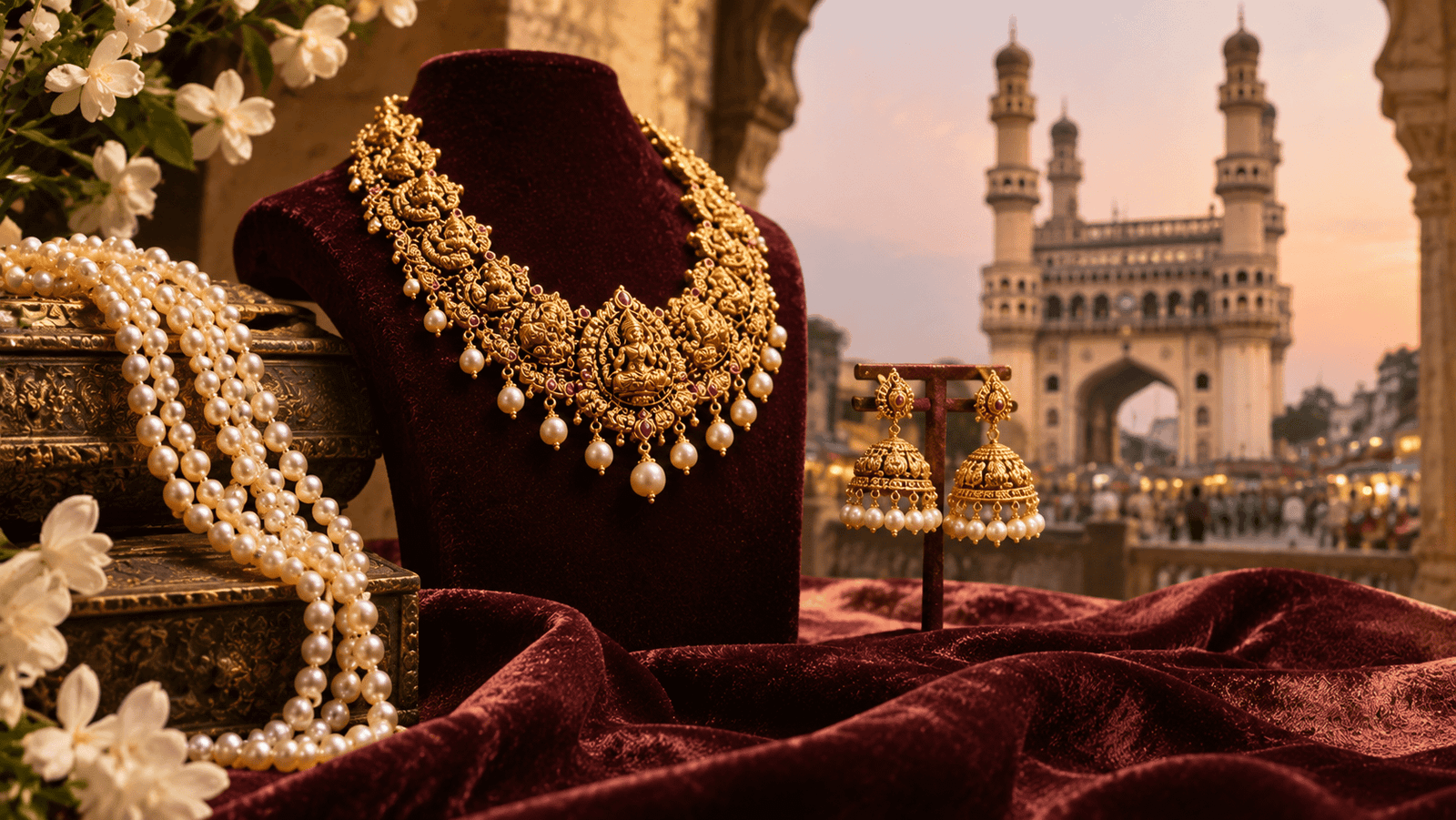
There is a special association of Hyderabad with ornaments. Gold and pearls have been an integral part of the identity of this city for many generations and have featured in collections of royalty, marriage rituals, family treasures, and even regular adornments. While the city enjoys fame as the “City of Pearls,” the association of this city with ornaments is not just confined to the act of purchasing and wearing them.s
How Hyderabad Became the City of Pearls
One fascinating feature about the history of pearl trade in Hyderabad was that the city never had a coastline or natural pearl fisheries at all. The image has been created by way of business and craftsmanship. Pearls emerged as an important item in the jewelry trade of Hyderabad during the times of the Qutb Shahi and later Asaf Jahi dynasties. The Nizams and previous monarchs had great interest in precious stones and jewelry, and thereby pearls were demanded by royal courts and rich people. Pearls from areas such as the Persian Gulf, including Basra, were bought by merchants. Also some crafters and traders found their way to Hyderabad. Through time, pearls were chosen and sold from Hyderabad. This business contributed to the formation of the image of the city. Even now, there are signs of this historical business at the traditional markets of Charminar and Pathergatti. The tradition of Hyderabadi pearl jewellery grew from this combination of imported materials and local expertise. It is a reminder that a city's craft identity does not always depend on where a material is found. Sometimes, it develops through the people who know how to work with it.
The Craft Behind Every Pearl
While a pearl is relatively straightforward once it is ready, getting it ready to be worn requires experience. Before a pearl is put into place in the necklace or any other piece of jewelry, it should be assessed in terms of its size, shape, color, and lustre. Depending on the nature of the pearl and the type of design, the task could include drilling, sorting, cleaning, and stringing. The task of matching the pearls is very significant when it comes to multi-strand necklaces because any difference in size or color could have an impact on how the piece would look and hang. One of the reasons why pearl stringing is traditionally performed by professionals is the same. There are many styles of pearl jewellery that have been made traditionally in Hyderabad. Satlada, for instance, is a style of necklace that uses seven strings of pearls. Other types of jewellery use fewer strings of pearls with pendants and other embellishments using various stones. They usually combine the pearls with gold and gemstones into highly intricate designs that do not need one material. It is not just about making new pieces of jewellery. Restringing or fixing old ornaments allows people to keep their family heirlooms. This type of job is usually undervalued, but it plays a significant role in maintaining the tradition.
Gold and the Meaning of Jewellery in Family Traditions
Gold holds a special significance in the world of jewellery making in Hyderabad not only due to its look. For many communities in India, gold represents weddings, celebrations, religious festivals and family events. This precious metal is considered a valuable commodity that can be stored for decades and inherited by subsequent generations. In Hyderabad, there exists a rich tradition of jewellery made at the request of kings. One example is the Nizam jewellery collection. It contains a great number of necklaces, bracelets, bangles, earrings, armlets and other accessories made during the period from the eighteenth century until the first years of the twentieth century. The collection displays the fusion of artistic traditions, such as Deccani, Mughal and others. Finally, gold creates the basis for the combination of pearl and other types of gemstone ornaments. Gold can become a way of fastening pearls in a necklace, as well as of creating the decoration in combination with enamel or colorful stones. The continued interest in 22KT gold jewellery reflects the wider importance of gold in Indian family traditions. Its role is not restricted to elaborate ornaments. Chains, bangles, earrings and smaller pieces are also associated with gifting, celebrations and personal milestones.
From Royal Heirlooms to Modern Celebrations
Many of Hyderabad’s most famous jewellery forms have been traditionally linked with dressing styles prevalent amongst royalty and aristocracy. One such example of a jewellery form is that of satlada. This piece is characterized by its seven strings, which are made up of perfectly matched pearls and precious stones. However, with changing tastes, the same style is now evolving to accommodate contemporary needs. Cultured pearls, colored stones or removable pieces are just some of the ways through which the same design can now be worn. This change can also be seen in wedding jewellery. Families may still value traditional necklaces and elaborate gold ornaments, but the way they are selected and worn is changing. Some prefer a complete traditional look for the main ceremony, while others choose individual pieces that can be used again with different outfits. The idea of bridal jewellery set for wedding is therefore not limited to preserving an old style. It also involves deciding how traditional pieces fit into present-day celebrations. Jewellery made out of pearl has evolved in much the same way. It is increasingly hard to obtain natural pearls from Basra in bulk enough for creating fancy necklaces. Cultivated pearls from all over the world have entered into the marketplace, providing the jewellers and buyers with choices in terms of color, size and price range. The material may differ, but the design elements still bear the influence of Hyderabad.
A Tradition That Continues to Evolve
The link between Hyderabad and gold and pearls has been created through the practice of trade, royal patronage, migration, and many years of craft. Pearl jewelry of the city was not the result of local production of pearls but of the acquisition of skills needed for preparation and transformation of pearls into jewelry. As for gold, it has always been associated with traditions and special occasions. Market demands and trends have changed, but the significance of those materials has not disappeared. A pearl necklace can be used as an heirloom of marriage, and a gold piece can symbolize some personal event. All of these pieces can have some history beyond the time when they were first acquired. This is the reason why one should study jewelry history of Hyderabad. It is not only about jewels of the king and old market streets. It is about the materials, skills, and traditions that have been influencing people's use of jewelry for many years.