
Combining two countries into one trip always comes with a question: is there enough time to do both justice? With an 8 day Nepal Bhutan tour, the answer is yes, but only if your itinerary is well planned and your expectations are clear. These two countries sit close to each other on the map but feel very different once you are on the ground. Nepal is busy, layered, and full of contrasts. Bhutan is calm, preserved, and remarkably consistent in its look and feel. Together, they offer a travel experience that is hard to match anywhere else in Asia.
This post breaks down what an 8 day Nepal Bhutan tour actually looks like, what you will realistically see and do, what the trip costs, and whether it is the right choice for first-time visitors to the region.
What Does an 8 Day Nepal Bhutan Tour Actually Cover?
Most 8 day Nepal Bhutan tours divide the time roughly into four days per country, though the split can vary depending on the operator. A typical structure looks something like this.
Days one and two are spent in Kathmandu. You visit the main UNESCO World Heritage sites including Pashupatinath, Boudhanath, Swayambhunath, and the old royal palace at Patan or Bhaktapur. These two days give you a solid introduction to Nepali culture, religion, and daily life without feeling rushed.
Day three often includes a mountain flight or a short excursion to Nagarkot or Dhulikhel for Himalayan views before the afternoon flight to Bhutan. This is a highlight of the Nepal portion for many travelers. Seeing the Himalayan range from the air as you depart for Paro is an experience that sticks with you.
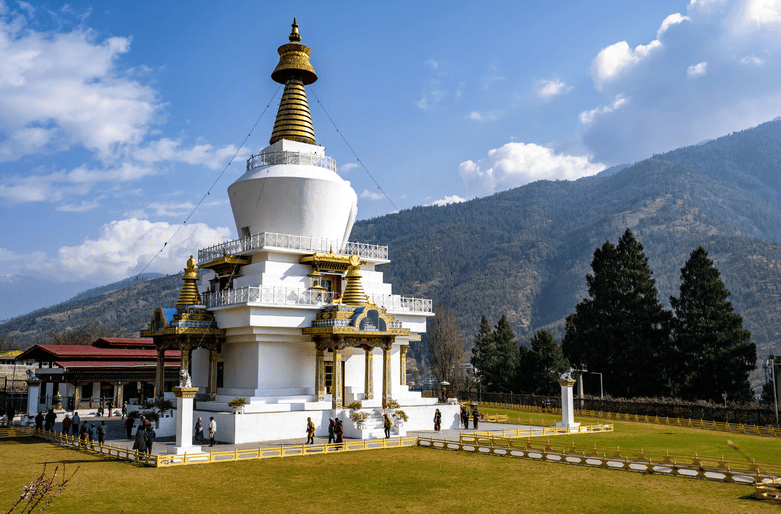
Days four through seven are spent in Bhutan, covering Paro, Thimphu, and Punakha. The Tiger's Nest monastery hike, Punakha Dzong, the Dochula Pass viewpoint, the National Memorial Chorten, and the weekend market in Thimphu are the standard highlights. Day eight is typically a departure day.
Is Eight Days Enough for Both Countries?
This is the question most people ask before booking, and the honest answer depends on what kind of traveler you are. If you like to move at a relaxed pace, linger in places, and explore beyond the main sites, eight days will feel a little tight. But if you are comfortable with a structured itinerary, enjoy organized touring, and are happy to see the highlights without deep exploration, eight days works very well.
The 8 day Nepal Bhutan tour is genuinely designed to give you the best of both countries in a single, manageable trip. It is not a rushed sampler. The key sites in both Kathmandu and Bhutan are close to each other and easy to visit in a short period without spending hours in transit every day.
What you will not have on this itinerary is time for longer trekking, remote areas, or off the beaten path experiences. Those things require a longer trip. But the cultural, architectural, and natural highlights of both countries are all very accessible within eight days.
How Much Does an 8 Day Nepal Bhutan Tour Cost?
Cost is one of the first practical considerations for this kind of combined trip. Nepal itself is relatively affordable for a destination of its significance. Hotels, food, and transport are reasonably priced and there is a wide range of options at different budget levels.
Bhutan is a different situation. The Bhutanese government requires all international tourists except those from India, Bangladesh, and the Maldives to pay a Sustainable Development Fee of USD 100 per person per night. This fee replaced the older minimum daily spend requirement in 2022 and is collected directly by the government. It covers the cost of conservation, free healthcare, and education for Bhutanese citizens.
On top of the daily fee, you will pay for your accommodation, meals, guide, transport, and flights. When you add everything together, an 8 day Nepal Bhutan tour including flights, hotels, guided touring, and all fees typically falls in the range of USD 2,500 to USD 4,000 per person depending on the quality of hotels and the season you travel.
This is not a budget trip. But for what the experience offers, most travelers who have done it say it is genuinely good value. Bhutan in particular is a country that stays with you long after you leave, and the controlled tourism model means it never feels overcrowded.
What Makes Nepal Worth Visiting First?
Nepal sets the tone for the trip in a way that Bhutan then deepens. Kathmandu is a city of contrasts: ancient temples next to modern shops, monks walking past motorbikes, and the sounds of chanting mixed with the noise of a busy Asian city. It is full of life and energy, and it gives you an immediate sense of how deeply religion shapes daily life in this part of the world.
The UNESCO World Heritage sites in the Kathmandu Valley are among the finest in Asia. Pashupatinath gives you an honest look at Hindu cremation rituals along the Bagmati river. Boudhanath is one of the largest Buddhist stupas in the world and a living place of worship, not just a monument. Bhaktapur's ancient Durbar Square is exceptionally well preserved and feels genuinely old in a way that many heritage sites do not.
For anyone interested in mountain views, Nepal delivers very well. A short morning mountain flight from Kathmandu shows you Everest and the entire central Himalayan range from the air. A drive to Nagarkot in the late afternoon gives you a wide ridge top view as the sun drops behind the hills. These are experiences that cannot be replicated anywhere else.
What Makes Bhutan Worth Visiting Second?
After the energy of Kathmandu, Bhutan feels like a very different kind of place. The capital Thimphu is small, clean, and quiet for a capital city. Traditional architecture is maintained across the country by law, so there are no glass towers or concrete blocks interrupting the visual character of towns and valleys. Driving through Bhutan feels like moving through a landscape that has been carefully looked after.
The Tiger's Nest hike is the centerpiece of any Bhutan visit and it earns its reputation. The trail climbs steadily through pine forest, passing prayer flags and small shrines, before the monastery comes into full view from a ridge across the gorge. The actual structure, built into the cliff face in the 17th century, is extraordinary to see in person. The hike takes around four to five hours at a comfortable pace and the views along the trail are consistently good.
Punakha Dzong is another highlight that photographs beautifully but is even better in person. Sitting at the junction of two rivers with mountains behind it, the fortress monastery has a calm grandeur that is hard to describe. If you visit in spring, the surrounding jacaranda trees bloom purple and the contrast with the white walls of the dzong is one of the best natural color combinations in Bhutan.
Who Is the 8 Day Nepal Bhutan Tour Best Suited For?
This itinerary works well for a wide range of travelers. Couples on a cultural honeymoon trip find that the combination of romance, scenery, and spiritual atmosphere suits them very well. First-time visitors to South Asia who want a structured introduction to the region benefit from having a guide take care of logistics in both countries. Photography enthusiasts find that eight days gives them enough variety to build a genuinely strong travel portfolio.
It is also well suited to older travelers or those who prefer a comfortable, organized experience without long travel days or rough accommodation. Both Nepal and Bhutan have very good mid-range and luxury hotels, and the main sites in both countries do not require extreme physical effort to reach, with the exception of the Tiger's Nest hike.
Travelers who want to trek for several days, visit remote areas of Bhutan like Haa Valley or Bumthang, or spend more time in the Himalayan foothills of Nepal would be better served by a longer itinerary. Ten to fourteen days is a much more comfortable length for a deeper experience of both countries.
Best Time to Book an 8 Day Nepal Bhutan Tour
October and November are the most popular months for this trip and for good reason. The monsoon has cleared, the air is clean, mountain views are clear, and the temperature is comfortable in both countries. March and April are also excellent, particularly for Bhutan where the rhododendrons are in full bloom and the spring light is very good for photography.
December and January are cold but clear, and visitor numbers are lower, which means quieter sites and sometimes better rates. June through September is monsoon season and while travel is still possible, mountain views are often blocked by cloud and rain is frequent.
Final Verdict: Is the 8 Day Nepal Bhutan Tour Worth It?
Yes, for most travelers the 8 day Nepal Bhutan tour is genuinely worth it. It delivers an experience that is culturally rich, visually varied, and logistically manageable. You leave with a real understanding of two very different Buddhist and Hindu traditions, you see some of Asia's finest mountain landscapes, and you visit places that have been carefully protected from the kind of mass tourism that has affected so many other destinations.
It is not a cheap trip and it is not a slow one. But if you are looking for a journey that gives you both depth and variety within a single week, this combination of two remarkable countries is one of the most rewarding options available in the region.