
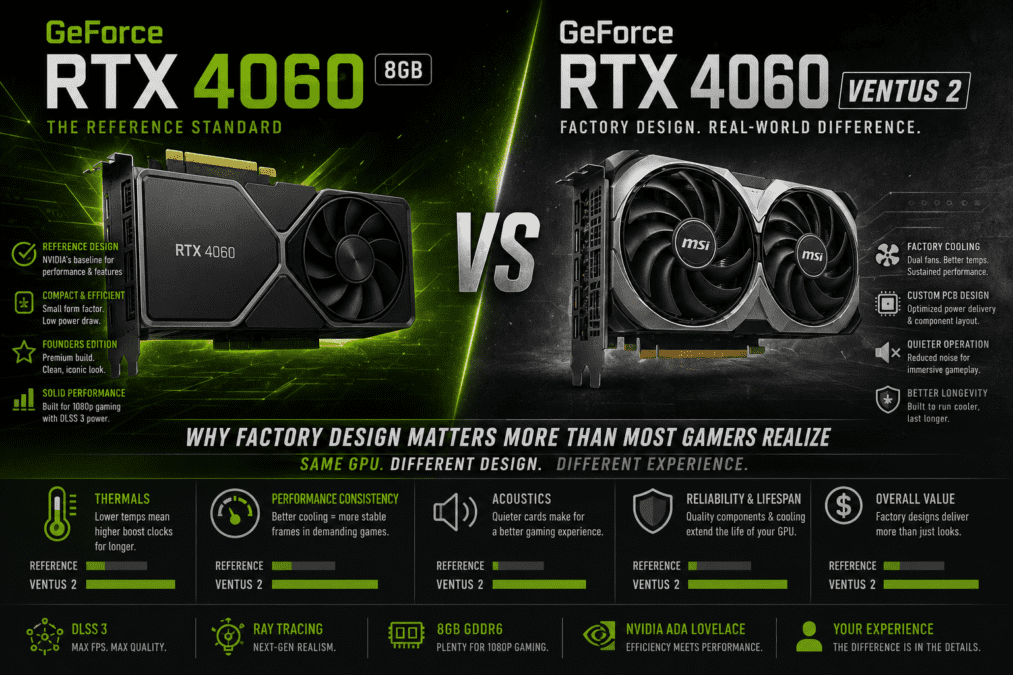

The geforce rtx 4060 8gb vs geforce rtx 4060 ventus 2 comparison appears straightforward at first glance because both graphics cards are built around NVIDIA’s RTX 4060 architecture. However, the reality is more nuanced. While the standard GeForce RTX 4060 8GB represents the underlying GPU specification, the GeForce RTX 4060 Ventus 2 is a specific board-partner implementation that introduces different cooling characteristics, power behavior, acoustic performance, and physical design considerations.
Understanding the geforce rtx 4060 8gb vs geforce rtx 4060 ventus 2 debate requires looking beyond core specifications. Many buyers focus exclusively on CUDA cores, VRAM capacity, and clock speeds, yet long-term ownership experience is often shaped by thermal efficiency, noise levels, durability, and factory engineering decisions. These factors can significantly influence gaming consistency and user satisfaction.
The central insight of this comparison is that performance differences between the two options are usually small, but operational differences can be meaningful. In many gaming systems, cooling design and board construction have a greater impact on daily experience than the minor clock speed variations typically highlighted in marketing materials.
Essential Specifications Comparison
| Attribute | GeForce RTX 4060 8GB Reference Specification | GeForce RTX 4060 Ventus 2 |
|---|---|---|
| GPU Architecture | Ada Lovelace | Ada Lovelace |
| VRAM | 8GB GDDR6 | 8GB GDDR6 |
| Memory Bus | 128-bit | 128-bit |
| CUDA Cores | 3,072 | 3,072 |
| Ray Tracing Cores | 3rd Generation | 3rd Generation |
| DLSS Support | DLSS 3 | DLSS 3 |
| Cooling System | Varies by manufacturer | Dual-Fan Ventus Thermal Design |
| Physical Size | Varies | Compact Dual-Fan Design |
| Power Consumption | Approximately 115W | Approximately 115W |
| Target Audience | Mainstream 1080p and 1440p Gaming | Mainstream 1080p and 1440p Gaming |
What Is the Difference Between GeForce RTX 4060 8GB and GeForce RTX 4060 Ventus 2?
The geforce rtx 4060 8gb vs geforce rtx 4060 ventus 2 comparison is fundamentally a comparison between a GPU specification and a manufacturer-specific implementation.
The GeForce RTX 4060 8GB refers to NVIDIA’s core GPU platform, including the AD107 processor, 8GB of GDDR6 memory, and Ada Lovelace technologies. The GeForce RTX 4060 Ventus 2 is MSI’s custom version of that GPU featuring a proprietary cooling solution, custom PCB design, and factory-tuned operating characteristics.
In simple terms, both cards deliver nearly identical core gaming capabilities, but the Ventus 2 differentiates itself through engineering, cooling efficiency, and physical construction.
Structural And Technical Foundations
When examining geforce rtx 4060 8gb vs geforce rtx 4060 ventus 2, the architectural foundation remains identical. Both products utilize NVIDIA’s Ada Lovelace platform, which emphasizes improved performance-per-watt, enhanced ray tracing capabilities, and DLSS 3 frame generation technology.
The AD107 processor at the heart of each card contains 3,072 CUDA cores and supports modern gaming workloads efficiently. NVIDIA’s architectural improvements allow these cards to deliver strong 1080p gaming performance while maintaining relatively low power consumption.
Where the distinction begins to emerge is in board-level implementation. The Ventus 2 introduces MSI’s thermal engineering approach, which includes dedicated heat dissipation pathways, optimized airflow management, and a dual-fan cooling system. Although these enhancements do not alter the GPU architecture itself, they can affect temperature stability during extended gaming sessions.
Consequently, the geforce rtx 4060 8gb vs geforce rtx 4060 ventus 2 discussion extends beyond raw specifications into the realm of practical system design.
Thermal Design And Cooling Performance
Cooling represents one of the most important differentiators in the geforce rtx 4060 8gb vs geforce rtx 4060 ventus 2 comparison.
Modern graphics cards increasingly rely on thermal efficiency to sustain boost frequencies. Although RTX 4060 GPUs consume relatively little power compared to high-end alternatives, cooling quality still influences long-term performance consistency.
The Ventus 2 employs a dual-fan configuration designed to balance airflow, acoustics, and compact dimensions. During extended gaming workloads, effective heat removal helps maintain stable boost clocks and reduces thermal fluctuations.
A generic GeForce RTX 4060 8GB model may use a variety of cooling systems depending on manufacturer and price tier. Some models perform exceptionally well, while entry-level variants may prioritize cost reduction over thermal optimization.
As a result, users evaluating geforce rtx 4060 8gb vs geforce rtx 4060 ventus 2 should pay close attention to cooling implementation rather than focusing exclusively on advertised clock speeds.
Gaming Performance Analysis
For pure gaming performance, the geforce rtx 4060 8gb vs geforce rtx 4060 ventus 2 matchup produces remarkably similar results.
Since both cards use the same GPU silicon and memory configuration, frame-rate differences are generally minor. Most modern titles show only small percentage variations that are unlikely to be noticeable during normal gameplay.
Popular esports games frequently exceed 144 FPS at 1080p settings, while demanding AAA titles remain highly playable with DLSS enabled. Ray tracing performance also remains largely equivalent because both cards rely on identical hardware acceleration resources.
The practical reality is that buyers should not expect dramatic FPS gains from choosing the Ventus 2. Instead, the advantage lies in operational refinement rather than outright gaming dominance.
Therefore, the geforce rtx 4060 8gb vs geforce rtx 4060 ventus 2 decision is less about speed and more about user experience.
GeForce RTX 4060 8GB: Strengths And Constraints
The standard GeForce RTX 4060 8GB platform offers several compelling advantages.
Its efficient Ada Lovelace architecture delivers strong performance-per-watt, making it an attractive option for mainstream gaming systems. DLSS 3 support extends longevity by improving frame rates in supported titles, while modest power requirements simplify installation in a wide variety of PCs.
Another major advantage is broad market availability. Consumers can select from numerous manufacturers and cooling designs, allowing greater flexibility across budgets.
However, this diversity also creates inconsistency. Not every implementation offers the same thermal performance, build quality, or acoustic characteristics. Buyers must carefully evaluate individual models rather than relying solely on GPU branding.
These factors represent the primary considerations within the broader geforce rtx 4060 8gb vs geforce rtx 4060 ventus 2 evaluation.
GeForce RTX 4060 Ventus 2: Strengths And Constraints
The Ventus 2 distinguishes itself through MSI’s emphasis on practicality and efficiency.
Its dual-fan cooling system provides dependable thermal management while maintaining a relatively compact footprint. This makes it suitable for mid-tower and smaller gaming systems where space constraints matter.
Build quality generally exceeds many budget-focused alternatives, and MSI’s reputation for thermal engineering contributes additional buyer confidence. Noise levels are often well-controlled under gaming workloads, improving overall system comfort.
The primary limitation is that performance gains remain modest because the underlying GPU remains unchanged. Users expecting substantial FPS improvements may be disappointed.
Thus, in the geforce rtx 4060 8gb vs geforce rtx 4060 ventus 2 comparison, the Ventus 2’s value proposition centers on refinement rather than revolutionary performance increases.
Comparative Advantages In Real-World Scenarios
Different users may reach different conclusions regarding geforce rtx 4060 8gb vs geforce rtx 4060 ventus 2.
For budget-conscious buyers, the lowest-priced RTX 4060 may represent the strongest value. If gaming performance is the only priority, spending extra on premium cooling may produce limited returns.
For long gaming sessions, however, the Ventus 2’s cooling design can offer tangible benefits. Lower operating temperatures may help sustain boost clocks more consistently while reducing fan noise.
Small-form-factor builders may also appreciate the Ventus 2’s compact dimensions. Meanwhile, users prioritizing reliability and balanced thermal behavior often favor reputable board-partner designs over entry-level alternatives.
This highlights the broader lesson of the geforce rtx 4060 8gb vs geforce rtx 4060 ventus 2 debate: the best choice depends on intended usage rather than benchmark numbers alone.
Scientific And Expert Consensus (2026)
Industry testing throughout 2025 and 2026 consistently demonstrates that RTX 4060 variants perform within a narrow margin of one another. Independent benchmarks typically reveal only small FPS differences among models sharing identical GPU configurations.
Experts generally agree that cooling quality, acoustic behavior, warranty support, and manufacturing standards should receive greater consideration than factory overclocks. Modern GPU boost algorithms already extract substantial performance from available hardware resources.
Consequently, the consensus surrounding geforce rtx 4060 8gb vs geforce rtx 4060 ventus 2 is that thermal engineering and ownership experience matter more than minor specification differences.
While benchmark charts often dominate discussions, real-world satisfaction frequently depends on quieter operation, lower temperatures, and consistent long-session performance.
Final Synthesis And Verdict
The geforce rtx 4060 8gb vs geforce rtx 4060 ventus 2 comparison reveals an important reality about modern graphics cards: GPU architecture alone does not determine ownership experience.
Both options provide nearly identical gaming performance because they share the same Ada Lovelace foundation, CUDA core count, memory capacity, and feature set. Frame-rate differences are typically minimal and rarely transformative.
The Ventus 2 earns its distinction through cooling efficiency, build quality, thermal consistency, and practical engineering decisions. Gamers seeking a quieter, more refined experience may find the premium worthwhile.
For buyers focused strictly on maximizing frames per dollar, any competitively priced RTX 4060 can be a strong option. For those valuing thermals, acoustics, and long-term usability, the Ventus 2 often represents the more balanced package.
In the end, the answer to geforce rtx 4060 8gb vs geforce rtx 4060 ventus 2 is not about which GPU is faster. It is about whether enhanced engineering justifies the additional investment for your specific gaming environment.
Frequently Asked Questions
Is there a performance difference between GeForce RTX 4060 8GB and GeForce RTX 4060 Ventus 2?
Yes, but it is usually small. Since both cards use the same RTX 4060 GPU, gaming performance differences are generally limited to minor variations caused by cooling efficiency and factory tuning.
Which card runs cooler in the GeForce RTX 4060 8GB vs GeForce RTX 4060 Ventus 2 comparison?
The Ventus 2 typically maintains better thermal control thanks to its dedicated dual-fan cooling design and optimized heatsink configuration.
Is the GeForce RTX 4060 Ventus 2 worth paying extra for?
For users who value quieter operation, stronger cooling, and consistent long-session performance, the additional cost can be justified. For pure FPS value, a lower-priced RTX 4060 may offer a better return.
Can both cards handle 1440p gaming?
Yes. Both the GeForce RTX 4060 8GB and GeForce RTX 4060 Ventus 2 can deliver solid 1440p gaming performance, especially when DLSS 3 is enabled in supported titles.