
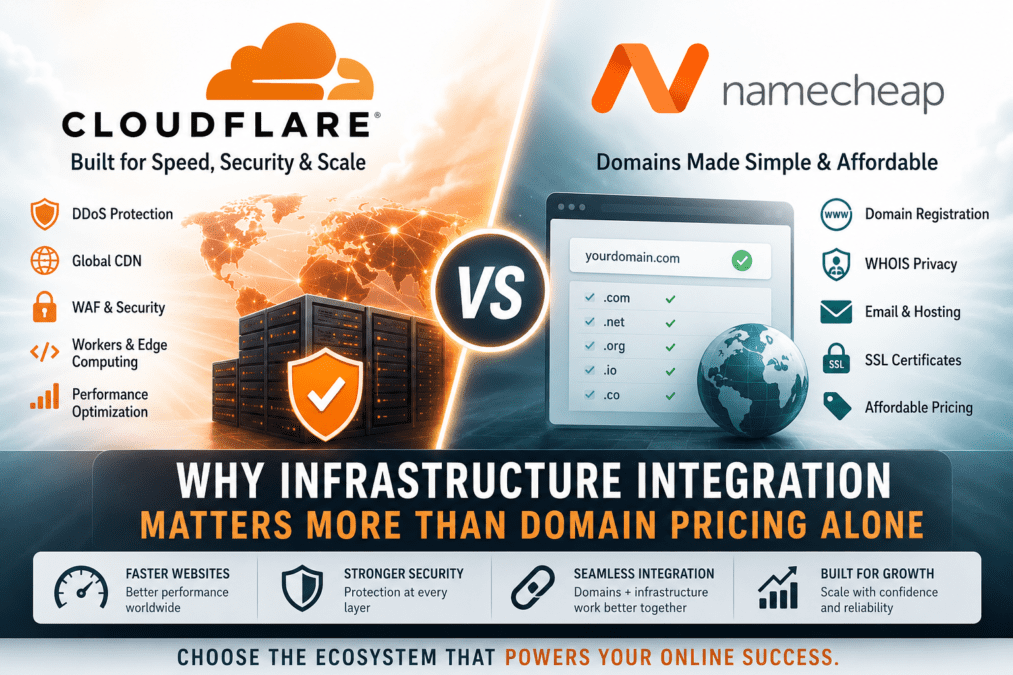

When businesses launch websites, one of the earliest decisions involves selecting a domain registrar and infrastructure provider. In many comparisons, cloudflare vs namecheap appears as a straightforward choice between two popular companies that offer domain-related services. However, the comparison is more complex than pricing tables or promotional discounts. Each platform approaches internet infrastructure from a fundamentally different perspective.
Namecheap began primarily as a domain registrar and expanded into hosting, email, security, and website-related services. Cloudflare, by contrast, built its reputation around content delivery networks, security architecture, traffic optimization, and edge computing before becoming a domain registrar. As a result, comparing cloudflare vs namecheap requires examining their underlying philosophies rather than simply comparing domain registration costs.
The central insight is that the most important difference is not who sells domains more cheaply. Instead, the decisive factor is whether a user prioritizes integrated internet performance and security infrastructure or prefers a traditional registrar ecosystem with broader consumer-oriented services. This distinction explains why both companies attract loyal users despite serving overlapping markets.
Essential Comparative Metrics
| Attribute | Cloudflare | Namecheap |
|---|---|---|
| Primary Focus | Internet infrastructure, CDN, security, DNS, edge computing | Domain registration, web hosting, email services |
| Founded | 2009 | 2000 |
| Core Business Model | Network performance and security platform | Domain registrar and hosting provider |
| Domain Registration | Available through Cloudflare Registrar | One of the world’s largest registrars |
| Domain Pricing Philosophy | Domains sold near wholesale cost | Competitive retail pricing with promotions |
| Free DNS Service | Industry-leading global DNS network | Reliable DNS management |
| DNS Performance | Among the fastest globally | Good but less infrastructure-focused |
| Content Delivery Network (CDN) | Extensive global CDN included | Limited native CDN capabilities |
| DDoS Protection | Advanced enterprise-grade protection | Basic to moderate protection |
| Web Application Firewall (WAF) | Comprehensive security features | Limited compared to Cloudflare |
| Bot Protection | Advanced bot detection and mitigation | Minimal native capabilities |
| Shared Hosting | Not a primary service | Major hosting product category |
| VPS Hosting | Not offered traditionally | Available |
| Dedicated Servers | No | Available in selected plans |
| Email Hosting | Limited offerings | Comprehensive email solutions |
| Website Builder | Not a major focus | Available for beginners |
| SSL Certificates | Strong SSL integration and management | Available for purchase and installation |
| Developer Tools | Extensive edge computing ecosystem | Limited developer-focused tools |
| Serverless Computing | Cloudflare Workers platform | Not a core offering |
| Global Infrastructure | Massive worldwide edge network | Traditional hosting infrastructure |
| Traffic Optimization | Core platform capability | Limited optimization features |
| Scalability | Excellent for high-traffic websites | Suitable for small to medium websites |
| Ease of Use | Moderate learning curve | Highly beginner-friendly |
| Best For | Developers, enterprises, high-performance websites | Bloggers, startups, small businesses |
| Customer Experience | Focused on infrastructure management | Focused on website ownership and management |
| Security Strength | Exceptional | Good for standard website needs |
| Performance Optimization | One of the strongest in the industry | Dependent on hosting environment |
| Ideal Use Case | Global websites requiring speed, security, and scalability | Affordable domain registration and website launching |
What Is Cloudflare?
Cloudflare is a global internet infrastructure platform that provides DNS services, content delivery, security protection, application acceleration, edge computing, and domain registration. Rather than focusing primarily on domain sales, Cloudflare aims to improve how websites perform and defend themselves across the internet.
A simple definition is that Cloudflare functions as an intermediary layer between users and websites, optimizing traffic while protecting digital assets from threats.
Many organizations evaluating cloudflare vs namecheap discover that Cloudflare’s registrar service represents only a small portion of its broader ecosystem. The company’s value proposition centers on performance enhancement, network intelligence, and cybersecurity rather than traditional hosting packages.
What Is Namecheap?
Namecheap is a domain registrar and web-services provider that offers domain registration, shared hosting, VPS hosting, email services, SSL certificates, and website-building tools.
In simple terms, Namecheap focuses on helping users acquire domains and launch websites through accessible and affordable services.
When discussing cloudflare vs namecheap, it is important to recognize that Namecheap was designed primarily around domain ownership and website deployment. This historical focus makes the platform particularly attractive to entrepreneurs, bloggers, freelancers, and small businesses seeking an all-in-one starting point.
Structural And Technological Foundations
The most significant distinction in cloudflare vs namecheap originates from infrastructure architecture. Cloudflare operates one of the world’s largest distributed edge networks, processing enormous volumes of internet traffic through globally distributed data centers. This architecture allows the platform to improve website speed, reliability, and resilience.
Namecheap’s infrastructure model follows a more traditional registrar-hosting approach. While highly capable for many use cases, its competitive advantage stems from service accessibility rather than global network scale.
Cloudflare’s architecture prioritizes traffic routing efficiency, threat mitigation, and application performance. Namecheap’s architecture prioritizes ease of ownership, hosting convenience, and affordable deployment. Neither approach is inherently superior; the better choice depends on operational goals.
This foundational difference influences nearly every aspect of the cloudflare vs namecheap comparison, including speed, scalability, security, and user experience.
Behavioral Patterns And Service Ecosystems
The behavior of each platform reflects its underlying business objectives. Cloudflare continuously expands into areas such as serverless computing, zero-trust security, application acceleration, and network optimization. Its ecosystem encourages users to centralize performance and security operations.
Namecheap exhibits a different growth pattern. The company expands around website ownership, domain management, hosting, email services, and small-business tools. Rather than becoming internet infrastructure itself, it focuses on making website deployment easier.
In practical terms, cloudflare vs namecheap resembles comparing a sophisticated network platform with a traditional digital-property management provider. While Cloudflare attempts to optimize the internet layer, Namecheap concentrates on simplifying website ownership.
This distinction affects purchasing decisions because users often select platforms based on future growth requirements rather than current functionality.
Wonton vs Dumpling: Why Wrapper Engineering And Cooking Method Create Fundamentally Different Foods
Cloudflare: Strengths And Constraints
Cloudflare’s greatest strength lies in infrastructure integration. Users gain access to powerful DNS management, content delivery services, caching systems, DDoS protection, web application firewall capabilities, and performance optimization tools through a unified environment.
Another major advantage in the cloudflare vs namecheap debate is Cloudflare’s registrar pricing philosophy. Domains are generally sold at cost rather than marked up significantly, which appeals to experienced users managing large portfolios.
Performance optimization represents another substantial benefit. Websites frequently experience faster loading speeds due to intelligent caching and traffic-routing technologies.
However, Cloudflare has limitations. Beginners may find the platform more technical than traditional registrars. Some advanced configurations require networking knowledge that casual website owners may not possess. Additionally, users seeking bundled hosting packages may discover that Cloudflare’s ecosystem differs from conventional hosting providers.
Therefore, Cloudflare excels when performance, scalability, and security outweigh simplicity.
Namecheap: Strengths And Constraints
Namecheap’s primary advantage is accessibility. New website owners can purchase domains, acquire hosting, configure email, and launch projects without navigating complex infrastructure concepts.
Affordability also contributes significantly to Namecheap’s popularity. Promotional pricing and beginner-focused packages reduce barriers to entry for startups and independent creators.
In the cloudflare vs namecheap discussion, customer convenience often becomes Namecheap’s strongest selling point. Many users appreciate the straightforward dashboard, integrated purchasing process, and broad service catalog.
Nevertheless, Namecheap faces limitations compared with infrastructure-focused competitors. Its global performance optimization capabilities are not as extensive as Cloudflare’s network architecture. Advanced traffic management, enterprise-scale security features, and edge-computing services are also less central to the platform.
As a result, Namecheap performs exceptionally well for website ownership and deployment, while Cloudflare often leads in infrastructure optimization.
Domain Registration Experience
Many users searching for cloudflare vs namecheap are primarily interested in domain registration. In this category, both companies perform strongly but for different reasons.
Cloudflare emphasizes transparent pricing and integration with its broader ecosystem. Users who already rely on Cloudflare’s DNS and security infrastructure may benefit from consolidating services within a single platform.
Namecheap emphasizes convenience and purchasing flexibility. The registration process is intuitive, and users often find additional services readily available during setup.
While Cloudflare focuses on operational efficiency and infrastructure integration, Namecheap focuses on customer accessibility and service packaging. This contrast explains why domain investors, developers, and businesses may arrive at different conclusions despite evaluating the same providers.
Security And Threat Protection Analysis
Security is one area where cloudflare vs namecheap becomes particularly interesting. Cloudflare has invested heavily in network-level defense mechanisms, including sophisticated DDoS mitigation, traffic filtering, bot management, and web application security.
Because Cloudflare operates at immense scale, it can analyze threat patterns across vast portions of internet traffic. This network visibility creates significant defensive advantages.
Namecheap provides valuable security services, including SSL certificates, privacy protections, and hosting-related safeguards. However, security is generally one component of a broader service portfolio rather than the platform’s defining feature.
Organizations concerned about large-scale attacks, performance degradation, or advanced threat mitigation often favor Cloudflare’s infrastructure-centric approach. Smaller websites with standard security requirements may find Namecheap’s offerings entirely sufficient.
Performance And Speed Considerations
Website speed affects user experience, search visibility, and conversion rates. Consequently, performance becomes a major factor in cloudflare vs namecheap evaluations.
Cloudflare’s CDN infrastructure distributes content across global locations, reducing latency and accelerating content delivery. Intelligent caching minimizes origin-server requests and improves responsiveness for visitors worldwide.
Namecheap can support fast websites through quality hosting environments, but performance optimization generally depends more heavily on hosting configurations and third-party enhancements.
While both platforms can contribute to successful websites, Cloudflare’s entire ecosystem is designed around reducing latency and improving delivery efficiency. This specialization frequently produces measurable performance advantages, particularly for websites serving geographically diverse audiences.
Comparative Advantages In Real-World Scenarios
The most useful way to understand cloudflare vs namecheap is through practical scenarios.
A first-time blogger launching a personal website often benefits from Namecheap’s simplicity. Domains, hosting, email, and website tools can be acquired quickly without extensive technical expertise.
A rapidly growing e-commerce business may benefit more from Cloudflare’s infrastructure capabilities. Enhanced performance, security protections, and scalability become increasingly important as traffic expands.
A developer building modern web applications may appreciate Cloudflare’s advanced platform features, including edge functions and programmable infrastructure.
A small local business with limited technical resources may prefer Namecheap’s straightforward management environment.
The answer to cloudflare vs namecheap therefore depends less on feature checklists and more on operational priorities.
Pricing Philosophy And Long-Term Value
Price comparisons often dominate discussions about cloudflare vs namecheap, but long-term value matters more than introductory costs.
Cloudflare frequently attracts cost-conscious domain owners because registrar pricing is based on a near-cost model. However, users may eventually invest in additional infrastructure features depending on operational requirements.
Namecheap offers attractive entry-level pricing and bundled services. For many small websites, these packages deliver excellent value because they simplify management and reduce setup complexity.
Over time, organizations should evaluate total ownership costs rather than isolated registration fees. Infrastructure efficiency, security benefits, operational convenience, and scalability can have larger financial impacts than annual domain pricing differences.
Therefore, the most economical option depends heavily on website objectives and growth expectations.
Scientific And Expert Consensus (2026)
Industry consensus in 2026 suggests that the cloudflare vs namecheap debate is not about determining a universal winner. Instead, experts increasingly frame the comparison as a question of infrastructure strategy.
Cloudflare is widely recognized for performance optimization, network security, traffic acceleration, and edge-computing innovation. Its influence extends beyond traditional registrar functions into broader internet architecture.
Namecheap remains highly respected for affordability, domain management, customer accessibility, and small-business support. The platform continues to serve millions of users seeking practical website deployment solutions.
Professional recommendations increasingly emphasize matching platform capabilities to organizational needs rather than pursuing a one-size-fits-all answer. This nuanced perspective reflects the growing complexity of modern web infrastructure.
Final Synthesis And Verdict
The most important conclusion from the cloudflare vs namecheap comparison is that these companies solve different problems despite competing in overlapping markets.
Cloudflare excels when security, performance, scalability, and infrastructure integration drive decision-making. Organizations expecting substantial growth or demanding advanced traffic management often benefit most from its ecosystem.
Namecheap excels when affordability, convenience, domain ownership, hosting accessibility, and ease of use take priority. Individuals and small businesses frequently find its approach more approachable.
A direct answer for most users is this: if your primary goal is launching and managing a website easily, Namecheap is usually the better starting point. If your primary goal is optimizing and protecting web infrastructure at scale, Cloudflare is generally the stronger choice.
Ultimately, the winner in cloudflare vs namecheap depends not on who offers more features, but on which platform aligns more closely with your operational objectives.
Frequently Asked Questions
Is Cloudflare cheaper than Namecheap for domains?
In many cases, Cloudflare’s registrar model offers extremely competitive pricing because domains are typically sold near wholesale cost. However, total value should be evaluated alongside infrastructure requirements and service needs.
Which is better for beginners: Cloudflare or Namecheap?
For most beginners, Namecheap is easier to understand and manage. The platform was designed around domain registration and website deployment, making onboarding more straightforward.
Can I use Namecheap domains with Cloudflare services?
Yes. Many website owners register domains through Namecheap while using Cloudflare for DNS management, performance optimization, and security protection.
Which platform is better for SEO?
Neither platform directly determines rankings. However, Cloudflare’s speed and performance optimizations can contribute positively to user experience metrics, while Namecheap provides reliable infrastructure for standard SEO requirements.
Should businesses choose Cloudflare or Namecheap in 2026?
Businesses focused on growth, security, and global performance often lean toward Cloudflare. Businesses prioritizing simplicity, affordability, and integrated website services often prefer Namecheap. The best decision depends on operational goals rather than brand popularity alone.