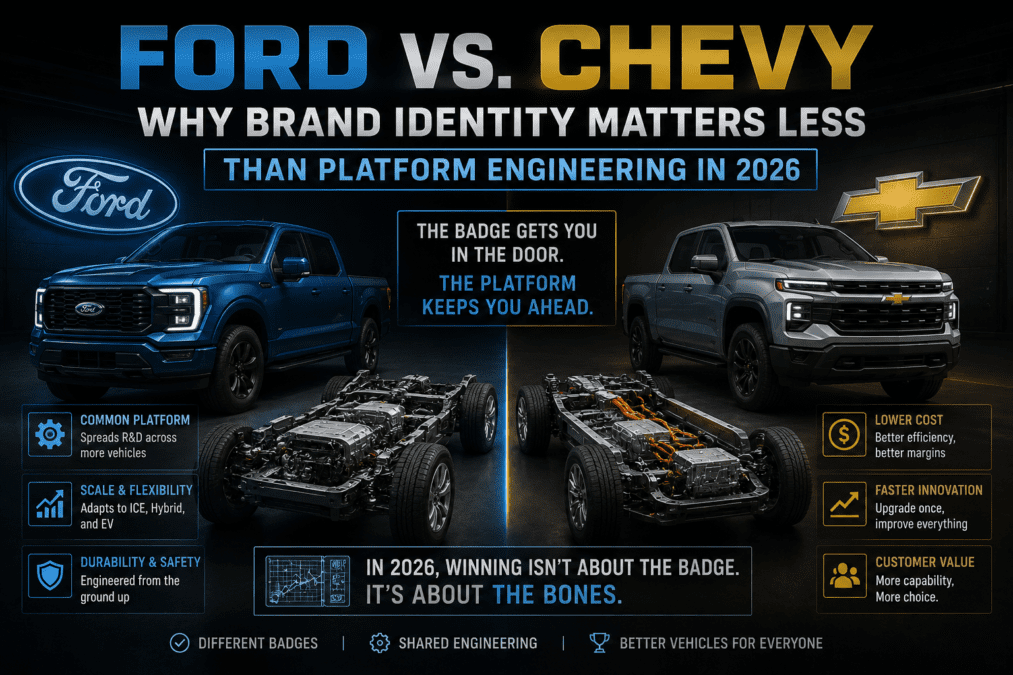

The modern ford vs chevy debate is no longer just a rivalry between two American automotive giants. It has evolved into a comparison between two engineering philosophies that influence pickup trucks, performance vehicles, electric mobility, fleet reliability, towing capability, and long-term ownership economics. For more than a century, both manufacturers have shaped North American transportation culture, yet their current market strategies reveal increasingly different priorities.
A meaningful ford vs chevy comparison requires more than emotional brand loyalty. Consumers today evaluate vehicles through measurable metrics such as drivetrain efficiency, platform durability, software integration, resale value, payload ratings, maintenance complexity, hybrid adoption, and manufacturing scalability. While previous generations often chose based on family tradition, modern buyers increasingly prioritize use-case optimization and lifecycle cost analysis.
The most surprising conclusion in the modern ford vs chevy discussion is that the competition is no longer decided by horsepower alone. Instead, platform adaptability, electronic architecture, fleet economics, and modular engineering now determine long-term competitive advantage. Ford often excels in innovation speed and towing-focused engineering, while Chevrolet frequently emphasizes drivetrain consistency, ride refinement, and broad accessibility across price segments.
Defining the Ford vs Chevy Rivalry in Modern Automotive Terms
The phrase ford vs chevy refers to the long-standing competition between the Ford Motor Company and Chevrolet brands across trucks, SUVs, sports cars, work vehicles, and consumer transportation markets.
In automotive analysis, ford vs chevy comparisons evaluate engineering efficiency, reliability trends, technological integration, cost of ownership, towing capability, performance metrics, and market adaptability rather than simple brand popularity.
While Ford frequently prioritizes bold redesign cycles and capability-focused engineering, Chevrolet often emphasizes platform refinement, drivetrain predictability, and mass-market usability. That distinction explains why buyer satisfaction varies significantly depending on intended vehicle use.
A direct answer to the question “Which brand is better in the ford vs chevy rivalry?” depends heavily on application. Ford generally leads in towing innovation, hybrid truck technology, and commercial fleet versatility, whereas Chevrolet often performs strongly in ride comfort, engine smoothness, pricing flexibility, and long-term drivetrain familiarity. For heavy-duty work applications, Ford tends to dominate professional preference surveys, while Chevrolet maintains strong appeal among mixed-use and family-oriented truck buyers.
Essential Comparative Metrics
| Category | Ford | Chevrolet |
|---|---|---|
| Primary Identity | Capability And Innovation Focus | Balanced Utility And Comfort |
| Truck Market Reputation | Strong Towing Leadership | Refined Everyday Practicality |
| Popular Pickup | F-Series | Silverado |
| Performance Icon | Mustang | Corvette |
| Hybrid Truck Development | Aggressive Adoption | More Gradual Expansion |
| Ride Comfort | Firm And Utility-Oriented | Smoother On Average |
| Towing Reputation | Industry-Leading In Many Segments | Competitive But More Conservative |
| Interior Design Philosophy | Technology-Centered | User Familiarity Focused |
| Fleet Market Presence | Extremely Strong | Broad Municipal And Commercial Use |
| Resale Strength | High In Trucks | Stable Across Broader Segments |
| Electric Transition Strategy | Fast Expansion | Platform Consolidation Approach |
Structural And Mechanical Foundations
The engineering foundation behind the ford vs chevy rivalry begins with chassis philosophy and platform scalability. Ford has increasingly invested in lightweight construction, modular truck platforms, aluminum-intensive body engineering, and integrated hybrid systems. This strategy improves towing efficiency and fuel optimization but can raise repair complexity and insurance costs in some markets.
Chevrolet traditionally relies on highly refined steel-intensive architectures that prioritize manufacturing consistency and drivetrain familiarity. This approach often results in predictable long-term durability and lower repair uncertainty for average owners. Chevrolet’s platform philosophy typically evolves gradually rather than through aggressive redesign cycles.
In the modern ford vs chevy landscape, suspension calibration also reveals philosophical differences. Ford trucks usually emphasize payload confidence and work-focused stiffness, whereas Chevrolet frequently tunes vehicles for smoother mixed-use driving characteristics. Buyers who regularly tow heavy equipment often prefer Ford’s controlled stability under load, while commuters and suburban users may find Chevrolet more comfortable during daily driving.
Powertrain strategy further separates the brands. Ford aggressively adopted turbocharged EcoBoost engines across multiple categories, while Chevrolet retained stronger emphasis on naturally aspirated V8 refinement. The result is a contrast between efficiency-oriented torque delivery and traditional mechanical simplicity.
Behavioral Patterns And Consumer Loyalty
Consumer psychology plays a major role in the enduring ford vs chevy rivalry. Few automotive comparisons generate the same emotional attachment because ownership often reflects regional identity, occupational culture, and generational tradition. Rural buyers, contractors, ranch operators, and fleet managers frequently inherit brand loyalty patterns through family or professional environments.
Ford buyers often prioritize measurable capability metrics such as towing ratings, payload performance, and innovation leadership. Chevrolet owners commonly value familiarity, drivability, maintenance predictability, and broad usability across work and personal scenarios. These tendencies are not absolute, but they appear consistently in ownership surveys and dealership retention data.
Another important aspect of ford vs chevy culture is aftermarket support. Ford’s truck ecosystem benefits from extensive commercial upfitting compatibility, performance tuning communities, and fleet customization infrastructure. Chevrolet also maintains strong aftermarket presence, particularly among performance enthusiasts and off-road truck owners, though its community identity is slightly more diversified.
Brand communication strategies reinforce these behavioral patterns. Ford marketing frequently highlights toughness, capability testing, and industrial strength, while Chevrolet advertisements often emphasize lifestyle integration, comfort, and versatility. These branding approaches shape buyer expectations long before test drives occur.
Ford: Strengths And Constraints
Within the broader ford vs chevy comparison, Ford’s greatest advantage lies in engineering ambition and capability leadership. The F-Series lineup has consistently maintained dominant market visibility because Ford aggressively optimizes towing technologies, chassis rigidity, engine output, and commercial adaptability. Innovations such as integrated trailer assistance systems and advanced hybrid truck solutions reinforce that leadership image.
Ford also excels in diversification. Vehicles like the Mustang, Bronco, Maverick, and F-150 Lightning demonstrate the company’s willingness to experiment with new market categories and emerging mobility trends. This adaptability strengthens Ford’s competitive position during technological transitions.
However, Ford’s aggressive innovation pace can create challenges. Rapid redesign cycles occasionally introduce reliability concerns during early production years. Turbocharged engine complexity, electronic integration, and advanced transmission systems may increase maintenance sensitivity compared to simpler configurations.
Another factor in the ford vs chevy discussion is repair economics. Aluminum-intensive body construction reduces weight but can increase repair specialization requirements. Fleet operators sometimes evaluate this carefully because downtime and repair accessibility influence operational profitability more than headline performance metrics.
Ford’s vehicles also tend to prioritize capability over ride softness. Drivers seeking relaxed daily commuting may perceive certain truck models as firmer or more utility-focused than comparable Chevrolet offerings.
Nissan Note vs Versa Note: Why Shared DNA Creates Two Very Different Ownership Experiences
Chevy: Strengths And Constraints
Chevrolet’s position in the ford vs chevy rivalry centers on balance, familiarity, and broad market accessibility. Chevrolet vehicles often appeal to buyers who want dependable usability without highly aggressive engineering experimentation. This strategy supports strong retention among traditional truck owners and mixed-purpose households.
The Silverado lineup demonstrates Chevrolet’s emphasis on drivability and mechanical consistency. Many owners appreciate the smoothness of GM V8 powertrains, predictable transmission behavior, and relatively comfortable highway characteristics. Chevrolet interiors also tend to favor straightforward usability rather than dramatic technological presentation.
In sports performance, Chevrolet holds exceptional credibility through the Corvette platform. The brand has repeatedly demonstrated an ability to deliver high-level performance engineering at comparatively attainable price points. This strengthens Chevrolet’s reputation beyond truck markets alone.
Yet the ford vs chevy comparison also reveals limitations for Chevrolet. Critics sometimes argue that Chevrolet adopts innovation more cautiously, particularly regarding hybrid truck expansion and dramatic platform redesigns. While this conservatism improves reliability perception, it may reduce leadership perception in emerging technologies.
Chevrolet’s towing figures also occasionally trail Ford’s top configurations in headline comparisons. Although real-world differences may be small for average consumers, commercial buyers often pay close attention to published capability numbers when selecting fleet vehicles.
Another challenge involves differentiation. Chevrolet competes internally within the broader General Motors ecosystem, which includes GMC positioning overlap in premium truck categories. Ford’s truck identity, by contrast, tends to appear more singular and concentrated.
Comparative Advantages In Real-World Scenarios
The practical outcome of the ford vs chevy debate depends heavily on operating conditions. Buyers focused on maximum towing capacity, advanced work technologies, and fleet-scale utility frequently gravitate toward Ford. Construction industries, agricultural operators, and heavy-equipment users often value Ford’s aggressive capability engineering.
Chevrolet performs particularly well among drivers seeking balanced versatility. Families using trucks for commuting, recreation, occasional towing, and highway travel may prefer Chevrolet’s smoother ride characteristics and familiar mechanical feel. Long-distance comfort remains an important differentiator in owner satisfaction studies.
In urban environments, Ford’s newer compact and hybrid-oriented offerings create competitive advantages in fuel efficiency and adaptability. Chevrolet, however, retains strong value perception through broad trim availability and pricing flexibility.
The ford vs chevy rivalry also varies by vehicle category. In muscle cars, Ford’s Mustang emphasizes accessible performance heritage, while Chevrolet’s Camaro historically pursued sharper handling identity. In sports cars, the Corvette occupies an entirely different prestige tier compared to Ford’s mainstream performance offerings.
Electric vehicles further complicate the comparison. Ford aggressively pursued visible EV branding with the F-150 Lightning and Mustang Mach-E, while Chevrolet has concentrated more heavily on scalable EV platform ecosystems intended for multiple future vehicle categories.
Regional infrastructure matters as well. Service availability, dealership competence, parts distribution, and mechanic familiarity can influence ownership experience more than raw engineering differences. In some rural markets, brand support networks effectively determine practical reliability.
Reliability And Long-Term Ownership Economics
Reliability discussions dominate many ford vs chevy debates because long-term ownership costs affect resale value, downtime, insurance rates, and maintenance predictability. However, reliability is often misunderstood as a single metric rather than a combination of mechanical durability, software stability, service accessibility, and component lifespan.
Ford’s modern vehicles frequently achieve strong performance metrics but may involve greater technological complexity. Turbocharged engines, advanced towing electronics, hybrid systems, and integrated software platforms improve functionality yet introduce more variables that can affect maintenance patterns over extended ownership periods.
Chevrolet traditionally benefits from perceptions of mechanical familiarity. Many independent mechanics have extensive experience with GM powertrains, which can simplify maintenance logistics. Owners who prioritize repair accessibility often view this as a major advantage in the ford vs chevy comparison.
Depreciation trends vary significantly by segment. Ford trucks, particularly higher-capability F-Series models, often maintain strong resale value due to sustained commercial demand. Chevrolet vehicles generally demonstrate stable depreciation curves across broader consumer categories, especially in mainstream truck trims and family SUVs.
Warranty experience also influences ownership satisfaction. Dealership quality, service turnaround times, and parts availability frequently matter more than isolated reliability statistics. Buyers sometimes overlook this operational dimension when comparing brands solely through online ratings.
Fuel economy trends add another layer. Ford’s EcoBoost systems can deliver impressive torque efficiency, while Chevrolet’s naturally aspirated engines may offer simpler maintenance profiles despite slightly different fuel performance characteristics depending on driving conditions.
Technology, Software, And The Digital Vehicle Era
The current phase of the ford vs chevy rivalry increasingly revolves around software architecture rather than mechanical engineering alone. Modern vehicles function as integrated digital ecosystems containing driver assistance systems, cloud-connected diagnostics, adaptive towing controls, infotainment software, and predictive maintenance algorithms.
Ford has aggressively embraced software-centered identity transformation. Large touchscreen integration, over-the-air updates, connected fleet management tools, and hybrid system analytics position Ford as a technologically progressive manufacturer. This appeals strongly to commercial operators managing large vehicle fleets.
Chevrolet’s approach tends to prioritize user familiarity and interface stability. Rather than introducing radical software redesigns at every cycle, Chevrolet often refines existing systems incrementally. For many consumers, this reduces learning friction and improves long-term usability.
In the ford vs chevy competition, advanced driver-assistance technologies reveal different priorities. Ford frequently markets innovation leadership, while Chevrolet emphasizes accessible integration across broader pricing tiers. The practical difference is that Ford may lead in high-end capability features, whereas Chevrolet sometimes spreads usable technology more evenly through mainstream models.
Cybersecurity and software reliability have also become critical considerations. Vehicles increasingly depend on stable digital infrastructure, meaning infotainment glitches and sensor calibration problems can influence consumer satisfaction nearly as much as engine reliability. This represents a major shift from earlier eras of automotive competition.
Performance Culture And Motorsport Identity
Performance heritage remains central to the emotional dimension of ford vs chevy culture. Even buyers who never race their vehicles often identify strongly with motorsport legacies, engineering mythology, and brand storytelling.
Ford’s performance identity traditionally emphasizes accessible enthusiasm. The Mustang became iconic because it democratized American performance culture, combining recognizable styling with broad affordability. Ford also maintains strong associations with off-road racing and endurance capability through platforms like the Raptor.
Chevrolet’s performance image, however, often emphasizes technical precision and raw output. The Corvette transformed from a domestic sports car into a globally respected high-performance platform capable of competing with European engineering benchmarks. This elevated Chevrolet’s prestige among enthusiasts and industry analysts alike.
The ford vs chevy rivalry is therefore not only commercial but symbolic. Ford represents rugged capability and industrial resilience, while Chevrolet often projects versatility and refined performance accessibility. These identities influence everything from advertising campaigns to dealership culture.
Motorsport participation reinforces these narratives. Racing success creates engineering credibility that manufacturers later integrate into consumer vehicle marketing. Whether discussing NASCAR heritage, drag racing history, endurance competition, or off-road performance, both brands continue using motorsport to strengthen consumer trust and emotional loyalty.
Scientific And Expert Consensus (2026)
Industry analysis in 2026 suggests that the modern ford vs chevy comparison cannot be reduced to a universal winner. Independent automotive testing increasingly shows that both brands perform exceptionally well when evaluated within their intended market strategies.
Engineering analysts often identify Ford as the stronger innovator in truck capability systems, hybrid adaptation, and commercial utility technologies. Ford’s willingness to pursue aggressive redesigns and advanced towing integration keeps it highly competitive in professional-use environments.
Chevrolet receives consistent praise for drivetrain refinement, comfort calibration, and broad ownership accessibility. Experts frequently note that Chevrolet vehicles provide balanced usability for drivers who need dependable versatility without highly specialized performance priorities.
A major consensus point in the ford vs chevy debate involves segmentation. The “better” manufacturer depends almost entirely on operational context. Fleet operators, contractors, and heavy towing users often lean toward Ford. Mixed-use suburban buyers, highway commuters, and comfort-oriented truck owners frequently prefer Chevrolet.
Analysts also agree that electrification may reshape future perceptions dramatically. Ford’s early EV visibility has strengthened its innovation branding, while Chevrolet’s scalable platform approach could prove strategically efficient over longer timelines. The competitive balance therefore remains dynamic rather than settled.
Market Evolution And Future Industry Pressure
The future of the ford vs chevy rivalry will likely depend less on traditional horsepower competition and more on manufacturing flexibility, battery supply chains, autonomous integration, and software ecosystem stability. The automotive industry is transitioning from purely mechanical competition toward mobility platform competition.
Ford’s aggressive experimentation may help it capture early technological momentum, especially among commercial operators seeking productivity-enhancing features. Chevrolet’s measured scalability could prove advantageous if economic conditions reward manufacturing efficiency and platform consistency.
Global regulation also influences both brands differently. Emissions requirements, electrification mandates, and software compliance standards increasingly shape engineering decisions. Future consumers may compare subscription ecosystems, charging infrastructure integration, and AI-assisted diagnostics as much as engine performance.
Another major shift in the ford vs chevy landscape involves younger buyers. Many consumers entering the truck market today prioritize connectivity, sustainability, and multi-purpose versatility alongside traditional capability metrics. This forces both manufacturers to modernize brand identity without alienating long-term loyalists.
Artificial intelligence integration inside vehicles may become the next competitive frontier. Predictive maintenance systems, adaptive route optimization, and intelligent towing analytics could redefine how consumers evaluate value and reliability over the next decade.
Final Synthesis And Verdict
The enduring popularity of the ford vs chevy rivalry reflects more than automotive preference. It represents two distinct philosophies of transportation engineering and consumer identity. Ford consistently pushes toward innovation-driven capability, while Chevrolet focuses on balanced usability and mechanical familiarity.
Ford generally leads in towing technology, commercial adaptability, hybrid experimentation, and aggressive engineering evolution. Buyers prioritizing work-focused performance, advanced truck systems, and maximum capability often find Ford especially compelling.
Chevrolet excels in comfort balance, drivetrain smoothness, ownership familiarity, and broad usability across diverse driving conditions. Consumers seeking practical versatility and predictable long-term operation frequently gravitate toward Chevrolet’s approach.
Ultimately, the modern ford vs chevy comparison is not about identifying a universally superior brand. It is about aligning vehicle philosophy with operational reality. The better choice depends on workload, driving environment, maintenance expectations, technological priorities, and ownership goals.
The most important insight is that platform engineering now matters more than historical reputation. In 2026, consumers who evaluate real-world use cases instead of relying solely on brand mythology are far more likely to make satisfying long-term vehicle decisions.
Frequently Asked Questions
Which brand wins most truck comparisons in the ford vs chevy rivalry?
Ford frequently wins towing and capability-focused comparisons, especially in heavy-duty truck categories. Chevrolet, however, often scores highly in ride comfort, drivability, and everyday usability. The best choice depends on intended vehicle use rather than overall brand superiority.
Is Ford more reliable than Chevy in 2026?
Reliability varies significantly by model and maintenance quality. Ford vehicles often include more advanced technology and turbocharged systems, while Chevrolet commonly emphasizes mechanical familiarity and incremental refinement. Long-term ownership experience depends heavily on servicing consistency and driving conditions.
Why is the ford vs chevy debate so culturally important?
The rivalry became deeply connected to American industrial identity, regional loyalty, motorsport culture, and family tradition. Pickup trucks especially represent work ethic, independence, and lifestyle identity, making brand preference emotionally significant for many owners.
Which brand is better for towing and work applications?
Ford generally maintains stronger leadership in towing innovation, payload engineering, and commercial fleet adaptability. Heavy-duty users often favor Ford for demanding workloads, although Chevrolet remains highly competitive in many real-world towing scenarios.
Is Chevy better for everyday driving comfort?
Many drivers consider Chevrolet trucks and SUVs smoother and more comfortable for commuting and mixed-use driving. Suspension tuning and drivetrain refinement often prioritize daily usability, whereas Ford sometimes emphasizes utility-focused performance characteristics more aggressively.