
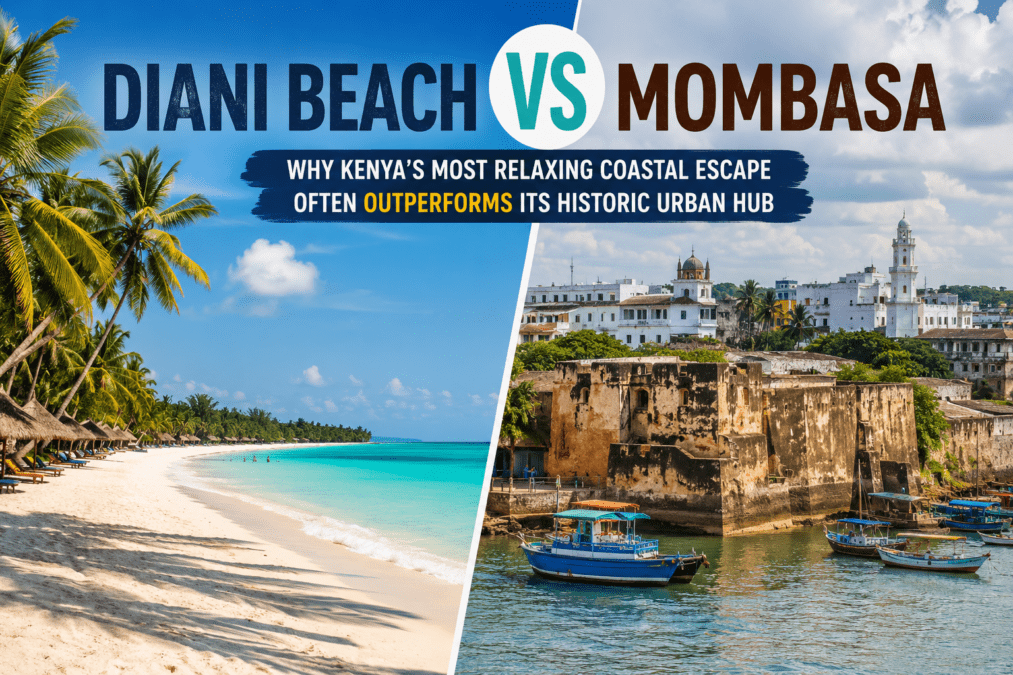

The debate around diani beach vs mombasa has evolved far beyond a simple tourist preference between two coastal destinations in Kenya. Today, travelers, digital nomads, marine researchers, hospitality investors, and even environmental planners evaluate these two regions through very different lenses. One represents a concentrated urban-coastal ecosystem shaped by centuries of trade, infrastructure growth, and cultural layering. The other reflects a lower-density beach environment centered around ecological aesthetics, tourism comfort, and lifestyle-oriented travel experiences.
Understanding diani beach vs mombasa requires more than comparing hotel prices or beach quality. The two destinations function differently at structural, social, economic, and environmental levels. Mombasa operates as East Africa’s historic maritime gateway with intense cultural density, while Diani Beach has increasingly positioned itself as a premium leisure coastline designed around tranquility, marine recreation, and tourism-driven lifestyle optimization.
The surprising insight in the diani beach vs mombasa comparison is that the “better” destination often depends less on attraction count and more on cognitive travel goals. Travelers seeking stimulation, history, commerce, nightlife, and urban immersion frequently favor Mombasa. Yet those prioritizing stress reduction, environmental beauty, emotional restoration, and controlled tourism density increasingly choose Diani Beach. In practical terms, one destination activates the senses, while the other regulates them.
Understanding The Core Difference Between Diani Beach And Mombasa
Diani Beach is a coastal leisure destination located south of Mombasa, known for white sand beaches, luxury resorts, coral reef ecosystems, and low-density tourism infrastructure. Mombasa is Kenya’s second-largest city and a historic Indian Ocean trade hub combining urban development, Swahili culture, commerce, and tourism.
In the broader discussion of diani beach vs mombasa, the distinction is fundamentally about travel psychology. Diani Beach prioritizes environmental calm and recreational balance, while Mombasa emphasizes cultural complexity and metropolitan energy.
When travelers compare diani beach vs mombasa, they are often comparing two entirely different experiences rather than competing versions of the same coastal destination.
Structural And Environmental Foundations
The environmental contrast is one of the most decisive elements in the diani beach vs mombasa discussion. Diani Beach developed primarily as a tourism-centered coastline. Its spatial planning evolved around resorts, beach villas, eco-lodges, and marine recreation. This produced a relatively controlled environmental structure with lower urban compression and greater visual continuity between architecture and coastline.
Mombasa developed under entirely different historical pressures. As a major trade port connecting Africa, the Middle East, and Asia for centuries, the city accumulated dense urban layers. Infrastructure expansion, port activity, population growth, and commercial concentration shaped an environment where tourism exists alongside intense economic functionality.
This divergence creates measurable experiential differences. Diani Beach benefits from reduced traffic noise, lower visual pollution, and wider uninterrupted coastal access. Mombasa, meanwhile, provides more complex urban functionality but sacrifices environmental calm. In many diani beach vs mombasa evaluations, travelers unconsciously prioritize sensory load. The more urbanized a destination becomes, the more cognitive fatigue travelers often experience during long stays.
The structural difference also affects mobility. Diani Beach generally encourages localized movement and slower pacing. Mombasa demands adaptive navigation through dense transportation systems, commercial zones, and highly active districts.
Behavioral Patterns And Social Intelligence
One overlooked dimension in the diani beach vs mombasa comparison is social rhythm. Destinations develop behavioral ecosystems shaped by tourism density, local economics, infrastructure, and cultural expectations. These behavioral patterns influence how visitors emotionally interpret a place.
Diani Beach operates through slower social pacing. Interactions in resorts, cafes, beach clubs, and marine excursion spaces tend to be more relaxed and service-oriented. Travelers frequently describe Diani as emotionally restorative because the environment minimizes urgency. This behavioral calm influences everything from dining experiences to recreational scheduling.
Mombasa presents a far more dynamic social ecosystem. The city is culturally rich, commercially aggressive, historically layered, and socially kinetic. Markets, transport networks, nightlife districts, and public spaces create a constant flow of sensory interaction. For some travelers, this energy produces excitement and authenticity. For others, it generates exhaustion.
In practical tourism psychology, the diani beach vs mombasa distinction often reflects a choice between stimulation and regulation. Mombasa rewards curiosity and adaptability. Diani Beach rewards decompression and immersion in natural scenery.
While Mombasa offers deeper cultural immersion, Diani Beach often provides greater emotional recovery during extended travel periods.
Coastal Geography And Marine Ecosystems
The marine dimension is central to understanding diani beach vs mombasa because coastline quality significantly influences long-term tourism appeal. Diani Beach possesses one of the most visually consistent beach environments in East Africa. Its coral reef systems, turquoise waters, and broad white-sand shoreline create ideal conditions for snorkeling, kitesurfing, scuba diving, and marine tourism.
The offshore reef structure near Diani acts as a natural stabilizer for wave conditions. This contributes to calmer swimming environments and improved visibility for underwater activities. Marine tourism businesses therefore operate more efficiently and predictably.
Mombasa’s marine environment is more fragmented due to urbanization, port activity, and dense coastal development. While there are attractive beaches and recreational zones, the coastline competes with industrial infrastructure and urban expansion. This creates inconsistent beach quality depending on location.
The ecological conversation within diani beach vs mombasa also includes sustainability concerns. Diani’s tourism economy depends heavily on preserving environmental aesthetics, giving local stakeholders strong incentives toward conservation initiatives. Mombasa, by contrast, balances industrial, residential, commercial, and tourism pressures simultaneously, complicating environmental management.
As climate awareness grows globally, travelers increasingly evaluate destinations through ecological quality rather than attraction quantity alone. This trend strongly benefits Diani Beach in the broader diani beach vs mombasa debate.
Cultural Identity And Historical Depth
One area where Mombasa decisively outperforms Diani Beach is historical and cultural complexity. The city represents centuries of Swahili civilization, Arab influence, Portuguese colonial history, and Indian Ocean trade dynamics. Its architecture, cuisine, language patterns, and social structures reveal deep intercultural layering rarely matched by pure resort destinations.
This makes the diani beach vs mombasa comparison particularly interesting because each location delivers a different form of authenticity. Diani Beach offers environmental authenticity through natural beauty and coastal atmosphere. Mombasa offers historical authenticity through urban continuity and cultural depth.
Travelers interested in museums, old architecture, historical narratives, and urban anthropology often prefer Mombasa. The city’s neighborhoods function as living historical systems rather than curated tourism zones.
Diani Beach, meanwhile, derives its identity primarily from experiential tourism rather than historical significance. Its cultural atmosphere is more internationally blended and hospitality-driven. This does not necessarily reduce its value, but it changes the nature of engagement.
The modern tourism industry increasingly divides travelers into two broad groups: those seeking interpretive experiences and those seeking restorative experiences. In many respects, diani beach vs mombasa reflects this exact division.
Tourism Infrastructure And Accessibility
Accessibility significantly shapes visitor satisfaction, making infrastructure a major factor in the diani beach vs mombasa analysis. Mombasa benefits from being a major urban center with extensive transportation networks, port access, business services, shopping districts, and public infrastructure. This allows visitors to access a wider range of accommodations, restaurants, healthcare facilities, and logistical support.
Diani Beach traditionally faced accessibility challenges because reaching the area required additional transportation coordination south of Mombasa. However, infrastructure improvements, including airport access and upgraded roads, have substantially improved connectivity.
Despite these improvements, Mombasa still retains logistical superiority for business travel, large-scale events, and high-volume tourism. Travelers who prioritize convenience and urban functionality may therefore lean toward Mombasa.
Yet infrastructure quality does not always correlate with travel satisfaction. One of the recurring themes in diani beach vs mombasa is that excessive urban infrastructure can diminish the emotional appeal of a coastal destination. Diani Beach benefits precisely because its infrastructure remains selectively scaled rather than overwhelmingly urbanized.
This creates an interesting paradox. Mombasa is objectively more functional as a city, while Diani Beach is often perceived as more enjoyable as a vacation environment.
Subject A: Strengths And Constraints Of Diani Beach
Diani Beach’s greatest strength lies in environmental consistency. Visitors generally know what experience they are receiving: calm beaches, premium hospitality, marine recreation, and a lower-stress atmosphere. This predictability increases destination satisfaction because expectation alignment remains high.
Another major advantage in the diani beach vs mombasa conversation is spatial openness. Diani Beach avoids much of the crowding, traffic pressure, and urban density that characterize large coastal cities. For families, honeymoon travelers, remote workers, and wellness-oriented tourists, this spatial freedom carries immense value.
Diani Beach also performs strongly in experiential luxury. Resorts, boutique hotels, eco-retreats, and beach villas frequently emphasize personalized service and environmental immersion rather than urban entertainment density.
However, Diani Beach has limitations. Cultural diversity and historical depth are less extensive compared to Mombasa. Travelers seeking intense nightlife, urban exploration, or complex local markets may eventually perceive Diani as repetitive during long stays.
Economic dependence on tourism also creates seasonal variability. Some businesses experience fluctuations tied directly to international tourism cycles, which can affect atmosphere and service availability during quieter periods.
Still, in the broader diani beach vs mombasa comparison, Diani Beach increasingly benefits from global travel trends favoring slower, wellness-oriented, environmentally conscious tourism.
Subject B: Strengths And Constraints Of Mombasa
Mombasa’s primary strength is multidimensionality. Few coastal cities in East Africa combine historical relevance, commercial importance, cultural diversity, and tourism infrastructure at the same scale. Visitors can explore historical architecture, experience Swahili cuisine, engage in urban commerce, and access beaches within the same metropolitan environment.
This complexity makes Mombasa intellectually engaging. In the diani beach vs mombasa comparison, Mombasa frequently attracts travelers who prefer layered experiences over purely recreational environments.
Another advantage is economic flexibility. Budget travelers, business travelers, backpackers, cultural tourists, and regional visitors can all find suitable accommodations and services across varied price ranges.
Yet Mombasa’s urban intensity introduces constraints. Traffic congestion, noise levels, infrastructure pressure, and overcrowding can reduce relaxation value. Beach quality also varies significantly across districts.
Environmental degradation remains another concern. Large-scale urban expansion inevitably affects coastal ecosystems, waste management, and public-space maintenance. Travelers expecting idyllic tropical serenity sometimes experience disappointment because Mombasa functions first as a city and second as a beach destination.
The core weakness in the diani beach vs mombasa framework is therefore experiential inconsistency. Mombasa can deliver extraordinary cultural experiences, but satisfaction often depends heavily on location selection, timing, and traveler adaptability.
Comparative Advantages In Real-World Scenarios
The most practical way to evaluate diani beach vs mombasa is through situational travel analysis rather than abstract ranking. Different traveler profiles benefit from different destination structures.
For honeymoon travel, Diani Beach generally outperforms Mombasa because privacy, visual aesthetics, and environmental calm strongly influence romantic satisfaction. Couples seeking emotional intimacy usually prefer low-noise, low-density environments.
magna carta psp vs ps2: A Platform Divide That Reshaped Tactical RPG Experience
For historical exploration and cultural immersion, Mombasa clearly dominates. The city offers far greater depth in architecture, heritage, cuisine, and urban storytelling.
For digital nomads, the outcome depends on work style. Remote workers prioritizing tranquility and focused productivity often choose Diani Beach. Those needing extensive urban services, networking access, and transportation connectivity may prefer Mombasa.
Families with children frequently favor Diani Beach because safer swimming conditions, resort infrastructure, and lower traffic stress simplify logistics. Adventure-oriented solo travelers, however, may appreciate Mombasa’s unpredictability and social energy.
The business tourism sector heavily favors Mombasa due to conference facilities, urban infrastructure, and transportation capacity. Leisure tourism increasingly leans toward Diani Beach because global travel behavior now prioritizes wellness, sustainability, and emotional restoration.
This explains why the diani beach vs mombasa debate has intensified in recent years. Travelers are no longer simply searching for destinations. They are searching for psychological outcomes.
Economic Development And Tourism Sustainability
Economic sustainability represents another important dimension in the diani beach vs mombasa analysis. Mombasa possesses diversified economic foundations including shipping, trade, logistics, manufacturing, and tourism. This diversification increases economic resilience but also intensifies urban pressure and environmental strain.
Diani Beach depends more heavily on tourism-centered revenue streams. At first glance, this may appear economically fragile. However, specialized tourism economies can outperform diversified urban economies in visitor satisfaction because infrastructure remains aligned with leisure priorities.
The sustainability challenge for Diani Beach involves preventing overdevelopment. Many global beach destinations lose their appeal once infrastructure expansion surpasses ecological balance. If Diani experiences uncontrolled urbanization, it risks reproducing some of the same environmental pressures seen in larger coastal cities.
Meanwhile, Mombasa faces the opposite challenge: managing modernization without eroding historical identity and coastal livability. Urban expansion can gradually reduce the very cultural distinctiveness that attracts visitors.
In the long-term diani beach vs mombasa outlook, sustainability may become the defining factor. Destinations capable of balancing tourism growth with environmental protection will likely dominate future travel preferences.
Hospitality Quality And Visitor Experience
Hospitality psychology plays a surprisingly large role in the diani beach vs mombasa comparison. Diani Beach hospitality systems often emphasize emotional relaxation, visual aesthetics, and personalized service design. Many accommodations intentionally create separation from external stressors.
This design philosophy aligns with global luxury tourism trends where travelers increasingly value privacy, calmness, and immersive environments over attraction density.
Mombasa’s hospitality sector is broader and more variable. Visitors can access everything from budget guesthouses to premium hotels, but service consistency differs widely depending on district and property category.
Interestingly, many travelers evaluating diani beach vs mombasa report that Diani Beach “feels easier.” This perception relates less to objective quality and more to reduced decision fatigue. Simpler transportation, calmer environments, and tourism-centered infrastructure minimize cognitive overload.
Mombasa offers more options, but more options also require more navigation, planning, and adaptation. For some travelers, this complexity enhances authenticity. For others, it reduces enjoyment.
The difference ultimately reflects two tourism philosophies: curated relaxation versus organic urban exploration.
Scientific And Expert Consensus (2026)
Tourism analysts in 2026 increasingly classify coastal destinations according to experiential categories rather than geographic similarity. Under this framework, the diani beach vs mombasa debate is less about superiority and more about traveler-outcome alignment.
Environmental tourism research consistently shows that low-density coastal environments improve perceived relaxation, sleep quality, and emotional recovery. This trend supports Diani Beach’s growing international reputation as a wellness-oriented destination.
Urban tourism research, however, demonstrates that culturally layered cities generate stronger memory retention, intellectual engagement, and social stimulation. Mombasa therefore maintains strong appeal among travelers seeking narrative-rich experiences.
Hospitality industry experts also observe changing traveler behavior after the global remote-work expansion of the 2020s. Longer stays increasingly favor destinations with calmer environmental profiles. This shift has disproportionately benefited Diani Beach.
At the same time, cultural preservation experts continue emphasizing Mombasa’s significance as one of East Africa’s most historically important urban centers. The city’s cultural value extends beyond tourism economics alone.
The emerging consensus in diani beach vs mombasa discussions is therefore nuanced: Diani Beach frequently delivers higher relaxation satisfaction, while Mombasa provides greater cultural and historical depth.
Safety, Comfort, And Traveler Psychology
Safety perception strongly influences destination popularity, particularly in modern tourism where emotional comfort affects online reviews and repeat visitation. In the diani beach vs mombasa comparison, Diani Beach often benefits from a perception of reduced stress and greater spatial safety.
Lower population density, resort-centered environments, and calmer transportation systems contribute to this perception. Visitors frequently report feeling more physically and mentally relaxed in Diani Beach.
Mombasa’s urban environment naturally introduces more complexity. Large cities generate higher variability in traveler experiences because interactions with transportation systems, commercial zones, nightlife districts, and public infrastructure increase unpredictability.
This does not necessarily mean Mombasa is unsafe. Rather, it means traveler awareness requirements are higher. Urban travel generally demands more adaptive behavior than resort-oriented tourism.
An important insight in the diani beach vs mombasa discussion is that perceived safety often matters as much as measurable safety statistics. Environments that reduce cognitive vigilance tend to produce higher satisfaction scores among leisure travelers.
For this reason, Diani Beach performs particularly well among first-time international tourists, couples, and wellness travelers seeking emotional ease rather than urban stimulation.
Final Synthesis And Verdict
The most accurate conclusion in the diani beach vs mombasa comparison is that these destinations fulfill fundamentally different human needs. Attempts to declare one universally superior misunderstand the structural and psychological distinctions between them.
Mombasa is a culturally layered coastal metropolis shaped by history, trade, urban energy, and social complexity. It rewards curiosity, adaptability, and interest in historical depth. Travelers who enjoy exploration, cultural immersion, and dynamic city environments often find Mombasa deeply engaging.
Diani Beach, by contrast, represents the evolution of modern coastal leisure tourism. It prioritizes emotional restoration, environmental beauty, marine recreation, and spatial calmness. Travelers seeking relaxation, scenic immersion, and lower sensory overload frequently prefer Diani Beach.
If the comparison focuses on cultural density, historical importance, infrastructure diversity, and urban functionality, Mombasa holds the advantage. If the focus shifts toward beach quality, relaxation efficiency, marine recreation, emotional comfort, and experiential tranquility, Diani Beach consistently outperforms.
The deeper insight from the diani beach vs mombasa debate is that modern travel decisions increasingly revolve around psychological outcomes rather than attraction counts. People are no longer only choosing destinations. They are choosing how they want to feel.
Frequently Asked Questions
Is Diani Beach better than Mombasa for relaxation?
Yes, Diani Beach is generally considered better for relaxation because it has lower tourism density, quieter beaches, reduced traffic congestion, and stronger resort-oriented infrastructure. Travelers seeking stress reduction and environmental calm usually prefer Diani Beach over Mombasa.
Which destination is better for cultural experiences in the diani beach vs mombasa comparison?
Mombasa is significantly stronger for cultural and historical experiences. The city contains centuries of Swahili, Arab, Portuguese, and Indian Ocean trade influences that create a much richer historical environment than Diani Beach.
Is Diani Beach more expensive than Mombasa?
In many cases, yes. Diani Beach often focuses on resort tourism and premium leisure experiences, which can increase accommodation and activity costs. Mombasa offers a wider range of budget-friendly options due to its larger urban economy.
Which is better for families: Diani Beach or Mombasa?
Families frequently prefer Diani Beach because of calmer beaches, lower traffic stress, safer swimming conditions, and more controlled tourism environments. However, Mombasa may appeal to families interested in cultural exploration and urban activities.