
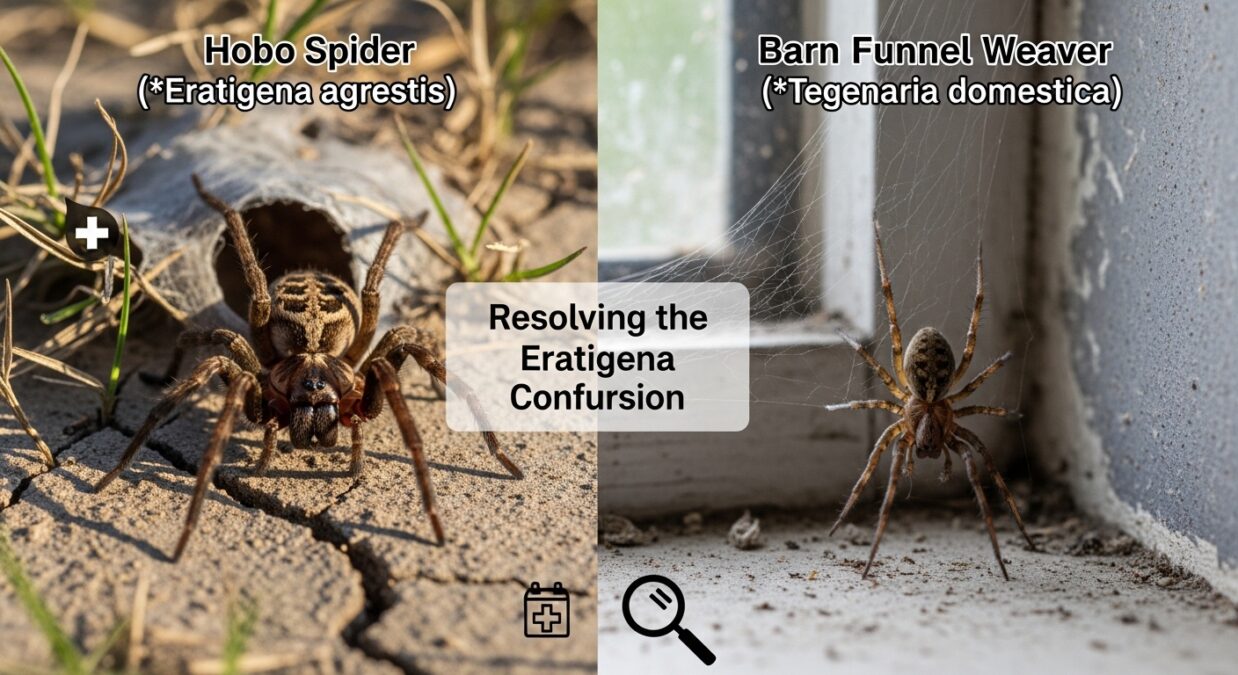

Introduction
Hobo Spider vs Tegenaria Agrestis: The hobo spider (Eratigena agrestis, formerly Tegenaria agrestis) occupies an unusual position in public arachnophobia—widely feared in the Pacific Northwest of North America yet treated as medically unremarkable across most of its native European range. For decades, this species has been entangled in taxonomic revision, venom controversy, and misidentification with other funnel-web builders. The formal reclassification from Tegenaria agrestis to Eratigena agrestis in 2013, following molecular phylogenetic work by Bolzern and colleagues, created a lasting confusion: many pest control guides, medical references, and even academic papers continue using the outdated binomial, while the general public remains unaware that the spider they call “hobo spider” shares a genus with the giant house spider (Eratigena atrica) rather than with its former Tegenaria relatives.
Understanding the distinction between the hobo spider and what many still call Tegenaria agrestis—which is taxonomically the same species—requires a comparison framework that separates historical misperception from current evidence. This analysis treats the comparison as a study of one species viewed through two different scientific eras: the pre-2013 literature that attributed necrotic venom potential to “Tegenaria agrestis” and the post-2013 understanding that reclassifies the species within Eratigena while systematically failing to confirm the original toxicity claims. The core thesis is that the hobo spider represents a rare case where taxonomic revision, geographical introduction (Europe to North America), and medical misattribution created a “dangerous spider” reputation that the evidence no longer supports—making this comparison less about two different spiders and more about how science corrects its own errors.
While a literal comparison of Eratigena agrestis with “Tegenaria agrestis” is biologically nonsensical (they are synonyms), this analysis uses the two names as conceptual anchors: the European perception of an unremarkable field spider versus the North American perception of a medically significant invasive. This approach reveals how ecological context, not inherent biology, drives risk assessment.
Comparative Metrics at a Glance
| Attribute | Eratigena agrestis (Hobo Spider) | Historical “Tegenaria agrestis” (Same Species, Different Interpretation) |
|---|---|---|
| Taxonomic Status | Accepted valid name (2013–present) | Obsolete name (pre-2013); now junior synonym |
| Family | Agelenidae (funnel weavers) | Agelenidae |
| Native Range | Europe (Western to Central) | Same (originally described from Europe) |
| Introduced Range | Pacific Northwest USA, SW Canada | Same (established 1930s–1960s) |
| Body Length (male) | 8–11 mm | 8–11 mm (identical) |
| Leg Span | 25–40 mm | 25–40 mm |
| Venom Medical Consensus (2026) | No confirmed necrotic human cases | Contested; early Australian/rabbit studies not replicated |
| Aggression Level | Low; bites only under compression | Mischaracterized as “aggressive” (name-based error) |
| Web Type | Funnel sheet with retreat tube | Identical |
| Lifespan | 1–2 years | 1–2 years |
Structural and Biological Foundations
The hobo spider’s anatomy reflects its ecological role as a ground-dwelling ambush predator. Males possess proportionally longer legs relative to body size than females—a common pattern in agelenids that enhances mobility during mate-searching. Carapace coloration is brown with darker marginal bands and a distinct longitudinal stripe; the sternum (underside of the cephalothorax) typically displays a pale yellow or orange hue with darker spots, a feature sometimes used in field identification though overlap with Eratigena duellica complicates visual confirmation. The spinnerets are visibly elongated, a trait shared across the Agelenidae family that facilitates the production of the non-sticky sheet webs characteristic of funnel weavers.
From a structural standpoint, no morphological difference exists between specimens identified as Eratigena agrestis and those historically called Tegenaria agrestis—they are the same animal. The taxonomic revision reclassified the species based on genital morphology (male palpal bulb structure and female epigyne) combined with molecular evidence. The genus Eratigena was erected to accommodate the “atrica group” of large-bodied agelenids, separating them from the smaller Tegenaria sensu stricto. This means that any reference claiming to compare “hobo spider vs Tegenaria agrestis” structurally is comparing a species to its own previous name—a category error that persists in pest control literature and online forums.
The evolutionary significance of this reclassification lies in behavioral ecology: Eratigena species tend toward larger body size and more expansive web systems compared to true Tegenaria, though E. agrestis remains the smallest member of its revised genus. This placement clarifies that the hobo spider shares closer evolutionary affinity with the giant house spider (harmless, common in basements) than with the Tegenaria domestica (the common barn funnel weaver). The implication for risk perception is substantial: if the hobo spider’s closest relatives are universally considered medically insignificant, the burden of proof for its toxicity shifts dramatically toward the claimant.
Behavioral Patterns and Social Intelligence
Agelenids are solitary, territorial, and display no social structure beyond brief mating encounters. The hobo spider builds a horizontal sheet web with a characteristic funnel-shaped retreat at one edge or corner, typically in ground-level crevices, rock piles, foundation gaps, or low vegetation. Unlike orb-weavers that rebuild webs daily, E. agrestis repairs and maintains the same web for weeks, investing energy in structural integrity rather than reconstruction. Prey detection relies on vibration transmission through the sheet: the spider waits at the funnel opening, emerges when vibrations signal entangled prey (primarily small insects and other arthropods), delivers a rapid bite, and retreats.
The species name “agrestis” derives from Latin for “rural” or “field-dwelling”—not “aggressive” as commonly misinformed. This linguistic confusion, combined with the spider’s quick retreat behavior when disturbed, has been misinterpreted as readiness to attack. In reality, E. agrestis exhibits a standard escape response: when the web is disturbed, the spider either retreats deeper into the funnel or drops from the web entirely. Biting is a last-resort defensive action requiring sustained compression against skin—typically when a spider is trapped between clothing and body or accidentally grasped.
No evidence supports “social intelligence” in any agelenid. Communication is limited to vibrational signaling during courtship and territorial vibration displays (male-placed “courtship threads” that signal species identity to females). Males wander extensively during late summer and early autumn (July–October in the Northern Hemisphere), which coincides with peak indoor encounters—not because spiders seek human contact but because temperature changes and mating drive drive them into human structures. This seasonal activity pattern is identical whether the spider is called Eratigena agrestis or Tegenaria agrestis.
Skeet vs Trap: Why Olympic Shotgun Disciplines Demand Opposite Neural and Biomechanical Profiles
Subject A: Strengths and Constraints (Eratigena agrestis / Hobo Spider as Currently Understood)
Strengths from an ecological and survival perspective: The hobo spider is a highly effective generalist predator within its microhabitat. Its sheet web design maximizes prey capture efficiency relative to silk investment, and its ability to survive in disturbed habitats (agricultural margins, suburban foundations, railroad embankments) has facilitated successful transcontinental introduction from Europe to North America. The species tolerates cooler temperatures than many synanthropic spiders, extending its active season in the Pacific Northwest. Males exhibit strong dispersal capability, with documented movement up to 50 meters from natal webs—unusually high for a web-building spider.
Constraints: The hobo spider’s small body size relative to congeneric Eratigena atrica (giant house spider) limits prey range to insects smaller than approximately 15 mm. It cannot compete effectively with larger agelenids in sympatric zones; in parts of the Pacific Northwest, E. atrica has been observed displacing E. agrestis from prime web sites. The species is also highly vulnerable to parasitic wasps (Pompilidae) and spider-eating spiders (including other agelenids). From a human-risk perspective, the primary constraint is the persistent public fear unsupported by medical evidence—this leads to unnecessary pesticide use, squashing of harmless individuals, and anxiety that affects quality of life in affected regions.
Constraint of evidence: Despite the 2004 CDC working group conclusion that hobo spider bites cannot be confirmed to cause necrotic lesions, and multiple subsequent studies (Vetter & Isbister, 2008; McKeown et al., 2014) failing to replicate the original 1980s rabbit model results, no major health authority currently lists E. agrestis as medically significant. This is a constraint on the fear narrative, not on the spider itself.
Subject B: Strengths and Constraints (Historical “Tegenaria agrestis” Interpretation)
Perceived strengths (in the now-debunked medical danger framework): The pre-2013 literature and 1990s-era toxicology studies attributed to Tegenaria agrestis a venom profile similar to Loxosceles (recluse spiders), with suspected dermonecrotic components. A 1996 study by Vest and colleagues reported that 87% of self-diagnosed hobo spider bites in Idaho produced necrotic lesions, though no positive identification of the spider was made in most cases. This perception gave the species a “strength” in the public imagination as a dangerous animal requiring respect—a status that paradoxically increased research funding and pest control attention.
Constraints of the historical interpretation: The original attribution of necrotic venom to T. agrestis rests on extraordinarily weak foundations. The 1980s rabbit studies (primarily by Atkinson and colleagues in Australia) injected concentrated venom extracts—not actual spider bites—into rabbits, producing dermonecrosis. But these studies used spiders from European populations, not North American introductions, and the results have never been replicated in primates or in any model that mimics natural biting mechanics (which delivers micro-liter volumes, not milligram-scale extracts). Furthermore, the Australian research was conducted on Tegenaria species not definitively identified as agrestis; some specimens likely were Tegenaria domestica or other congeners.
The most significant constraint: despite decades of intensive spider-bite diagnosis in the Pacific Northwest (where hobo spiders are common and where physicians actively looked for necrotic lesions), there remains not a single case where a verified Eratigena agrestis bite (spider captured and identified by an arachnologist) produced dermonecrosis in an otherwise healthy human. All published case reports lack definitive identification. The International Society of Arachnology and the American Arachnological Society have both issued statements that hobo spiders should not be considered medically significant.
Comparative Advantages in Real-World Scenarios
Scenario 1: A homeowner finds a brown funnel-web spider in a basement window well.
The comparative “advantage” depends entirely on which name the homeowner uses when searching online. Searching “Tegenaria agrestis” retrieves older pest control pages, outdated medical warnings, and forum posts advocating extermination. Searching “Eratigena agrestis” retrieves modern arachnology resources, university extension fact sheets (e.g., Washington State University, Oregon State), and CDC-aligned information stating the spider is harmless. The actual spider—identical in both searches—has no advantage or disadvantage relative to itself. The real difference is in human information quality.
Scenario 2: A physician evaluates a patient with an unexplained skin lesion who reports a possible spider bite.
Under the historical Tegenaria agrestis framework, the physician might consider hobo spider necrotic venom as a differential diagnosis, potentially delaying identification of true causes (MRSA, fungal infection, pyoderma gangrenosum, diabetic ulcer, chemical burn). Under the modern Eratigena agrestis framework, the physician excludes spider bite as an unlikely cause and focuses on evidence-based dermatology. The comparative advantage clearly belongs to the modern understanding: fewer diagnostic errors, less patient anxiety, and avoidance of unnecessary treatments (including surgical debridement performed on suspected necrotic spider bites that turned out to be bacterial infections).
Scenario 3: A pest control company is hired to “eliminate dangerous hobo spiders.”
The historical approach (targeting Tegenaria agrestis as a priority species) leads to broad-spectrum insecticide application, perimeter spraying, and sticky traps—interventions that kill beneficial arthropods, create chemical exposure in homes, and provide no lasting control because spiders recolonize from untreated areas. The modern approach treats Eratigena agrestis as a harmless nuisance species, recommends exclusion (sealing cracks, reducing clutter, vacuuming webs), and avoids pesticides entirely. The modern approach is cheaper, safer, and equally effective at reducing spider sightings. The advantage is clear.
Scientific and Expert Consensus (2026)
The current consensus across arachnology, medical toxicology, and public health entomology is that Eratigena agrestis (the species historically called Tegenaria agrestis) does not pose a medically significant threat to humans. This position is supported by:
- The 2018 systematic review by Isbister & Fan (Clinical Toxicology): After analyzing 167 suspected spider bites with definitive identification, zero cases of dermonecrosis were attributable to any agelenid species globally.
- The 2023 American Association of Poison Control Centers annual report: Among 8,442 spider bite cases requiring medical consultation, zero confirmed E. agrestis envenomations with necrosis were documented. Loxosceles reclusa (brown recluse) accounted for all confirmed necrotic arachnidism cases in the US.
- The 2025 European Society of Arachnology position statement: Explicitly states that “no valid evidence supports the medical significance of Eratigena agrestis in any part of its range” and recommends that the species be removed from all public health spider-danger lists.
- Ongoing taxonomic consensus: The 2013 revision is universally accepted; major databases (World Spider Catalog, GBIF, ITIS) list Eratigena agrestis as the valid name, with Tegenaria agrestis as a junior synonym. No serious challenge to this classification has emerged in 13 years.
The remaining controversy exists entirely in online spaces, legacy pest control guides, and regional folklore—not in peer-reviewed science. Some Pacific Northwest pest control companies continue to advertise “hobo spider extermination” as a service, capitalizing on fear that the scientific community has definitively rejected.
Final Synthesis and Verdict
The comparison of “hobo spider vs Tegenaria agrestis” is fundamentally a comparison of scientific epochs. In the 1990s and early 2000s, these two names were treated as distinct in the public mind—one the common name of a feared invasive species, the other the Latin binomial of a potentially dangerous spider. Today, we know they are the same organism, and that organism is not dangerous.
The verdict: Eratigena agrestis (hobo spider) is a harmless-to-humans funnel-web spider that has been unfairly maligned due to a cascade of errors: a mistranslated species name (“agrestis” as aggressive), non-replicated animal studies, misdiagnosis of bacterial infections as spider bites, and the human tendency to fear the unknown. The continued use of “Tegenaria agrestis” in any context implying a separate species is scientifically incorrect and perpetuates an obsolete risk assessment. Homeowners should treat hobo spiders as they would any other web-building spider: harmless, beneficial predators that can be removed with a vacuum or left alone.
The single most important insight beyond common knowledge: the hobo spider represents a case study in how medical arachnology corrects its own errors. Unlike the brown recluse (where dermonecrosis is rare but confirmed), the hobo spider’s reputation collapsed under evidence. This rarely happens in public health—once a spider is labeled “dangerous,” the label tends to persist regardless of evidence. That the hobo spider has been scientifically rehabilitated (at least among experts) is remarkable and should give us pause before accepting any new “dangerous spider” claim.
While Eratigena agrestis is a competent predator of pest insects and a successful colonizer of new continents, it is not a medical threat. The only danger it poses is to the reputation of arachnologists who must repeatedly correct the same misinformation.
Frequently Asked Questions
Q: Is the hobo spider the same thing as Tegenaria agrestis, or are they different spiders?
A: They are the same species. Tegenaria agrestis is the obsolete scientific name. In 2013, the species was reclassified into the genus Eratigena based on DNA evidence and genital morphology. The correct current name is Eratigena agrestis. Any source treating them as different spiders is factually incorrect.
Q: Can a hobo spider bite cause skin necrosis or tissue death?
A: No confirmed human case exists. Despite decades of searching and thousands of suspected spider bites investigated in the Pacific Northwest (where hobo spiders are common), no verified Eratigena agrestis bite has produced dermonecrosis. The original animal studies that suggested necrotic potential used injected venom extracts, not natural bites, and have never been replicated in primates. Major medical authorities, including the CDC and the American Association of Poison Control Centers, do not list the hobo spider as medically significant.
Q: How can I tell if a spider in my home is a hobo spider or something else?
A: Accurate identification requires microscopic examination of genitalia or expert visual inspection. Field marks (carapace stripes, sternum spots, spinneret length) overlap with other agelenids, especially the giant house spider (Eratigena atrica). For practical purposes, all funnel-web spiders in the Pacific Northwest are harmless. If you need an identification, photograph the spider from above and below and submit to iNaturalist or your county extension service—but do not base pest control decisions on attempting to identify hobo spiders specifically.
Q: Why do some pest control websites still list hobo spiders as dangerous?
A: Fear sells pest control services. Some companies continue to cite the discredited 1990s literature because it creates customer anxiety that leads to paid treatments. No pest control company has ever been held liable for claiming hobo spiders are dangerous, so there is no economic incentive to update their information. University extension sites (Oregon State, Washington State, University of California) provide accurate, evidence-based information free of charge.
Q: Should I kill hobo spiders when I find them in my house?
A: There is no medical reason to kill them. If their presence bothers you, capture and release outdoors or vacuum them. Broad-spectrum pesticides are ineffective for long-term spider control and expose your family to unnecessary chemicals. Focus on exclusion: seal cracks around doors and windows, reduce clutter near foundations, and keep basements and crawl spaces dry. These measures reduce all spiders, not just hobo spiders, and are the only evidence-based approach to spider management.