
Building software is the easy part now. Shipping it, over and over, without breaking things, is the hard part. That gap is where a good DevOps services company earns its keep. It turns a clever build into something that runs in the real world, day after day.
And the gap matters more than ever. As companies rush to add AI, the pressure on delivery has only grown. A shaky pipeline shows up fast once real users arrive. What worked for a small team of five breaks the moment you have fifty engineers pushing changes every day. The cracks were always there. Scale just makes them impossible to ignore.
What a DevOps services company actually does
The core job is simple to state. Keep software flowing from a developer’s laptop to production, safely and often. The details are where the skill lives.
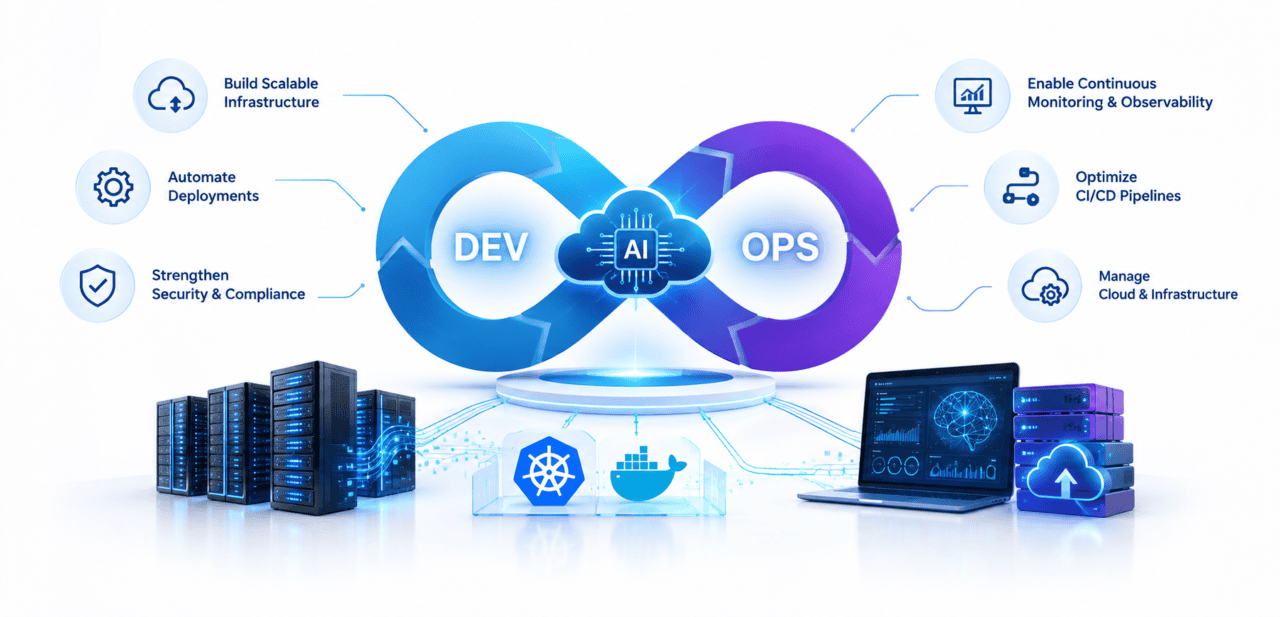
A strong DevOps services company builds the pipes that make releases boring. And boring is good. When a deploy is dull and predictable, nobody is up at 2 a.m. fixing it. The team stops dreading release day. They ship when the work is ready, not when the calendar says it is safe. That shift alone changes how a whole engineering group works.
The parts that matter
- CI/CD pipelines that build, test, and ship code on their own.
- Cloud setup written as code, so it is repeatable and easy to fix.
- Monitoring that flags trouble before your users feel it.
- Security built into the flow, not bolted on at the end.
Why AI raises the bar
AI has changed what delivery has to handle. Models are not static. They drift, they need retraining, and they behave in ways plain code never did.
So any AI business solution needs more than a smart model. It needs a pipeline that can deploy, watch, and update that model safely. Without one, the model works in a demo and falls apart in production. Data shifts. User behavior changes. A model that was accurate in January can quietly go wrong by June, and nobody notices until a customer complains.
This is the quiet reason so many AI projects stall. The model is fine. The delivery around it is not. A capable DevOps team is what carries an AI business solution from the lab into daily use.
What good delivery looks like day to day
It helps to picture the difference in plain terms. On a weak team, a release is an event. People block off the afternoon. Someone writes a rollback plan just in case. Everyone holds their breath.
On a strong team, a release is a non-event. Code merges, tests run, and the change goes live on its own. If something looks off, the system rolls it back before a human even reacts. That calm is not luck. It is built, one pipeline at a time.
The same calm applies to AI work. A model update flows through the same tested path as any other change. It gets checked, watched, and reversed if it misbehaves. No drama, no guesswork.
Where teams get it wrong
The mistakes rarely come from bad engineers. They come from skipping the boring groundwork.
- Manual deploys that work until the one time they do not.
- No monitoring, so problems surface as angry customers.
- Security bolted on late, when it is hardest to fix.
- No plan for model updates, so the AI slowly goes stale.
Each one is avoidable. A good DevOps services company sees these coming and builds around them from the start. The cost of fixing them early is small. The cost of fixing them after a public outage is not.
How to choose the right partner
The partner you pick shapes the outcome. A few signals tell you who is real.
- They automate releases, so deploys are routine, not risky.
- They treat security as part of the pipeline, not a final gate.
- They plan for AI workloads, including model monitoring and updates.
- They can show systems they run today, not just slides.
A partner who plans for what comes after launch is the one worth hiring. The quick setup that ignores upkeep always costs more later.
Frequently asked questions
What does a DevOps services company do?
It manages the systems that move software from code to production. That means CI/CD pipelines, cloud infrastructure, monitoring, and security. The goal is fast, safe, repeatable releases.
Why does DevOps matter for AI?
An AI business solution needs to deploy, monitor, and update models safely. Good DevOps provides that. Without it, a model that shines in a demo often breaks in production.
Does a DevOps company replace our engineers?
No. It handles the delivery groundwork, so your team can focus on building. The two work together.
How is AI delivery different from normal software?
Models drift and need retraining, while plain code does not. So it needs monitoring and update pipelines that standard apps can skip.
How do we pick a DevOps partner?
Choose one that automates releases, bakes in security, and plans for AI workloads. Ask them to show systems they run today, not just a deck.
The bottom line
Great software is not the one that demos well. It is the one that ships and keeps running. That is what a strong DevOps services company delivers. It makes releases safe, catches trouble early, and keeps your AI reliable long after launch. The work is quiet and mostly invisible, which is exactly why it gets skipped. But it is the difference between a system you trust and one you babysit. Get that foundation right, and everything you build on top holds up.