
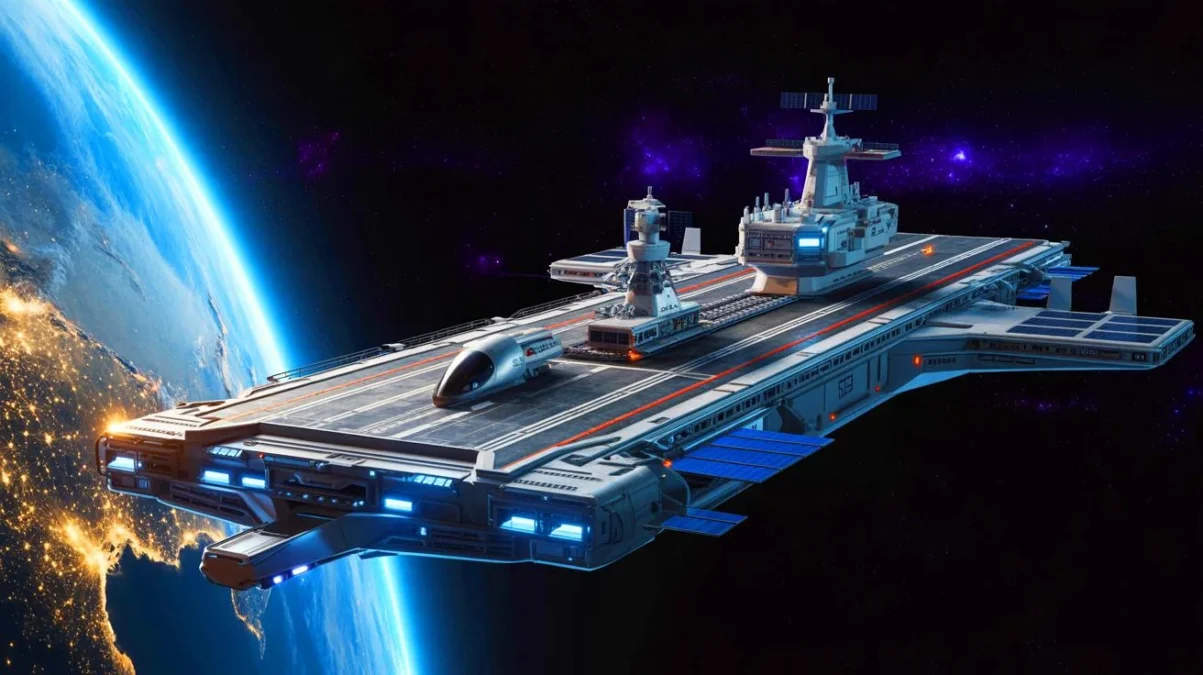

Introduction: The Era of Orbital Aircraft Carriers
Science fiction has long captivated human imagination with grand visions of massive military vessels patrolling the cosmos, but recent defense developments are steadily transforming those cinematic concepts into operational reality. The United States Space Force is actively shifting its strategic posture away from exclusive reliance on terrestrial launch facilities toward flexible, space-based architectures. At the forefront of this technological migration is the space force orbital warship carrier initiative, a project designed to establish a persistent operational presence directly within Earth’s orbit. By partnering with commercial aerospace innovators through substantial defense contracts, the military is laying the groundwork for a revolutionary infrastructure capable of housing, maintaining, and deploying strategic assets without the delays inherent to ground operations.
This visionary approach fundamentally redefines how national security organizations approach satellite logistics and orbital defense. Traditional space missions require weeks or months of meticulous launch preparation, leaving critical networks vulnerable during sudden geopolitical crises or physical counter-space attacks. The development of a functional space force orbital warship carrier resolves these vulnerabilities by operating as an on-demand deployment hub pre-positioned in low Earth orbit. Instead of waiting for favorable weather windows and rocket availability on Earth, defense commanders can release specialized payloads within minutes, ensuring immediate operational flexibility and establishing an unprecedented level of deterrence across the domain.
What Is the Space Force Orbital Carrier Project?
A common misconception surrounding the space force orbital warship carrier concept is that the military intends to build giant, heavily armed battlecruisers straight out of science fiction. In reality, the actual engineering project focuses on developing modular, large-diameter space station platforms engineered specifically for payload storage and autonomous release. Utilizing advanced module designs, such as those pioneered by aerospace developers like Gravitics, these structures feature spacious internal bays capable of housing maneuverable spacecraft, protective environmental shielding, robust power networks, and automated mechanical ejection systems built to launch small satellites on short notice.
Operating under the oversight of military innovation programs like SpaceWERX, this strategic initiative serves as an active, persistent orbital hub rather than a science-fiction warship. It keeps defensive payloads and reconnaissance hardware in a protected, ready-to-deploy state while sheltering sensitive electronics from the harsh thermal dynamics of space. By combining commercial modular space station designs with specialized defense requirements, the space force orbital warship carrier project establishes a versatile platform that bridges the gap between commercial space infrastructure and cutting-edge military capabilities.
Tactical Advantages: Why the US Space Force Needs Orbital Carriers
The modern space domain has quickly become a highly contested arena where adversary capabilities, including anti-satellite missiles, high-powered lasers, and signal jammers, pose real threats to vital orbiters. Deploying a dedicated space force orbital warship carrier offers a powerful defense strategy by drastically reducing the timeline needed to deploy replacement hardware or tactical countermeasures. By storing operational units inside an active carrier structure, the military effectively removes launchpad bottlenecks, enabling near-instantaneous responses to unexpected satellite failures or hostile actions.
Beyond rapid response capabilities, the carrier framework provides long-term physical protection for valuable military assets. Storing maneuverable craft inside a heavy, climate-controlled hull shields delicate internal components from micrometeorites, solar radiation, and extreme temperature fluctuations that typically degrade hardware over time. Furthermore, a fully operational space force orbital warship carrier serves as a centralized hub for dynamic space operations, offering docking ports for orbital refueling, hardware servicing, and hardware upgrades that dramatically extend the operational lifespan of deployed satellites.
How the Orbital Carrier System Operates in Low Earth Orbit

The operational lifecycle of this advanced carrier platform relies on a sophisticated three-phase logistics model execution within low Earth orbit. First, commercial heavy-lift rockets transport carrier modules and pre-loaded maneuverable spacecraft from Earth into stable storage orbits. Once positioned, internal control systems continuously monitor the health of every stored unit, preserving electrical reserves and propellants so that the hardware remains in peak operational condition throughout extended periods of inactive orbital storage.
The final operational phase centers on high-precision tactical ejection triggered by secure command networks. When a mission request is initiated, internal mechanical systems quickly align the selected payload and launch it into a precise orbital trajectory with incredible accuracy. By executing the entire deployment sequence directly in space, the space force orbital warship carrier eliminates traditional atmospheric ascent challenges, offering national defense networks an agile, highly reliable method for maintaining continuous situational awareness and rapid satellite fleet replenishment.
Geopolitical Implications and Strategic Defense Challenges
The emergence of an active space force orbital warship carrier carries profound geopolitical implications that are reshaping international discussions surrounding space security. Defense analysts predict that rival spacefaring nations will view these platforms as major strategic leaps, likely driving them to accelerate their own orbital staging and counter-space programs. As orbital real estate becomes increasingly crowded and militarized, the presence of persistent carrier platforms highlights the urgent necessity for updated international norms, clear rules of engagement, and robust communication channels between competing powers.
From a legal perspective, defensive carrier platforms remain fully compliant with foundational international frameworks like the 1967 Outer Space Treaty, which specifically prohibits weapons of mass destruction in orbit while permitting conventional defensive infrastructure. However, operating these complex structures introduces significant engineering and logistical hurdles. Program managers must navigate high development expenses, complex orbital traffic coordination, and proactive space debris mitigation strategies to ensure the carrier operates safely without endangering commercial or civilian satellites sharing low Earth orbit.
The Road to 2026 and Beyond: What Lies Ahead
Flight demonstration missions and technical pathfinders are progressing rapidly as engineering teams rigorously test avionics, ejection mechanics, and automated rendezvous software in orbit. The integration of modular carrier technology alongside existing space security programs creates an interconnected, highly responsive defense network. As manufacturing scales and flight tests validate payload release protocols, these platforms will transition from experimental prototypes into permanent components of national orbital infrastructure.
Looking further ahead, future iterations of the space force orbital warship carrier could expand their operational reach well beyond low Earth orbit. Extending carrier deployment into geostationary belts or cislunar space would create a multi-layered defense architecture capable of protecting deep-space assets and lunar logistics corridors. This ongoing technological evolution guarantees that orbital carrier platforms will remain central to space exploration, national defense, and satellite protection strategies for decades to come.
Conclusion
The transition toward persistent, space-based deployment architectures represents one of the most significant technological evolutions in modern aerospace history. The space force orbital warship carrier project successfully shifts orbital defense strategy from static, reactive ground launches toward dynamic, pre-positioned orbital readiness. By combining commercial space station designs with military operational requirements, the Pentagon is building a resilient framework capable of responding to complex threats in real time.
Collaborating with forward-thinking commercial aerospace partners ensures the United States Space Force maintains a decisive technological edge in an increasingly contested domain. As these carrier modules complete orbital testing and achieve full operational status, they will serve as vital guardians of human space infrastructure. By establishing reliable, on-demand satellite deployment, this pioneering initiative protects critical navigation, communication, and defense networks worldwide.
Frequently Asked Questions (FAQs)
What is a space force orbital warship carrier?
A space force orbital warship carrier is a modular orbital platform designed to store, service, and rapidly deploy maneuverable satellites and small spacecraft directly in space, functioning similarly to an aircraft carrier operating at sea.
Is the Space Force building heavily armed battleships for space?
No. The project does not involve building sci-fi warships equipped with heavy kinetic weapons or combat lasers. Instead, it focuses on modular, protective staging platforms engineered for satellite maintenance, defensive deployment, and orbital logistics support.
Which company is helping develop the Space Force orbital carrier?
Commercial aerospace developer Gravitics was selected by SpaceWERX for a Strategic Funding Increase (STRATFI) contract worth up to $60 million to design, build, and flight-test modular orbital carrier technologies.
How does an orbital carrier improve satellite deployment over traditional ground launches?
Earth-bound launches frequently suffer from weather delays, scheduling bottlenecks, and long ascent times. An orbital carrier keeps operational satellites pre-positioned directly in space, allowing commanders to deploy assets within minutes during a crisis.
Does the orbital carrier project violate international space treaties?
No. The Outer Space Treaty of 1967 bans weapons of mass destruction and nuclear assets in orbit. Conventional defensive deployment platforms, satellite hubs, and logistical support structures operate in full compliance with international space law.
You may also read: Marriage and Private Family Life with Matt Long