
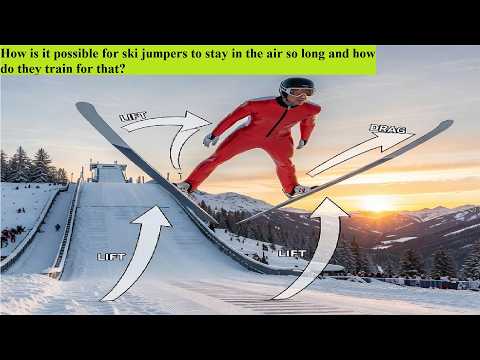

Imagine standing precariously at the absolute edge of a towering ice-glazed ramp, peering down a near-vertical drop before launching yourself completely into open space. When watching winter sports unfold on television or live from the stadium, millions of spectators find themselves wondering how is it possible for ski jumpers to stay in the air so long and how do they train for that? This breathtaking spectacle of human flight feels almost magical, defying the relentless pull of gravity and turning ordinary athletes into temporary aviators who can glide the entire length of a football field. Beneath this stunning visual display lies a precise, calculated combination of advanced aerodynamics, rigid physical physics, and relentless multi-year athletic preparation. Understanding the mechanics of this extreme sport requires looking deep into the delicate science of how human bodies interact with rushing air currents at terrifying speeds.
The journey of a ski jumper begins long before they ever leave the takeoff threshold, rooted deeply in the physics of momentum and gravitational acceleration. As competitors rocket down the steep in-run, they build immense velocity, translating potential energy into pure kinetic speed that they must harness in a split second. To achieve maximum flight duration, modern athletes utilize the evolutionary V-style technique, spreading their fiberglass skis wide apart to create roughly thirty percent more surface area than older parallel jumping methods. This strategic posture immediately transforms the athlete’s entire body into an organic glider wing, capturing oncoming wind resistance and converting it into sustained upward lift that keeps them floating effortlessly above the snow contour.
The Aerodynamics of Human Flight and Surface Area Mechanics
Mastering the delicate angle of attack is perhaps the single most critical factor that separates elite champions from recreational participants in the competitive circuit. Fans often ask how is it Possible for Ski Jumpers to stay in the air so long and how do they train for that? as they watch competitors lean forward aggressively at an exact thirty-degree angle relative to the rushing wind. Carefully balancing air pressure above and below their soaring frames prevents an abrupt and dangerous loss of lift that would shorten their distance significantly. Every single millimeter of posture adjustment dictates whether a jumper catches a powerful thermal pocket or sinks prematurely toward the ground.
Beyond body positioning and posture control, specialized athletic equipment acts as an invisible engine that sustains these extended airborne moments. Modern competition suits are meticulously engineered from slightly porous fabrics designed to catch rushing air currents while maintaining strict aerodynamic streamlining. Furthermore, international sports federations enforce stringent regulations regarding body mass index and suit permeability to ensure absolute fairness across the board. Lighter athletes frequently harness a fascinating natural advantage, because lower body weight interacts differently with gravitational pull, allowing them to remain suspended in the air for longer durations as they glide smoothly toward the landing zone.
Elite Training Regimes and Progressive Skill Development
Achieving world-class status in this extreme sport requires years of dedicated, incremental preparation, which consistently brings us back to the core question of how is it possible for ski jumpers to stay in the air so long and how do they train for that? Athletes typically begin their developmental journey at a remarkably young age, starting out on miniature plastic summer ramps that measure barely one meter in height. Over many years of consistent practice, these aspiring competitors gradually progress to intermediate hills before finally attempting massive, terrifying ski-flying structures that demand absolute psychological fortitude and flawless technical execution.
In addition to traditional on-snow practice, elite competitors spend countless hours inside professional wind tunnels to refine their craft to absolute perfection. These specialized facilities allow coaches and aerodynamicists to study microscopic shifts in body posture, suit permeability, and glove positioning under simulated flight conditions. By analyzing real-time data inside the wind tunnel, athletes learn how to minimize aerodynamic drag and maximize lift, ensuring that every single flight maximizes both distance and safety before they ever step foot onto an international competition ramp.
Dry-Land Conditioning, Explosive Power, and Simulation Drills

Off the snow, winter sport champions endure grueling, year-round conditioning routines explicitly designed to build explosive leg power, lightning-fast reflexes, and impenetrable core stability. Summer training regimens regularly feature intensive water-ramp jumping sessions where athletes launch themselves off steep slides directly into deep lakes, practicing their mid-air body control without the terrifying risk of a hard snow impact. Aspiring young athletes constantly research how is it possible for ski jumpers to stay in the air so long and how do they train for that? to replicate these exact aquatic simulations that help build the critical muscle memory required to maintain a rigid, aerodynamic V-style posture while traveling through the freezing atmosphere at highway speeds.
Furthermore, dry-land workouts heavily incorporate advanced trampoline training and heavy resistance weightlifting to cultivate extraordinary lower-body explosiveness. The instantaneous takeoff from the ramp requires immense leg drive, meaning athletes must possess phenomenal quadricep, hamstring, and gluteal strength combined with exceptional balance. Without this rigorous physical conditioning foundation, even the most talented jumper would struggle to generate the initial upward thrust needed to initiate a successful, long-distance flight.
Surviving the Impact and Mastering Safe Landing Mechanics
Sustaining a magnificent, multi-second flight means absolutely nothing if the athlete cannot safely absorb the violent mechanical forces associated with the final descent. Fortunately, ski jumping hills are purposefully engineered with a steep landing slope that perfectly matches the natural trajectory of the descending athlete’s flight path. This brilliant architectural design drastically reduces the impact shock your body has to absorb, distributing the kinetic energy safely compared to the catastrophic forces of dropping directly onto flat ground.
To finalize their jump successfully and impress the panel of judges watching closely from below, competitors must execute the legendary Telemark landing style. This specialized technique requires the jumper to land with one foot staggered slightly ahead of the other while maintaining a low, balanced center of gravity to absorb remaining momentum gracefully. By mastering this precise landing posture, athletes protect their joints from severe injury while securing maximum style points that can ultimately determine the podium winners in high-stakes international competitions.
Frequently Asked Questions (FAQs)
How long are ski jumpers actually suspended in the air during a competitive jump?
Elite competitors typically remain airborne for about five to seven seconds, though the exact duration depends heavily on hill size, jumper weight, and prevailing wind conditions.
How fast do professional athletes travel when they leave the takeoff table?
Professional ski jumpers routinely reach staggering takeoff speeds between fifty-five and sixty miles per hour (ninety to ninety-five kilometers per hour) at the very end of the ramp.
Why did the international sport transition from parallel skis to the modern V-style?
Introduced in the mid-1980s, spreading the skis into a wide V-shape dramatically increases surface area and aerodynamic lift, allowing athletes to fly significantly farther and safer than older techniques.
At what age do prospective champions usually begin learning how is it possible for ski jumpers to stay in the air so long and how do they train for that?
Most athletes start training on small plastic-matted ramps between six and ten years old to build essential balance, spatial body awareness, and fearless confidence early in their developmental years.
Do winter sport competitors get injured frequently during their landings?
While dramatic crashes can occasionally happen due to sudden wind shifts, landing on a sloped contour aligned with the flight trajectory effectively absorbs the impact shock, making serious injuries relatively rare under standard competitive conditions.
You may also read: Step-by-Step Guide to Effective Domain Discovery