

Most people asking this question are really asking two things: how rough will the next few days be, and how long before I can eat normally and stop thinking about it. The answers are quite different, because implant treatment has a short recovery and a long one running at the same time.
The short one is the surgery itself, and it’s usually milder than expected. The long one is the bone fusing to the implant, which happens quietly over months while you go about your life. Before you start, your Pyrmont dentist will map both out for your case, since the timeline shifts depending on which jaw is involved and whether any grafting is needed.
The first 48 hours
Expect some oozing on the first day, swelling that builds rather than appears immediately, and discomfort that responds to over-the-counter pain relief for most people. Swelling generally peaks around day two or three and then falls away, which catches people out when they wake up looking worse on Tuesday than they did on Monday.
What helps:
- Cold packs on the cheek in short bursts through the first day
- Sleeping with your head elevated
- Soft, cool food and plenty of water
- Leaving the site alone rather than poking at it with your tongue
- No smoking, no straws, no vigorous rinsing on day one
Salt water rinses usually start from the second day. Skip the gym for a few days, since raising your blood pressure early on can restart bleeding.
The first week
By around day three or four, most people are noticeably more comfortable. Plenty return to desk work the day after a single implant, though anything physical is worth delaying. Stitches either dissolve or come out at a review appointment in the first fortnight.
Eating is the main adjustment. Soft food on the implant side for the first week or two is standard advice, and it’s not a punishment so much as protection: chewing forces on a freshly placed implant are the thing to avoid while the surrounding bone settles.
The part that takes months
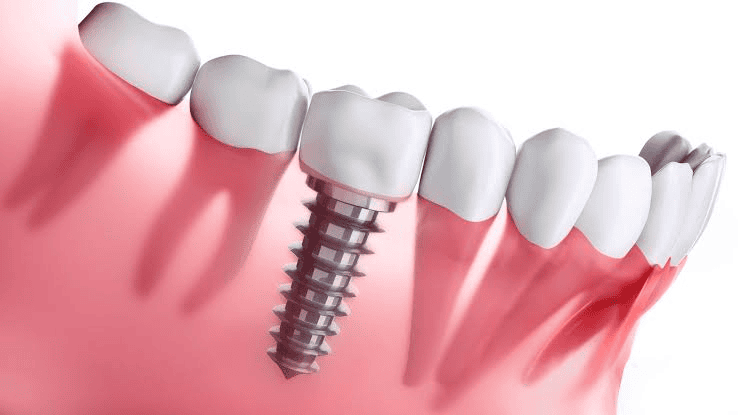
Here’s where the real timeline lives. An implant works because bone grows directly onto its surface, a process called osseointegration, and that can’t be rushed. It commonly takes around three to four months in the lower jaw and longer in the upper, where the bone is less dense. If you need a bone graft or a sinus lift, add further healing time before the implant goes in at all.
You’re not toothless in the meantime. A temporary tooth, a partial denture or a bonded bridge usually covers the gap, particularly at the front. Some cases suit a temporary crown fitted on the day, though even then the diet restrictions stay in place while the bone does its work.
Fitting the actual tooth
Once integration is confirmed, the restorative stage begins: an abutment is attached, impressions or a scan are taken, and the crown is made and fitted. This part is comfortable and typically spans a few weeks. From first surgery to final crown, a straightforward single implant often runs four to six months, and cases involving grafting run longer.
What slows things down
Smoking is the big one, because it reduces blood supply to healing bone and raises the risk of early failure. Poorly controlled diabetes, untreated gum disease, heavy grinding and certain bone medications all matter as well. None of these automatically rule implants out, but they change the planning and sometimes the timeline.
Ring your clinic rather than waiting it out if pain increases after day three, swelling worsens after day four, you develop a fever or a bad taste, or the implant feels loose at any point.
Frequently asked questions
How much time off work should I take?
For a single implant, one day is enough for many people and two is comfortable. Multiple implants, grafting or a more complex surgical site can mean three to five days, particularly for physical work.
When can I eat normally again?
Soft food for one to two weeks, then gradually back to normal on the other side. Full chewing on the implant itself waits until the crown is fitted and your dentist gives the all-clear.
Is the recovery worse than a tooth extraction?
Usually not. Many patients report less discomfort after an implant than after having the tooth removed in the first place, partly because implant sites are prepared with more control.
Does it hurt during the procedure?
The surgery is done under local anaesthetic, so you feel pressure rather than pain. Sedation options are available if you’re anxious about it.
Planning around it
Recovery from the surgery is measured in days. Recovery of the bone is measured in months, and that stretch is mostly uneventful. If you’re timing treatment around a wedding, a holiday or a busy work period, bring that up at the consultation. The sequence has more flexibility than people assume when it’s planned early rather than mid-treatment.