
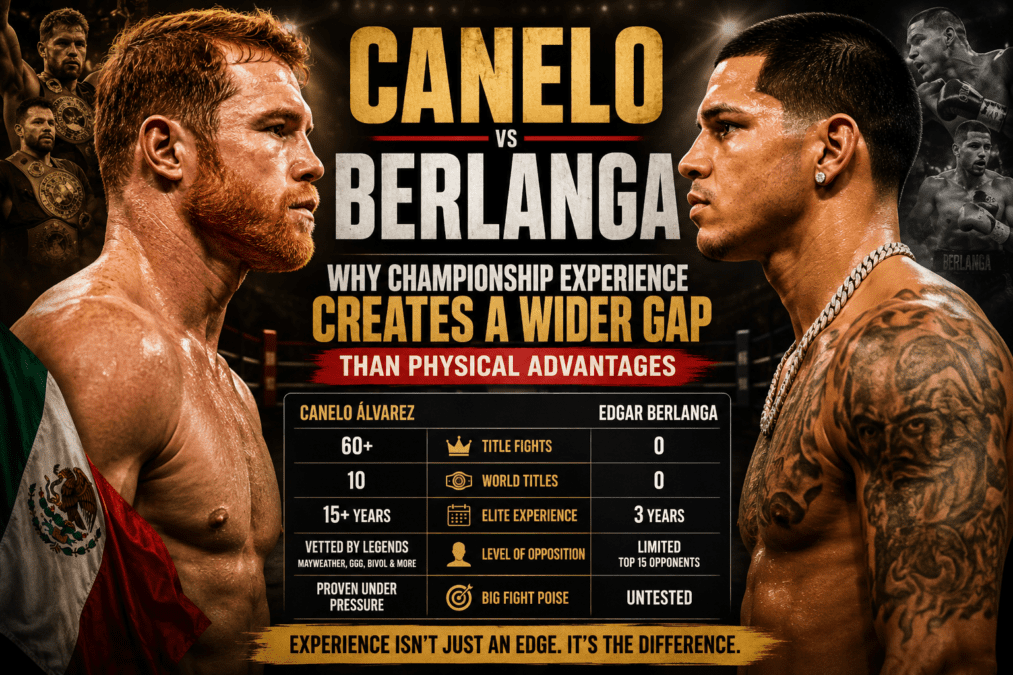

The canelo vs berlanga matchup represents one of boxing’s most intriguing modern comparisons because it pits proven elite championship experience against explosive knockout potential. On one side stands Mexican superstar Canelo Álvarez, a multi-division world champion whose résumé includes victories over some of boxing’s most accomplished fighters. On the other stands Edgar Berlanga, an undefeated power puncher who built his reputation through a remarkable streak of first-round knockouts and aggressive offensive performances.
A meaningful canelo vs berlanga analysis requires more than comparing records or knockout percentages. Modern boxing evaluation must consider technical adaptability, championship-level opposition, tactical intelligence, defensive responsibility, endurance under pressure, and the ability to execute strategic adjustments during elite competition. These dimensions often determine outcomes more reliably than raw athletic attributes.
The most surprising insight from the canelo vs berlanga discussion is that physical advantages alone rarely overcome the accumulated advantages created by years of elite-level competition. While Berlanga possesses youth, size, and power, Canelo’s greatest weapon may be something less visible: an extensive database of championship experiences that allows him to recognize patterns, solve problems, and control high-pressure moments with remarkable consistency.
A professional boxing comparison evaluates how two fighters perform across technical, physical, strategic, and psychological dimensions.
The canelo vs berlanga debate centers on whether emerging power and athleticism can overcome elite championship experience and technical mastery.
While Berlanga may offer greater youthful explosiveness, Canelo possesses a deeper collection of proven skills developed against significantly stronger opposition throughout his career.
Direct Answer: In a comprehensive canelo vs berlanga evaluation, Canelo holds substantial advantages in experience, defensive technique, ring intelligence, adaptability, and championship performance. Berlanga’s primary advantages involve youth, power, physical confidence, and offensive aggression. Most boxing analysts consider championship experience the decisive differentiator because elite-level decision-making often neutralizes physical advantages over the course of a fight.
Essential Comparative Metrics
| Attribute | Canelo Álvarez | Edgar Berlanga |
|---|---|---|
| Professional Status | Multi-Division World Champion | Contender and Rising Star |
| Fighting Style | Counter-Puncher / Pressure Boxer | Aggressive Power Puncher |
| Experience Level | Elite Championship Veteran | Developing Elite Competitor |
| Notable Strength | Ring IQ and Adaptability | Explosive Knockout Power |
| Defensive Ability | Exceptional | Above Average |
| Body Punching | Elite | Strong |
| Championship Rounds | Extensive | Limited Relative Experience |
| Pressure Management | Proven at the Highest Level | Still Being Evaluated |
| Strategic Flexibility | Very High | Moderate to High |
| Career Stage | Established Legend | Emerging Contender |
Structural And Biological Foundations
From a physical perspective, the canelo vs berlanga comparison begins with contrasting athletic profiles. Berlanga represents the younger generation of super-middleweight competitors. Youth typically provides advantages in recovery speed, explosiveness, reflexive reactions, and sustained athletic output. His frame and natural power generation have contributed significantly to his reputation as a dangerous offensive fighter.
Canelo, meanwhile, demonstrates a different athletic model. Rather than relying primarily on speed or volume, he has refined efficiency. Years of elite competition have produced exceptional balance, timing, punch placement, and defensive positioning. These qualities often age better than raw athleticism because they depend on accumulated skill rather than purely physical attributes.
In the canelo vs berlanga discussion, biology alone does not provide a complete answer. Boxing history repeatedly shows that refined technique can compensate for modest physical disadvantages. The key question is whether Berlanga’s physical strengths can create opportunities before Canelo’s technical advantages begin controlling the pace and structure of the contest.
Behavioral Patterns And Social Intelligence
Boxing intelligence extends beyond tactical knowledge. It includes emotional regulation, pressure management, adaptability, and the ability to interpret an opponent’s intentions in real time. This dimension is often overlooked in casual canelo vs berlanga conversations but may be one of the most important factors.
Canelo consistently demonstrates remarkable composure. Throughout his career, he has faced hostile crowds, championship expectations, elite challengers, and high-stakes events. Rarely does he appear emotionally overwhelmed. Instead, he collects information during rounds, identifies patterns, and gradually imposes strategic control.
Berlanga’s behavioral profile is built around confidence and aggression. He projects belief in his offensive abilities and often seeks to establish psychological dominance early. Such confidence can become a powerful competitive asset because hesitation is frequently punished in boxing.
The challenge in the canelo vs berlanga equation lies in determining which psychological style proves more effective under championship pressure. Aggressive confidence can create opportunities, but calm analytical decision-making often becomes increasingly valuable as fights progress into deeper rounds.
Subject A: Strengths And Constraints
The strongest argument in favor of Canelo within the canelo vs berlanga analysis is the extraordinary breadth of his skill set. Few fighters combine defensive awareness, counter-punching precision, body attack efficiency, timing, and strategic flexibility at such a high level. He rarely depends on a single pathway to victory.
Another significant advantage is opponent quality. Canelo has spent years competing against world champions and elite contenders. This exposure creates a vast reservoir of tactical experiences. When confronted with unfamiliar situations, he can often draw from previous encounters to formulate effective responses.
However, no fighter is without limitations. As athletes accumulate mileage, maintaining peak physical performance becomes increasingly difficult. Small declines in reaction speed, movement, or stamina may not be obvious but can influence competitive outcomes against younger opponents.
In the canelo vs berlanga matchup, Canelo’s challenge is ensuring that experience remains a decisive advantage rather than allowing youth and aggression to dictate the tempo. Managing distance and avoiding unnecessary exchanges becomes especially important against a powerful challenger.
Subject B: Strengths And Constraints
Berlanga enters the canelo vs berlanga discussion with attributes that naturally attract attention. His punching power, offensive mindset, and confidence make him a dangerous opponent for any fighter. Knockout threats alter strategic calculations because every exchange carries elevated risk.
His youth also creates unpredictability. Younger fighters often improve rapidly, and traditional performance models sometimes underestimate developmental leaps. If a fighter successfully combines natural athletic ability with growing technical sophistication, dramatic progression can occur over a relatively short period.
The primary concern involves experience against elite opposition. Dominating less accomplished opponents does not necessarily prepare a fighter for championship-level problem solving. Elite competitors present complex tactical challenges that cannot always be solved through aggression alone.
Within the canelo vs berlanga framework, Berlanga’s greatest opportunity lies in creating moments of uncertainty. If he can force exchanges, disrupt rhythm, and capitalize on power opportunities, he increases the likelihood of shifting momentum. The difficulty is sustaining effectiveness against a veteran renowned for defensive discipline and tactical adjustments.
Comparative Advantages In Real-World Scenarios
Examining practical fight scenarios reveals why the canelo vs berlanga debate remains fascinating. In early rounds, Berlanga may benefit from freshness, enthusiasm, and offensive initiative. Aggressive starts can place psychological and tactical pressure on opponents, especially if meaningful power shots connect.
Mid-fight scenarios generally favor experience. This is where pattern recognition becomes critical. Fighters with extensive championship backgrounds often begin identifying tendencies, timing entries, and exploiting recurring mistakes. Canelo has repeatedly demonstrated excellence in this phase of competition.
Late rounds create another layer of analysis. Championship experience often improves energy management and strategic discipline. Fighters accustomed to twelve-round contests understand how to conserve resources while maintaining effectiveness.
Therefore, the canelo vs berlanga comparison changes depending on timing. Berlanga may possess advantages during explosive exchanges, while Canelo typically benefits from prolonged strategic contests. The longer a fight becomes a technical problem-solving exercise, the more valuable accumulated experience tends to become.
Technical Skill Comparison
A technical breakdown strengthens understanding of the canelo vs berlanga matchup. Canelo’s defensive structure ranks among the sport’s best. His head movement, upper-body positioning, counter-punch timing, and ability to minimize clean impacts create substantial challenges for aggressive opponents.
Berlanga’s offensive technique emphasizes power generation and forward momentum. He excels when dictating action and forcing opponents into exchanges. His ability to generate impactful punches quickly makes him dangerous even when trailing strategically.
The distinction becomes particularly important when evaluating efficiency. Elite boxing often rewards accuracy over activity. A fighter landing fewer but cleaner punches can outperform an opponent generating greater volume with lower effectiveness.
In the canelo vs berlanga context, technical efficiency generally favors Canelo. Berlanga’s success depends on translating offensive pressure into meaningful scoring opportunities without exposing himself to counters. Achieving that balance against an elite technician represents one of boxing’s most difficult challenges.
Tactical Adaptability And Ring IQ
Ring intelligence may be the most significant factor in any serious canelo vs berlanga evaluation. Great fighters are not merely skilled; they are adaptable. They recognize changing circumstances and modify strategies accordingly.
Canelo has repeatedly demonstrated this capability. He can pressure opponents, box from range, counter effectively, attack the body, or slow the pace depending on tactical requirements. Such versatility prevents opponents from relying on a single game plan.
Berlanga’s development as a strategist remains one of the most interesting aspects of his career. The more diverse his tactical toolkit becomes, the more dangerous he grows against elite competition. Power alone rarely sustains long-term championship success.
When analysts discuss canelo vs berlanga, ring IQ frequently emerges as a central theme. Physical tools create opportunities, but strategic interpretation determines how effectively those opportunities are used. This area remains one of Canelo’s most significant advantages.
Scientific And Expert Consensus (2026)
The broader expert consensus surrounding canelo vs berlanga generally emphasizes experience as the defining variable. Boxing analysts, trainers, and performance evaluators often place substantial value on demonstrated success against elite competition because it provides evidence under the sport’s most demanding conditions.
Research into combat sports performance consistently highlights decision-making quality as a major predictor of success. Fighters capable of processing information quickly, adapting strategies, and managing emotional responses often outperform opponents possessing superior raw athletic characteristics.
Experts evaluating canelo vs berlanga typically identify several decisive categories: defensive reliability, championship experience, tactical flexibility, and proven performance under pressure. In each area, Canelo maintains a measurable advantage.
That consensus does not imply inevitability. Combat sports remain inherently unpredictable. Power punchers can alter outcomes with a single sequence. Nevertheless, when experts compare total skill portfolios rather than isolated strengths, the majority assessment tends to favor the fighter with the more complete competitive résumé.
Historical Context And Legacy Implications
The canelo vs berlanga matchup also carries broader significance within boxing’s generational cycle. Established champions eventually encounter emerging challengers seeking validation. These contests often function as tests of whether experience can continue resisting youthful ambition.
For Canelo, such fights reinforce legacy. Successful performances demonstrate that elite skills remain effective even against younger, stronger, and highly motivated opponents. Maintaining excellence across different competitive eras strengthens historical standing.
For Berlanga, the opportunity is transformative. Competing against an established superstar provides a platform unavailable through ordinary contests. A breakthrough performance can instantly alter public perception and career trajectory.
This broader context elevates the importance of canelo vs berlanga beyond a simple stylistic comparison. It becomes a case study in how boxing transitions from one generation to the next and whether emerging contenders are prepared to assume leadership positions within the sport.
Final Synthesis And Verdict
After evaluating physical attributes, technical skills, behavioral characteristics, tactical intelligence, and expert consensus, the overall canelo vs berlanga assessment favors Canelo. The margin is not created primarily by power, size, or athleticism. Instead, it emerges from accumulated championship experience and a more complete competitive skill set.
Berlanga possesses legitimate strengths. His confidence, youth, offensive aggression, and knockout potential ensure he remains dangerous throughout any contest. These qualities prevent the comparison from being one-sided.
However, the central conclusion of the canelo vs berlanga analysis remains consistent. Experience at the highest levels of boxing creates advantages that are difficult to quantify but impossible to ignore. Pattern recognition, composure, adaptability, and strategic discipline frequently determine outcomes when talent levels are relatively close.
The final verdict is that Canelo’s proven championship foundation provides the stronger overall profile. Berlanga offers intrigue and potential, but the evidence suggests that elite experience remains one of boxing’s most valuable competitive assets.
Frequently Asked Questions
Who has more power in the canelo vs berlanga comparison?
Most observers view Berlanga as the naturally bigger one-punch knockout threat. However, Canelo combines significant power with superior timing, accuracy, and body punching technique, making his offense highly effective despite differing stylistic approaches.
Why do analysts favor Canelo in most canelo vs berlanga predictions?
Analysts typically emphasize championship experience, defensive skills, tactical adaptability, and success against elite opponents. These factors provide stronger predictive value than raw power alone.
What is Berlanga’s biggest advantage in canelo vs berlanga discussions?
Youth, explosiveness, confidence, and offensive aggression are generally considered Berlanga’s greatest advantages. His ability to create dangerous exchanges gives him opportunities against any opponent.
What is the most important factor in canelo vs berlanga evaluations?
Most experts identify experience as the defining variable. Elite-level competition develops decision-making, composure, and adaptability that often become decisive during high-pressure championship fights.