
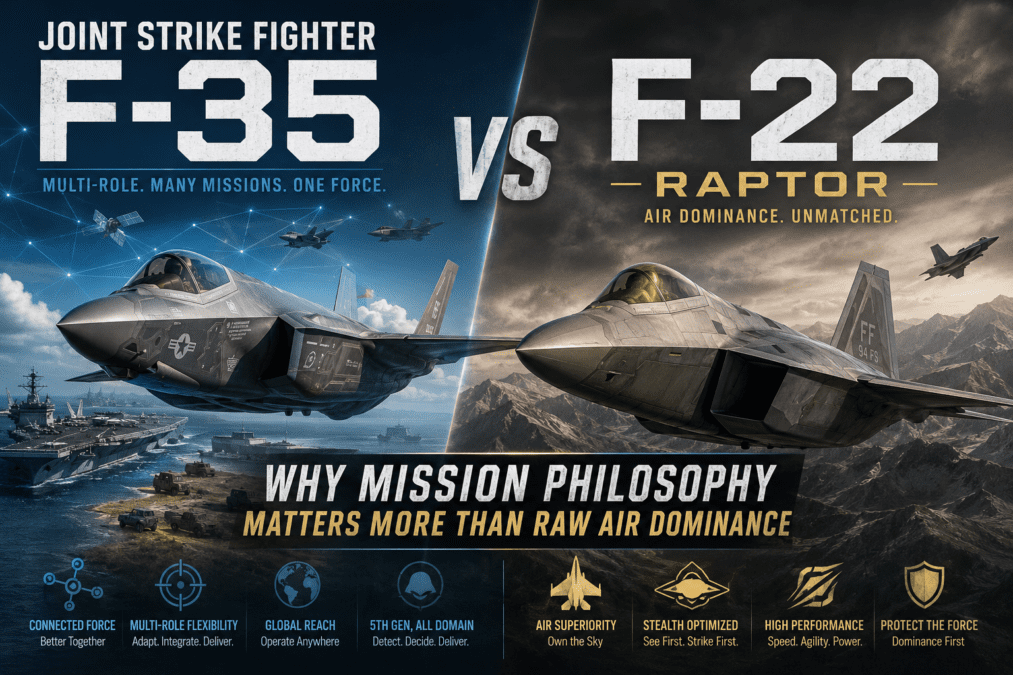

The debate surrounding joint strike fighter vs f 22 raptor remains one of the most significant discussions in modern military aviation. Both aircraft emerged from different strategic requirements within the United States military, yet they are often compared because they represent the pinnacle of fifth-generation fighter technology. The Joint Strike Fighter program produced the F-35 Lightning II, while the F-22 Raptor was developed primarily as an air-superiority fighter designed to dominate enemy aircraft.
A meaningful joint strike fighter vs f 22 raptor analysis requires more than comparing speed, stealth, or maneuverability. These aircraft were engineered to solve different operational problems. The F-22 was designed to win control of the skies against sophisticated adversaries, whereas the Joint Strike Fighter was conceived as a multi-role platform capable of serving multiple military branches while integrating advanced sensor fusion and network-centric warfare capabilities.
The most surprising insight in the joint strike fighter vs f 22 raptor debate is that the technically superior aircraft in a pure dogfight is not necessarily the more strategically valuable platform. Modern warfare increasingly rewards information dominance, interoperability, and multi-domain integration rather than relying solely on traditional fighter performance metrics.
Comparative Metrics Overview
| Attribute | Joint Strike Fighter (F-35 Lightning II) | F-22 Raptor |
|---|---|---|
| Primary Mission | Multirole Strike Fighter | Air Superiority Fighter |
| First Flight | 2006 | 1997 |
| Service Entry | 2015 | 2005 |
| Variants | F-35A, F-35B, F-35C | Single Operational Variant |
| Maximum Speed | Mach 1.6 | Mach 2+ |
| Supercruise Capability | Limited | Yes |
| Stealth Design | All-Aspect Low Observable | Optimized For Air Combat Stealth |
| Internal Weapons Capacity | Moderate | Higher Air-To-Air Focus |
| Sensor Fusion | Industry Leading | Advanced But Older Architecture |
| International Operators | Extensive Global Adoption | United States Only |
| Production Status | Active | Production Ended |
| Primary Strategic Value | Multi-Mission Flexibility | Air Dominance |
A Joint Strike Fighter is a fifth-generation multirole combat aircraft designed to perform air-to-air, air-to-ground, reconnaissance, and electronic warfare missions within a single platform.
The F-22 Raptor is a fifth-generation air-superiority fighter optimized to defeat enemy aircraft through stealth, speed, maneuverability, and advanced weapons integration.
In the context of joint strike fighter vs f 22 raptor, the F-35 emphasizes information sharing and mission flexibility, while the F-22 prioritizes unmatched aerial combat performance and air dominance.
Structural And Technological Foundations
Understanding joint strike fighter vs f 22 raptor begins with their underlying design philosophies. The F-22 was conceived during an era when military planners anticipated large-scale confrontations with advanced enemy fighter fleets. Its structure prioritizes aerodynamic efficiency, thrust-vectoring capability, and superior kinematic performance. Every aspect of its design supports the objective of winning air combat engagements.
The Joint Strike Fighter follows a fundamentally different path. Rather than maximizing one mission area, engineers sought to create a versatile aircraft adaptable across multiple military services. The resulting platform balances stealth, sensor integration, strike capability, and operational flexibility. Its architecture allows pilots to receive an unprecedented level of battlefield awareness.
The distinction is significant because aircraft design inevitably involves tradeoffs. In joint strike fighter vs f 22 raptor, one aircraft sacrifices specialization for adaptability, while the other sacrifices flexibility to achieve exceptional performance within a narrower mission profile.
Behavioral Patterns And Combat Intelligence
Modern fighter aircraft can be viewed as flying information systems. This perspective dramatically reshapes the joint strike fighter vs f 22 raptor discussion.
The F-22 excels at detecting, engaging, and defeating hostile aircraft. Its avionics provide impressive situational awareness, but they were developed during an earlier technological era. Although continually upgraded, the aircraft’s architecture reflects design priorities established decades ago.
The Joint Strike Fighter introduces a more integrated concept of combat intelligence. Sensor fusion combines radar inputs, electronic warfare data, infrared tracking, and external information streams into a unified operational picture. Instead of managing multiple independent systems, pilots receive a synthesized understanding of the battlespace.
This difference affects battlefield behavior. The F-22 acts as an elite hunter focused on controlling airspace. The Joint Strike Fighter functions more like a command-and-control node capable of collecting, processing, and distributing information throughout a military network.
As a result, the joint strike fighter vs f 22 raptor comparison increasingly centers on information dominance rather than purely aerodynamic performance.
Stealth And Survivability Analysis
Stealth remains one of the most important factors in any joint strike fighter vs f 22 raptor evaluation.
The F-22 was specifically engineered to minimize detection during air combat operations. Its shape, materials, engine integration, and radar signature management make it exceptionally difficult for adversaries to track and target. Combined with high speed and supercruise capability, this stealth profile enables the aircraft to penetrate contested airspace while maintaining tactical advantages.
The Joint Strike Fighter also employs advanced stealth technologies but applies them across a wider mission spectrum. Its design balances survivability with strike missions, intelligence gathering, and electronic warfare functions. Rather than relying exclusively on physical stealth, the aircraft supplements survivability through electronic warfare capabilities and networked awareness.
Some analysts argue that the F-22 retains a slight advantage in pure stealth performance. However, survivability in modern warfare increasingly depends on sensing threats before they become lethal. This is where the Joint Strike Fighter’s integrated systems contribute significantly.
Consequently, joint strike fighter vs f 22 raptor discussions often reveal that stealth alone no longer defines battlefield survivability.
Air-To-Air Combat Performance
Air superiority remains the category where the F-22 establishes its strongest position in the joint strike fighter vs f 22 raptor comparison.
The aircraft combines supercruise, thrust-vectoring nozzles, high thrust-to-weight ratios, and exceptional agility. These characteristics provide advantages in beyond-visual-range and within-visual-range combat scenarios. The F-22 can engage threats while maintaining favorable energy states and maneuvering options.
The Joint Strike Fighter approaches air combat differently. Instead of relying primarily on aerodynamic dominance, it emphasizes detection, targeting, and first-shot opportunities. Advanced sensors allow pilots to identify threats early and coordinate engagements across a broader network.
In a traditional dogfight, many experts believe the F-22 possesses a significant edge. Its maneuverability and acceleration remain among the best ever fielded in a production fighter.
However, air combat increasingly occurs beyond visual range. Therefore, the joint strike fighter vs f 22 raptor debate cannot be resolved solely by examining turning performance or speed metrics.
Strike Capability And Ground Attack Operations
One area where the joint strike fighter vs f 22 raptor comparison shifts dramatically is strike warfare.
The Joint Strike Fighter was designed from the beginning to conduct precision attacks against ground targets. Its sensor suite, targeting systems, and weapons integration enable operations against diverse target sets under challenging conditions.
The F-22 possesses limited ground-attack capability but was never intended to function as a primary strike platform. Its mission remains centered on establishing and maintaining air superiority.
This distinction has profound strategic implications. Modern conflicts often involve precision strikes, suppression of enemy air defenses, and close coordination with ground forces. The Joint Strike Fighter’s versatility allows commanders to assign a broader range of missions to a single aircraft type.
For nations seeking maximum capability from limited fleets, this flexibility frequently becomes a decisive advantage in the joint strike fighter vs f 22 raptor assessment.
Sensor Fusion And Battlefield Awareness
Perhaps no area better illustrates modern military transformation than sensor integration. This category frequently determines the outcome of the joint strike fighter vs f 22 raptor debate among defense analysts.
The Joint Strike Fighter was built around sensor fusion as a core principle. Radar systems, infrared sensors, electronic support measures, and external intelligence sources contribute to a single coherent operational picture. This reduces pilot workload while enhancing situational awareness.
The F-22 offers impressive awareness capabilities, but its architecture reflects an earlier generation of systems engineering. Although upgrades continue to improve functionality, the aircraft was not originally designed around the same degree of digital integration.
Battlefield awareness often translates directly into survivability and mission success. Pilots who understand the environment better can make faster and more informed decisions.
Because of this reality, many military planners increasingly view the joint strike fighter vs f 22 raptor comparison through the lens of information management rather than pure aircraft performance.
Operational Flexibility And Mission Diversity
A major differentiator in joint strike fighter vs f 22 raptor analysis is mission adaptability.
The Joint Strike Fighter supports conventional takeoff operations, carrier deployments, and short takeoff/vertical landing configurations depending on variant. This flexibility enables service across air forces, navies, and marine aviation units.
The F-22 lacks this adaptability because its design focused on achieving air dominance at the highest possible level. While extraordinarily effective within its mission set, it cannot fulfill the same range of operational requirements.
Military budgets increasingly favor platforms capable of performing multiple tasks. Aircraft that can conduct strike missions, reconnaissance, electronic warfare, and air combat offer greater strategic value in many operational environments.
This reality explains why the Joint Strike Fighter has achieved broad international adoption while the F-22 remains a uniquely American capability.
Cost, Sustainment, And Strategic Economics
Economics play a substantial role in the joint strike fighter vs f 22 raptor discussion.
The F-22 represents one of the most sophisticated fighter aircraft ever produced. Its advanced design and relatively limited production run contributed to high acquisition and sustainment costs. Maintaining such specialized capabilities requires significant investment.
The Joint Strike Fighter also faced cost controversies during development. However, larger production volumes and international participation created economies of scale unavailable to the F-22 program.
Strategic value is not determined solely by performance. Military planners must evaluate procurement costs, maintenance requirements, modernization pathways, and long-term fleet sustainability.
When examined through this lens, the joint strike fighter vs f 22 raptor comparison becomes less about identifying a superior aircraft and more about determining which platform better aligns with national defense priorities.
Global Influence And Alliance Integration
The international dimension significantly influences the joint strike fighter vs f 22 raptor debate.
The F-22 has never been exported, preserving its advanced capabilities exclusively for U.S. forces. This policy reflects concerns about protecting sensitive technologies and maintaining strategic advantages.
The Joint Strike Fighter, by contrast, serves as a multinational defense platform. Allied nations operate compatible variants, creating opportunities for interoperability, shared logistics, and coordinated modernization efforts.
This international ecosystem generates strategic effects beyond combat performance. Shared technology standards strengthen alliances and improve coalition effectiveness during multinational operations.
Consequently, the Joint Strike Fighter’s influence extends far beyond aviation. It functions as both a military asset and a geopolitical instrument.
Comparative Advantages In Real-World Scenarios
A practical joint strike fighter vs f 22 raptor assessment depends heavily on mission context.
If the objective is defeating advanced enemy fighters and establishing uncontested air superiority, the F-22 remains extraordinarily difficult to surpass. Its speed, stealth, maneuverability, and combat performance create advantages specifically tailored for aerial dominance.
If the mission involves precision strikes, intelligence gathering, coalition warfare, electronic warfare, or multi-role operations, the Joint Strike Fighter frequently becomes the preferred choice. Its versatility allows commanders to adapt quickly to evolving operational requirements.
In a modern conflict, both aircraft often complement rather than compete with one another. The F-22 can secure airspace while the Joint Strike Fighter exploits information superiority and mission flexibility.
This synergy highlights an important lesson from the joint strike fighter vs f 22 raptor debate: military effectiveness increasingly depends on integrated systems rather than isolated platforms.
Scientific And Expert Consensus (2026)
Defense analysts in 2026 generally agree that direct comparisons between these aircraft can be misleading. The joint strike fighter vs f 22 raptor discussion often assumes both aircraft pursue identical objectives, which is not the case.
Expert consensus typically recognizes the F-22 as the premier operational air-superiority fighter. Its combination of stealth, speed, supercruise, and maneuverability remains unmatched in several critical categories.
At the same time, many analysts consider the Joint Strike Fighter the more strategically influential platform. Its sensor fusion, networking capabilities, multinational adoption, and multi-role flexibility align closely with contemporary warfare requirements.
The emerging view is that future conflicts will reward information dominance as much as kinetic performance. In that environment, aircraft capable of collecting and sharing data may generate effects disproportionate to traditional measures of combat power.
Therefore, the joint strike fighter vs f 22 raptor comparison increasingly reflects a broader debate about the future direction of military aviation.
Final Synthesis And Verdict
The answer to the joint strike fighter vs f 22 raptor question depends entirely on what criteria define success.
For pure air dominance, the F-22 remains the benchmark. Its design focuses relentlessly on defeating enemy aircraft, and decades after its introduction it continues to represent one of the most capable fighters ever produced.
For strategic versatility, coalition integration, strike operations, and network-centric warfare, the Joint Strike Fighter demonstrates strengths that extend beyond traditional fighter metrics. It functions not merely as an aircraft but as a battlefield information platform.
The most accurate conclusion is that these aircraft embody different visions of military power. The F-22 represents the peak of specialized air-superiority design. The Joint Strike Fighter represents the evolution toward interconnected, multi-domain warfare.
Rather than asking which aircraft is universally better, decision-makers should ask which operational challenge requires solving. In that context, the joint strike fighter vs f 22 raptor debate reveals that mission philosophy often matters more than raw performance.
Frequently Asked Questions
Which aircraft wins in a dogfight: the Joint Strike Fighter or the F-22 Raptor?
Most experts believe the F-22 holds a significant advantage in a traditional dogfight due to superior maneuverability, thrust-vectoring technology, acceleration, and energy management characteristics.
Why is the Joint Strike Fighter considered so important despite being slower?
The Joint Strike Fighter emphasizes sensor fusion, network connectivity, precision strike capability, and multi-role flexibility. These attributes make it highly effective in modern warfare environments where information superiority is critical.
Is the F-22 more stealthy than the Joint Strike Fighter?
Many analysts consider the F-22 to have an advantage in air-combat-oriented stealth performance. However, both aircraft are among the most survivable and stealth-capable fighters ever deployed.
Why are both aircraft still needed?
They fulfill complementary roles. The F-22 specializes in achieving air superiority, while the Joint Strike Fighter provides multi-role capability, intelligence collection, strike operations, and coalition interoperability. Together they create a more capable force than either platform could alone.