
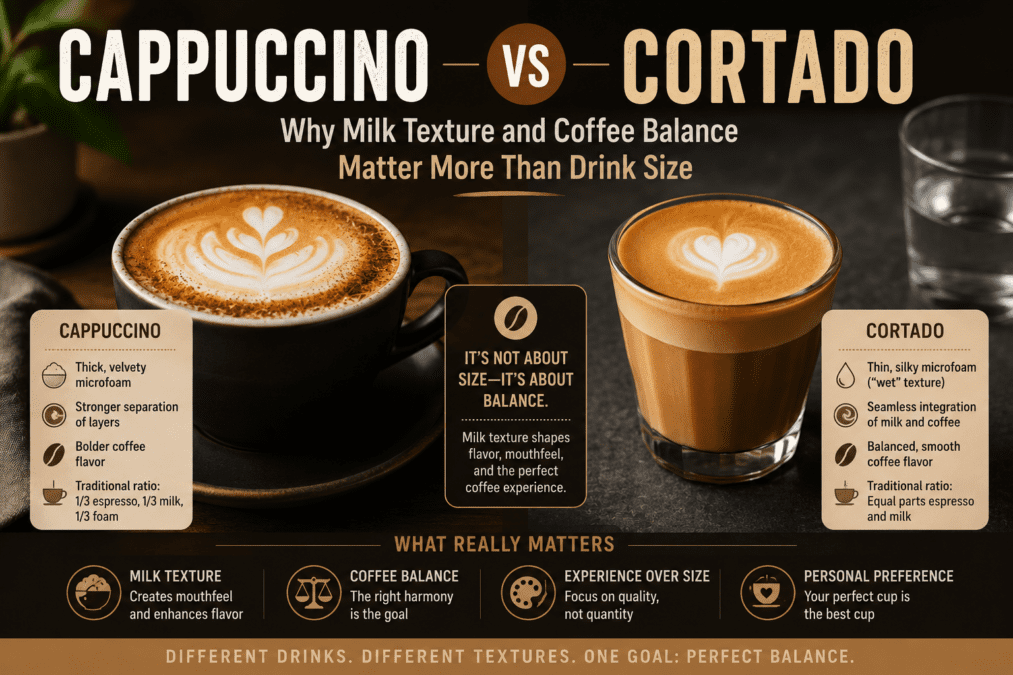

Coffee culture has evolved far beyond simple choices between black coffee and milk-based beverages. Modern specialty cafés now offer a wide range of espresso drinks, each designed around specific ratios of espresso, milk, foam, and texture. Among the most frequently compared options are cappuccino and cortado, two drinks that appear similar at first glance but deliver remarkably different experiences.
The comparison between cappuccino vs cortado is not merely about serving size or café preference. It involves understanding how milk structure, foam density, espresso concentration, flavor perception, and drinking context interact. Although both beverages originate from espresso traditions, they were developed with different objectives. One emphasizes texture and airiness, while the other prioritizes balance and clarity.
The most important insight in the cappuccino vs cortado debate is that the distinction is driven less by quantity and more by sensory engineering. A cappuccino transforms espresso through foam and milk expansion, while a cortado intentionally minimizes those effects to preserve coffee character. As a result, choosing between them depends largely on whether the drinker values texture-driven comfort or flavor-driven precision.
A cappuccino is an espresso-based drink made with steamed milk and a substantial layer of milk foam. A cortado is an espresso drink that combines espresso and lightly steamed milk in roughly equal proportions to reduce acidity while preserving coffee intensity.
While a cappuccino emphasizes creamy texture and foam structure, a cortado focuses on maintaining espresso clarity through restrained milk integration.
For most coffee drinkers, the answer to cappuccino vs cortado comes down to flavor balance. Those seeking a softer, creamier, and more indulgent experience often prefer cappuccino, whereas those wanting stronger coffee character without the harshness of straight espresso typically choose cortado.
Essential Comparative Metrics
| Feature | Cappuccino | Cortado |
|---|---|---|
| Definition | An espresso-based drink made with steamed milk and a thick layer of milk foam. | An espresso-based drink made with roughly equal parts espresso and steamed milk. |
| Origin | Italy | Spain |
| Primary Purpose | Create a creamy, airy, and balanced coffee experience. | Reduce espresso sharpness while preserving coffee flavor. |
| Typical Ratio | 1/3 espresso, 1/3 steamed milk, 1/3 foam | Approximately 1:1 espresso to steamed milk |
| Serving Size | 150–180 ml (5–6 oz) | 120–150 ml (4–5 oz) |
| Foam Content | High | Minimal |
| Milk Quantity | Moderate to high | Moderate |
| Coffee Intensity | Medium | Medium-high |
| Flavor Profile | Smooth, creamy, slightly sweet | Bold, balanced, espresso-forward |
| Texture | Light, airy, and frothy | Dense, silky, and smooth |
| Espresso Visibility | Partially softened by milk and foam | Remains highly noticeable |
| Acidity Perception | Lower | Moderately reduced |
| Sweetness Perception | Higher due to greater milk influence | Moderate |
| Best For | Drinkers who enjoy creamy, comforting coffee. | Drinkers who want strong coffee flavor with some milk. |
| Latte Art Potential | Moderate | High |
| Breakfast Pairing | Excellent | Good |
| Specialty Coffee Tasting | Good | Excellent |
| Calories (Approx.) | 70–120 calories | 50–90 calories |
| Caffeine Content | Usually similar, depending on espresso shots | Usually similar, depending on espresso shots |
| Overall Character | Texture-focused and comforting | Flavor-focused and balanced |
Structural And Biological Foundations
Understanding cappuccino vs cortado begins with milk physics rather than coffee beans. Both drinks rely on espresso extraction, yet their identities are created through different methods of milk treatment. During steaming, milk proteins trap air and form microscopic bubbles. The amount of air introduced dramatically affects flavor perception, mouthfeel, and aroma release.
In a cappuccino, a significant portion of the beverage consists of microfoam. This foam creates a lighter texture and distributes coffee flavors across a larger volume. The resulting drink feels softer and sweeter because the milk proteins and air dilute espresso intensity.
A cortado uses considerably less aeration. Instead of emphasizing foam, it relies on gently textured milk that integrates closely with the espresso. This creates a denser beverage where coffee compounds remain more prominent. The result is a drink that maintains espresso character while reducing excessive bitterness and acidity. Therefore, the structural differences in cappuccino vs cortado directly shape how the brain interprets sweetness, strength, and body.
Behavioral Patterns And Social Intelligence
Coffee drinks often reflect broader cultural habits. The popularity of cappuccino vs cortado is closely linked to how different societies approach coffee consumption.
Historically, cappuccino became associated with leisurely café culture. In many regions, it evolved into a breakfast beverage that complements pastries and lighter meals. Its larger volume and airy texture encourage slower consumption. The foam layer also enhances aroma retention, making the experience more sensory and prolonged.
The cortado emerged from a different philosophy. Spanish coffee culture traditionally values efficient, concentrated coffee experiences. The purpose of adding milk was not to create a creamy beverage but to “cut” the sharpness of espresso without overwhelming it. In fact, the name cortado derives from the Spanish word meaning “cut.”
These cultural patterns continue to influence modern coffee preferences. Consumers who prioritize comfort and relaxation often gravitate toward cappuccino, while those seeking flavor precision frequently favor cortado. This social dimension adds another layer to the cappuccino vs cortado discussion beyond simple ingredient ratios.
Cappuccino: Strengths And Constraints
The greatest strength of a cappuccino is sensory richness. The combination of espresso, steamed milk, and foam creates multiple layers of texture that evolve throughout the drinking experience. The first sip often feels airy, followed by creamy sweetness and a moderate coffee finish.
Another advantage is accessibility. New coffee drinkers often find cappuccino easier to enjoy because the foam and milk soften espresso’s sharper characteristics. The drink also pairs exceptionally well with breakfast foods, desserts, and bakery items.
However, cappuccino has limitations. The increased milk volume and foam can partially mask subtle coffee characteristics. High-quality beans with distinctive tasting notes may become less noticeable compared with more espresso-forward beverages.
Consistency can also be challenging. Foam quality varies significantly depending on barista technique, milk temperature, and equipment calibration. Poorly textured foam can create a dry or unstable drinking experience. Consequently, when evaluating cappuccino vs cortado, cappuccino often wins on comfort but sometimes sacrifices flavor transparency.
Cortado: Strengths And Constraints
The cortado’s primary strength lies in balance. By using a restrained amount of steamed milk, it softens espresso without hiding it. This allows drinkers to experience origin characteristics, roast profiles, and extraction quality more clearly.
Many specialty coffee professionals appreciate cortados because they provide a useful middle ground between straight espresso and larger milk-based drinks. Acidity remains noticeable, sweetness becomes more integrated, and bitterness is moderated without disappearing.
The cortado also offers remarkable consistency. Since it contains less foam, there are fewer variables that can significantly alter texture and flavor. This predictability has contributed to its popularity among experienced coffee consumers.
Yet the cortado is not ideal for everyone. Drinkers accustomed to creamy, milk-heavy beverages may perceive it as too intense. Its smaller volume can also feel less satisfying for those seeking a longer drinking experience. These trade-offs help explain why the cappuccino vs cortado debate remains highly personal despite clear technical differences.
Comparative Advantages In Real-World Scenarios
The practical value of cappuccino vs cortado becomes clearer when examined through everyday situations.
For breakfast consumption, cappuccino often performs better. Its larger volume and softer flavor profile complement pastries, toast, and sweet baked goods. The foam contributes to a comforting morning ritual that many consumers enjoy.
In specialty coffee environments, cortados frequently excel. Their balanced composition allows coffee enthusiasts to evaluate bean quality without the intensity of pure espresso. Distinct flavor notes remain easier to identify.
For casual coffee drinkers transitioning toward stronger beverages, cortados can serve as an educational step between milk-heavy drinks and espresso. Conversely, cappuccinos remain an excellent option for individuals who prioritize texture and creaminess.
Workplace settings provide another interesting contrast. A cappuccino may encourage a slower coffee break, while a cortado aligns more naturally with quick yet flavorful consumption. These situational advantages demonstrate that the winner in cappuccino vs cortado depends heavily on context rather than objective superiority.
Flavor Chemistry And Sensory Perception
One of the most fascinating aspects of cappuccino vs cortado is how milk changes flavor chemistry. Espresso contains hundreds of aromatic compounds, many of which influence sweetness, bitterness, fruitiness, and body.
Milk proteins bind to certain bitter compounds, reducing perceived harshness. Milk sugars also contribute natural sweetness, especially when steaming temperatures are properly controlled. However, the extent of these effects depends on milk volume and foam structure.
In cappuccinos, greater aeration disperses flavor compounds across a larger matrix. This often creates a smoother and less intense sensory profile. The foam also affects aroma release by slowing the escape of volatile compounds.
Cortados preserve a more concentrated environment. Aromatic molecules remain closer to their original espresso concentration, allowing flavors to appear more vivid and defined. As a result, many coffee professionals view cortados as superior tools for assessing bean quality. This scientific perspective adds substantial depth to the cappuccino vs cortado comparison.
Nutritional Differences
Although neither beverage is typically considered unhealthy, nutritional distinctions exist. In the cappuccino vs cortado comparison, milk volume is the primary factor influencing calories, protein, and carbohydrate content.
A traditional cappuccino generally contains more milk, leading to slightly higher calorie content. Depending on preparation methods and milk choice, calories commonly range between 70 and 120 per serving.
A cortado usually contains less milk overall, resulting in somewhat lower calorie intake. Protein and sugar levels are correspondingly reduced. Because espresso content remains similar, caffeine differences are often minimal.
Alternative milks introduce additional variation. Oat milk tends to increase carbohydrate content, while almond milk may lower calories. Regardless of milk type, both beverages remain moderate choices compared with larger flavored coffee drinks containing syrups and whipped toppings.
Therefore, nutritional considerations rarely determine the outcome of cappuccino vs cortado, though cortados often hold a slight advantage for calorie-conscious consumers.
Scientific And Expert Consensus (2026)
Current specialty coffee consensus does not identify a universal winner in cappuccino vs cortado. Instead, experts generally frame the comparison as a choice between different sensory objectives.
Coffee educators consistently note that cappuccinos excel at showcasing texture. Their layered structure creates a multidimensional experience emphasizing creaminess, sweetness, and aroma. Properly prepared examples demonstrate exceptional balance between milk and espresso.
At the same time, coffee professionals frequently praise cortados for preserving coffee identity. The restrained use of milk allows bean characteristics to remain recognizable while reducing espresso harshness. Many tasting programs use cortado-style preparations to evaluate coffee quality under milk conditions.
Research into sensory perception further supports this distinction. Greater milk incorporation tends to soften flavor contrasts, whereas lower milk ratios maintain stronger flavor differentiation. As of 2026, expert consensus suggests that neither beverage is inherently superior. Instead, each succeeds according to its intended design philosophy.
Market Trends And Consumer Preferences
The global specialty coffee movement has reshaped the cappuccino vs cortado landscape. Traditional cappuccinos continue to dominate mainstream cafés because they appeal to a broad audience and align with established coffee habits.
However, cortados have experienced significant growth within specialty coffee sectors. Consumers increasingly seek drinks that reveal bean quality while remaining approachable. The cortado satisfies this demand effectively.
Social media has also influenced preferences. Latte art culture initially boosted cappuccino popularity, while educational coffee content later introduced wider audiences to cortados and other espresso-forward beverages.
Interestingly, younger specialty coffee consumers often alternate between both drinks depending on circumstances. They may choose cappuccinos for relaxation and cortados for tasting-focused experiences. This evolving consumer behavior suggests that the future of cappuccino vs cortado is not a competition for dominance but a coexistence driven by different drinking occasions.
Final Synthesis And Verdict
The comparison of cappuccino vs cortado ultimately reveals two distinct philosophies of coffee preparation. Cappuccino uses foam and milk structure to create a comforting, creamy, and texture-driven experience. Cortado uses restraint to preserve espresso character while improving balance and drinkability.
If your priority is richness, softness, and a longer café-style experience, cappuccino is often the stronger choice. If your goal is to experience coffee flavor more directly without the intensity of straight espresso, cortado usually delivers greater precision.
The most important takeaway is that cappuccino vs cortado is not a battle between a superior and inferior drink. It is a comparison between two expertly designed approaches to balancing espresso and milk. One highlights texture; the other highlights clarity. Understanding that distinction allows coffee drinkers to select the beverage that best matches their preferences, context, and sensory goals.
Frequently Asked Questions
Is a cortado stronger than a cappuccino?
In most cases, yes. Because a cortado contains less milk and significantly less foam, espresso flavors remain more concentrated. The caffeine content may be similar, but the coffee taste is generally stronger.
Why does a cappuccino taste sweeter than a cortado?
A cappuccino often tastes sweeter because its larger milk volume and foam structure soften bitterness and spread flavors across a greater volume, creating a smoother sensory experience.
Which is better for beginners: cappuccino or cortado?
Most beginners find cappuccino easier to enjoy due to its creamy texture and reduced coffee intensity. However, a cortado can be an excellent option for those who want to explore stronger coffee flavors gradually.
Can the same coffee beans be used for both drinks?
Absolutely. The same espresso beans can produce excellent cappuccinos and cortados. The difference comes primarily from milk ratio, foam structure, and overall beverage design rather than the coffee itself.