
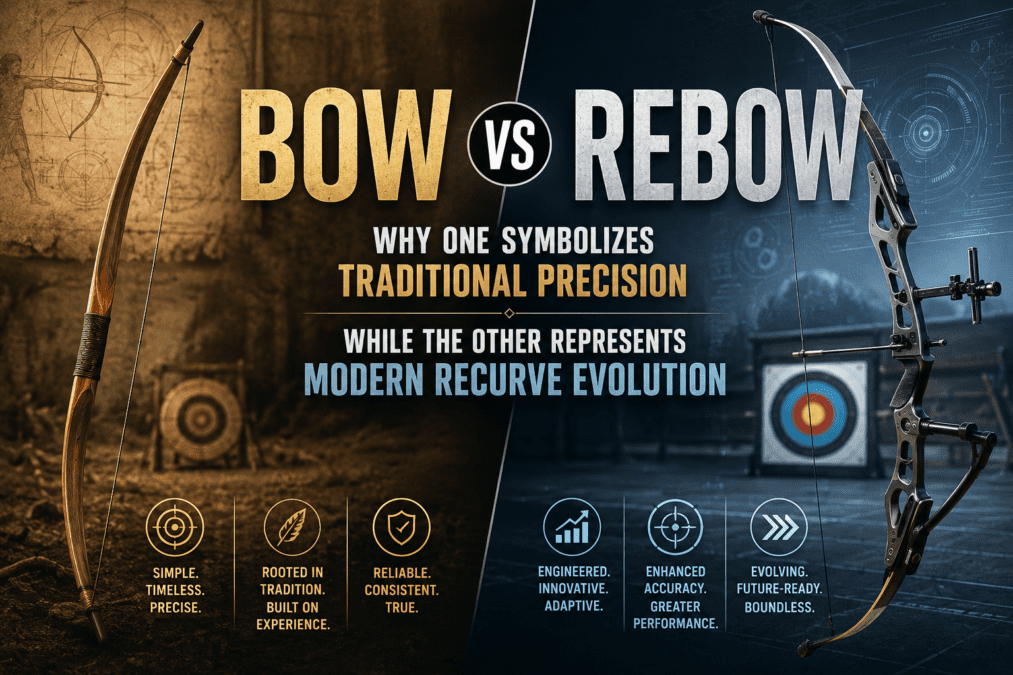

The bow vs rebow comparison is often misunderstood because many people assume both terms describe completely different weapons. In reality, the distinction usually refers to a traditional straight or longbow-style design versus a recurve bow (sometimes informally shortened or misspelled as “rebow” in online discussions). Both launch arrows using stored elastic energy, yet their engineering principles, performance characteristics, and practical applications differ significantly.
A meaningful bow vs rebow analysis requires more than comparing appearance. Factors such as limb geometry, energy storage efficiency, draw-force curves, shooting accuracy, hunting effectiveness, competitive use, and user learning curves all influence performance. Looking only at arrow speed or historical popularity provides an incomplete picture.
The most surprising conclusion from a modern bow vs rebow evaluation is that superiority depends heavily on purpose. Traditional bows excel in simplicity, instinctive shooting, and historical authenticity, while recurves achieve greater energy efficiency and often deliver improved performance without the complexity of compound systems. The result is not a simple winner but a clear understanding of which design best serves specific users and environments.
A bow is an archery tool that stores energy through flexible limbs and transfers that energy to an arrow upon release.
A rebow, commonly referring to a recurve bow, is a bow whose limb tips curve away from the archer, increasing energy storage and shooting efficiency.
While traditional bows prioritize simplicity and direct shooting mechanics, recurves maximize limb efficiency and arrow velocity through advanced limb geometry.
For most archers, the answer to the bow vs rebow question is straightforward: a traditional bow offers authenticity, ease of maintenance, and instinctive shooting, whereas a recurve bow provides greater power, efficiency, and competitive versatility. The better option depends on whether the archer values tradition or performance optimization.
Comparative Metrics Table
| Attribute | Traditional Bow | Rebow (Recurve Bow) |
|---|---|---|
| Limb Shape | Straight or mildly curved | Tips curve away from archer |
| Energy Storage Efficiency | Moderate | High |
| Arrow Speed | Moderate | Higher |
| Draw Smoothness | Consistent | Often smoother through draw cycle |
| Forgiveness for Beginners | Moderate | High |
| Historical Authenticity | Excellent | Moderate |
| Olympic Competition Use | Rare | Standard |
| Maintenance Requirements | Low | Low to Moderate |
| Hunting Capability | Good | Excellent |
| Accessory Compatibility | Limited | Extensive |
| Learning Curve | Steeper | Generally Easier |
Structural And Biological Foundations
The foundation of the bow vs rebow debate lies in limb architecture. Traditional bows generally feature straight limbs that bend uniformly during the draw cycle. This design has existed for thousands of years and reflects an engineering philosophy centered on simplicity and reliability.
A rebow, or recurve bow, incorporates outward-curving limb tips. These recurved ends remain engaged longer during the draw process, allowing the bow to store more potential energy without requiring dramatically increased draw weight. As a result, a recurve often launches arrows faster than a traditional bow of comparable draw weight.
From a biomechanical perspective, archers experience these designs differently. Traditional bows tend to place greater emphasis on consistent form and muscle memory. Recurves distribute draw forces more efficiently, helping shooters maintain stability throughout the draw cycle. This difference significantly influences shooting comfort, especially during extended practice sessions.
Understanding these structural distinctions is essential to any serious bow vs rebow comparison because the physical design directly determines performance outcomes.
Skeet vs Trap: Why Olympic Shotgun Disciplines Demand Opposite Neural and Biomechanical Profiles
Behavioral Patterns And Social Intelligence
The cultural dimensions of the bow vs rebow discussion are as important as technical performance. Traditional bow users often prioritize historical connection, craftsmanship, and instinctive shooting methods. Many enthusiasts view traditional archery as a discipline that combines athletic skill with historical appreciation.
Recurve archers frequently operate within structured training systems and competitive environments. Olympic archery, national tournaments, and advanced coaching methodologies overwhelmingly rely on recurve platforms. This has created a community culture focused on measurable precision, equipment optimization, and performance analysis.
Interestingly, both groups display distinct forms of expertise. Traditional archers often develop exceptional intuitive shooting abilities, relying on subconscious distance estimation and body alignment. Recurve shooters typically cultivate highly refined technical skills supported by sights, stabilizers, and repeatable shooting mechanics.
In the broader bow vs rebow conversation, these cultural differences explain why debates frequently become philosophical rather than purely technical. Participants are often defending entire approaches to archery rather than simply comparing equipment.
Traditional Bow: Strengths And Constraints
When evaluating bow vs rebow, the strengths of traditional bows remain compelling despite advances in archery technology.
One major advantage is simplicity. Traditional bows contain fewer components and fewer potential points of failure. This reliability makes them attractive for survival training, historical reenactment, and minimalist hunting applications.
Traditional bows also promote instinctive shooting. Many archers appreciate the direct connection between body mechanics and arrow flight. Without extensive accessories, success depends heavily on technique and repetition.
Weight is another advantage. Traditional bows are often lighter and easier to transport. Their straightforward construction also simplifies maintenance and long-term ownership.
However, constraints exist. Traditional bows generally store less energy than equivalent recurves. This translates into slower arrow speeds and potentially reduced effective range. Beginners may also struggle with consistency because traditional shooting offers fewer technological aids.
Thus, within the bow vs rebow framework, traditional bows excel in authenticity and simplicity but may sacrifice some performance efficiency.
Rebow (Recurve Bow): Strengths And Constraints
The rebow side of the bow vs rebow comparison demonstrates how design innovation can improve efficiency without abandoning traditional archery principles.
The defining advantage of a recurve bow is superior energy transfer. Curved limb tips create a mechanical advantage that allows more stored energy to be converted into arrow velocity. This often results in flatter trajectories and improved downrange performance.
Recurves are also remarkably versatile. Modern designs accommodate sights, stabilizers, clickers, and other accessories that enhance accuracy. These features make recurves the dominant platform in Olympic competition and structured target archery.
Another benefit is scalability. Archers can begin with basic setups and gradually add equipment as their skills develop. This adaptability supports long-term progression.
Yet recurves are not without limitations. Increased complexity can raise costs. Accessory tuning requires knowledge and time. Some archers also feel that extensive equipment reduces the instinctive nature of traditional shooting.
Still, in many practical evaluations of bow vs rebow, recurves emerge as the more performance-oriented option.
Comparative Advantages In Real-World Scenarios
The most useful bow vs rebow analysis examines actual use cases rather than theoretical specifications.
For historical reenactment, living-history demonstrations, and traditional archery competitions, conventional bows possess a clear advantage. Authenticity matters more than marginal performance gains in these contexts.
For Olympic competition, the answer is equally clear. Recurve bows dominate because their design supports extraordinary precision and consistency under controlled conditions.
Hunters often face a more nuanced decision. Traditional bows offer lightweight portability and challenge-driven hunting experiences. Recurves provide higher arrow speeds and potentially greater effectiveness at varying distances.
For beginners, recurves frequently represent the better starting platform. Their forgiving draw characteristics and accessory compatibility accelerate skill development. Traditional bows, however, may cultivate stronger fundamental shooting habits because they require deeper attention to form.
This practical perspective reveals why the bow vs rebow debate persists. Different objectives naturally produce different winners.
Performance Efficiency And Energy Transfer
A deeper bow vs rebow investigation requires examining physics.
Every bow functions as an energy-storage system. During the draw, muscular effort is converted into potential energy stored within the limbs. Upon release, that energy accelerates the arrow.
Traditional bows perform this task effectively but relatively straightforwardly. Their limb geometry limits how much energy can be stored within a given draw length.
Recurves alter the equation. Curved limb tips increase leverage throughout the draw cycle, enabling more efficient energy accumulation. Consequently, recurves often achieve greater arrow velocity without requiring substantially heavier draw weights.
Efficiency influences more than speed. Faster arrows generally experience reduced gravitational drop over distance, simplifying aiming. Improved energy transfer can also increase penetration in hunting contexts.
These mechanical realities explain why many engineers and competitive archers favor recurves when conducting objective bow vs rebow performance assessments.
Accuracy And Precision Analysis
Accuracy is often misunderstood in the bow vs rebow discussion.
A bow itself is not inherently accurate. Rather, accuracy emerges from the interaction between equipment, archer skill, and environmental conditions.
Traditional bows encourage instinctive aiming. Skilled practitioners can achieve remarkable precision through repetition and muscle memory. However, performance depends heavily on individual consistency.
Recurves introduce advantages through equipment design. Stabilizers reduce vibration. Sights provide repeatable aiming references. Clickers help maintain consistent draw lengths. Together, these features reduce variability and improve shot-to-shot consistency.
At elite levels, these small improvements become decisive. Olympic competition demonstrates how recurve technology supports extraordinary precision under pressure.
Nevertheless, traditional archers frequently outperform recurve shooters in instinctive shooting environments where rapid target acquisition matters more than measured aiming procedures.
Therefore, a balanced bow vs rebow evaluation recognizes that accuracy depends on context rather than equipment alone.
Scientific And Expert Consensus (2026)
Current archery research and coaching methodologies generally agree on several conclusions regarding bow vs rebow performance.
First, recurve bows store and transfer energy more efficiently than comparable traditional bow designs. This advantage is well understood through mechanical analysis and practical testing.
Second, recurve systems provide greater opportunities for performance optimization through accessories and tuning. Competitive archery organizations worldwide rely on these advantages.
Third, traditional bows remain highly effective when used within their intended applications. Their longevity across thousands of years demonstrates practical reliability rather than technological inferiority.
Experts increasingly reject simplistic winner-versus-loser narratives. Modern coaching emphasizes matching equipment to goals, body mechanics, experience levels, and shooting preferences.
As a result, the emerging consensus within the bow vs rebow field is that equipment selection should prioritize purpose-specific effectiveness rather than abstract superiority.
Long-Term Ownership And Skill Development
Another important aspect of bow vs rebow decision-making involves long-term progression.
Traditional bow ownership often encourages mastery through repetition. Because fewer variables can be adjusted, archers spend more time refining technique. This process develops strong instinctive shooting skills and deep familiarity with equipment behavior.
Recurve ownership supports continuous technical advancement. Adjustable components allow archers to refine performance as their abilities improve. This creates a structured pathway from beginner to elite competitor.
Financial considerations also matter. Entry-level traditional bows are often affordable and straightforward. High-end recurves may involve additional investments in stabilizers, sights, arrows, and tuning equipment.
The long-term experience therefore differs substantially. Traditional bows reward simplicity and personal refinement, whereas recurves reward technical optimization and competitive progression.
These contrasting development paths further enrich the bow vs rebow discussion.
Final Synthesis And Verdict
The bow vs rebow comparison reveals that neither design universally dominates the other.
Traditional bows excel in simplicity, historical authenticity, portability, and instinctive shooting. They represent a direct connection to archery’s origins and reward disciplined technique. For archers seeking minimalism, craftsmanship, and tradition, conventional bows remain exceptionally appealing.
Recurve bows excel in efficiency, energy transfer, accuracy potential, and competitive adaptability. Their advanced limb geometry delivers measurable performance advantages while preserving the core principles of traditional archery. For target competition, structured training, and performance-focused shooting, recurves frequently provide the superior platform.
Ultimately, the strongest conclusion from the bow vs rebow debate is that effectiveness depends on purpose. If authenticity and instinctive mastery are priorities, a traditional bow is often the better choice. If precision, versatility, and measurable performance matter most, a recurve bow generally offers greater advantages.
Rather than replacing traditional bows, recurves represent an evolutionary refinement of archery technology. Both remain relevant because they satisfy different definitions of excellence.
Frequently Asked Questions
What is the main difference in bow vs rebow performance?
The primary difference is efficiency. In a bow vs rebow comparison, recurves generally store more energy and launch arrows faster due to their curved limb tips, while traditional bows prioritize simplicity and instinctive shooting.
Is a rebow easier for beginners than a traditional bow?
In many cases, yes. The bow vs rebow learning curve often favors recurves because accessory options and forgiving draw characteristics help new archers develop consistency more quickly.
Which is better for hunting in a bow vs rebow comparison?
Both can be effective. Traditional bows offer lightweight simplicity, while recurves typically provide higher arrow speeds and improved energy transfer, which may benefit hunting performance.
Why are recurve bows used in Olympic archery?
Olympic competition emphasizes precision and consistency. In the bow vs rebow debate, recurves provide superior tuning potential, accessory compatibility, and repeatable shooting mechanics, making them ideal for elite-level target archery.
Does a traditional bow require more skill than a recurve bow?
Not necessarily more skill, but a different type of skill. Traditional bows emphasize instinctive shooting and body awareness, whereas recurves reward technical precision, equipment tuning, and repeatable form.