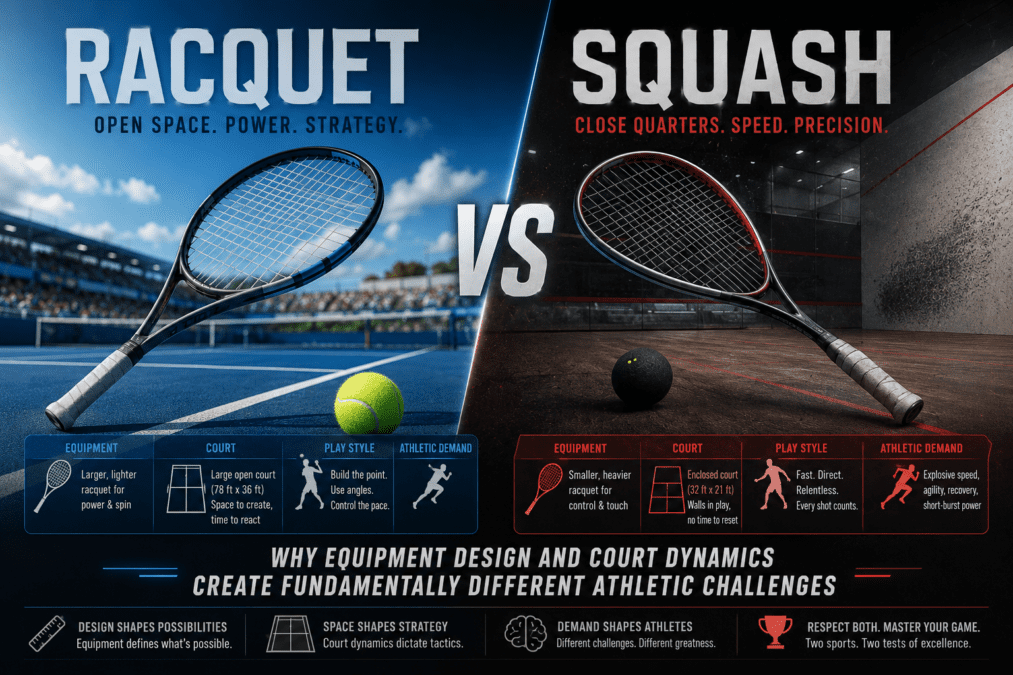

Racquet sports and squash are often grouped together because both involve striking a ball with a racket-like tool, fast reflexes, strategic movement, and competitive gameplay. Yet beneath these surface similarities lies a surprisingly deep divide in mechanics, athletic requirements, equipment engineering, and tactical decision-making. Understanding the distinction is important for athletes, coaches, recreational players, and anyone evaluating which sport better suits their physical strengths and competitive preferences.
This racquet vs squash comparison examines the structural, biomechanical, strategic, and performance-related differences between the two sporting categories. Rather than focusing solely on rules, the analysis evaluates how equipment characteristics, court environments, movement demands, and skill development pathways shape the athlete’s experience.
The central insight of this racquet vs squash study is that squash compresses athletic performance into a confined, high-intensity environment, while broader racquet sports often distribute physical and tactical challenges across larger spaces and longer reaction windows. Although both demand coordination and precision, they reward different combinations of endurance, explosiveness, anticipation, and decision-making.
Comparative Metrics Overview
| Attribute | General Racquet Sports | Squash |
|---|---|---|
| Playing Environment | Usually open court | Enclosed four-wall court |
| Ball Trajectory | Direct player-to-player | Wall-assisted rebounds |
| Reaction Time | Moderate to high | Extremely high |
| Court Coverage | Larger distances | Compact but constant movement |
| Aerobic Demand | High | Very high |
| Shot Variety | Wide tactical range | Highly technical wall-based shots |
| Learning Curve | Moderate | Steep |
| Equipment Complexity | Varies by sport | Specialized but streamlined |
| Typical Rally Structure | Linear exchanges | Multi-angle rebounds |
| Space Utilization | Horizontal emphasis | Three-dimensional emphasis |
What Is the Difference Between Racquet and Squash?
A racquet sport is any game in which players use a strung implement to strike a ball or shuttlecock. Tennis, badminton, racquetball, and squash are all examples of racquet sports.
Squash is a specific racquet sport played inside an enclosed court where players can use the walls strategically. While many racquet sports rely primarily on direct exchanges, squash incorporates rebound geometry and spatial control as core elements of competition.
In a simple racquet vs squash comparison, racquet sports generally emphasize court coverage and direct shot placement, while squash emphasizes continuous pressure, wall usage, and rapid positional recovery.
Structural And Biological Foundations
The foundation of the racquet vs squash debate begins with environment and equipment design. Traditional racquet sports such as tennis often take place on expansive courts where athletes generate power through long kinetic chains involving the legs, hips, torso, shoulders, and arms. Players have greater space to accelerate and create momentum before executing strokes.
Squash operates under different physical constraints. The enclosed court reduces available space while increasing the complexity of movement patterns. Players repeatedly accelerate, decelerate, lunge, rotate, and recover within seconds. This produces a distinctive physiological profile characterized by elevated cardiovascular demand and rapid neuromuscular activation.
Biomechanically, squash rewards efficiency over maximal force. Because opponents can retrieve balls from wall rebounds, success depends less on outright power and more on precision, anticipation, and court positioning. This distinction forms one of the most important conclusions in any serious racquet vs squash evaluation.
Behavioral Patterns And Social Intelligence
Competitive behavior differs significantly across the racquet vs squash landscape. Many racquet sports encourage players to exploit open space, forcing opponents to cover large distances. Tactical planning often revolves around creating angles, changing pace, and manipulating court geometry.
Squash introduces an additional layer of complexity. Since players share the same confined court, spatial awareness becomes critical. Athletes must predict not only ball trajectories but also opponent movement patterns. Successful players continuously interpret body language, swing preparation, recovery habits, and positioning cues.
This heightened requirement for anticipation can be viewed as a form of sporting intelligence. Elite squash competitors frequently make decisions in fractions of a second, balancing offensive opportunities with positional safety. Consequently, the racquet vs squash comparison reveals that squash often places a greater premium on immediate tactical adaptation under pressure.
Subject A: Strengths And Constraints
The broader category of racquet sports offers several advantages. First, the diversity of formats allows athletes to select environments that match their abilities. Tennis rewards power and endurance, badminton emphasizes speed and agility, and table tennis prioritizes reaction speed and precision.
Another strength is accessibility. Racquet sports are played worldwide and benefit from extensive coaching infrastructures, competitive pathways, and spectator appeal. Their global reach supports talent development and recreational participation alike.
However, racquet sports can require substantial court space and often involve environmental variables such as wind, surface conditions, and weather. These factors may introduce inconsistency into performance outcomes.
Within the racquet vs squash framework, racquet sports provide versatility and broad athletic development but may not always generate the same level of sustained intensity found in squash competition.
Subject B: Strengths And Constraints
Squash possesses a unique collection of strengths that distinguish it from other racquet sports. The enclosed court eliminates weather-related disruptions and creates a highly controlled competitive environment. Every rally remains active until the ball becomes unplayable, encouraging relentless engagement.
The sport is renowned for its cardiovascular demands. Research consistently places squash among the most physically demanding racket-based activities due to continuous movement and limited recovery periods. Players develop exceptional agility, balance, and endurance.
Nevertheless, squash presents challenges. The steep learning curve can discourage beginners. Understanding wall angles, ball behavior, and court positioning requires significant practice. The confined environment may also feel intimidating for newcomers accustomed to open courts.
Despite these limitations, many analysts consider squash one of the most complete athletic tests in the entire racquet vs squash spectrum.
Equipment Engineering And Performance Impact
Equipment differences significantly influence outcomes in the racquet vs squash discussion. Traditional racquet sports often feature larger rackets designed for power generation, spin production, or defensive reach. Equipment customization can dramatically affect performance.
Squash rackets are typically lighter and optimized for maneuverability. Because players operate in close quarters and face rapid exchanges, swing efficiency becomes more valuable than maximum force output.
Ball design creates another important distinction. Squash balls are engineered to react differently depending on temperature and pace of play. Skilled competitors intentionally manipulate ball conditions throughout matches, adding a strategic layer rarely seen in other racquet disciplines.
These engineering differences reinforce the idea that squash rewards precision and control, whereas many racquet sports provide greater opportunities for power-oriented play.
Movement Patterns And Athletic Demands
One of the most revealing sections of any racquet vs squash analysis concerns movement. Tennis players may sprint longer distances during points, but squash athletes often perform more frequent directional changes within a shorter timeframe.
Squash movement involves repeated lunges, explosive recoveries, rotational pivots, and center-court repositioning. The cumulative effect is substantial physiological stress. Players operate near their aerobic and anaerobic thresholds for extended periods.
Racquet sports distribute movement demands differently. Larger playing areas require acceleration and deceleration over longer distances. Athletes often have slightly more time between actions, allowing strategic pacing and recovery.
The result is not a question of which sport is harder overall, but rather which athletic qualities are being challenged most intensely.
Comparative Advantages In Real-World Scenarios
For individuals seeking cardiovascular conditioning, squash often delivers exceptional efficiency. The continuous nature of rallies and compact court environment generate sustained physical engagement.
For athletes who prefer tactical variety, outdoor environments, and broader competitive ecosystems, traditional racquet sports may offer greater flexibility. Tennis, for example, supports singles, doubles, professional tours, collegiate pathways, and recreational leagues.
In practical terms, the racquet vs squash decision depends heavily on personal goals. Someone focused on fitness and reaction speed may gravitate toward squash. Someone seeking global competition opportunities and diverse playing styles may prefer other racquet sports.
Neither choice is universally superior; each excels under different performance criteria.
Scientific And Expert Consensus (2026)
Current sports science literature generally agrees that both categories provide substantial cardiovascular, muscular, and cognitive benefits. However, squash consistently ranks among the most demanding racket-based sports in terms of caloric expenditure and sustained intensity.
Researchers studying reaction time and perceptual decision-making frequently highlight squash as an environment requiring unusually rapid information processing. The enclosed court, wall interactions, and shared playing space create an exceptionally dynamic decision environment.
Meanwhile, broader racquet sports continue to demonstrate advantages in skill transferability, participation rates, and global accessibility. Coaches increasingly recognize that training methods from one racquet discipline can enhance performance in another.
The emerging consensus from the racquet vs squash debate is that these activities should be viewed as complementary rather than competing athletic systems.
Psychological And Strategic Differences
Mental performance plays a major role in the racquet vs squash comparison. Racquet sports often involve long-term strategic planning across sets and matches. Athletes manage momentum swings, energy conservation, and opponent adaptation.
Squash compresses these decisions into shorter intervals. Tactical errors are punished quickly, and players must recover mentally as rapidly as they recover physically. Concentration lapses can transform winning positions into losing rallies within seconds.
This psychological intensity explains why experienced squash players frequently describe the sport as a mental chess match conducted at sprinting speed.
Which Sport Is Better For Fitness?
The answer depends on how fitness is defined.
If fitness emphasizes cardiovascular output, agility, and continuous movement, squash frequently ranks among the strongest options available.
If fitness includes power generation, long-distance court coverage, and varied movement patterns, other racquet sports provide equally valuable benefits.
While squash generally produces higher sustained intensity, many racquet sports offer broader movement environments and longer-term participation opportunities.
Final Synthesis And Verdict
The most important conclusion from this racquet vs squash study is that the comparison is not simply about equipment or court design. It is a comparison between two distinct philosophies of athletic performance.
Racquet sports typically reward space management, stroke diversity, and adaptable strategic frameworks. Squash rewards compressed decision-making, relentless movement, and mastery of three-dimensional court geometry.
While racquet sports often provide greater variety and accessibility, squash delivers one of the most concentrated tests of endurance, agility, and tactical awareness available in modern sport.
For fitness-focused athletes, squash frequently offers the greater physiological challenge. For players seeking broader competitive ecosystems and multiple style options, traditional racquet sports may be the stronger choice.
Ultimately, the racquet vs squash verdict depends on what an athlete values most. If intensity, reaction speed, and continuous engagement are priorities, squash has a compelling advantage. If versatility, global participation, and diverse tactical environments matter more, the wider world of racquet sports remains difficult to surpass.
Frequently Asked Questions
Is squash considered a racquet sport?
Yes. Squash is a racquet sport because players use a strung racket to strike a ball. However, it differs from many other racquet sports because it is played inside an enclosed court where wall rebounds are part of normal gameplay.
Which is harder, racquet sports or squash?
The answer varies by sport and skill level. Squash generally demands higher continuous intensity and faster reactions, while many racquet sports require greater court coverage and specialized technical skills.
Does squash provide better fitness benefits?
Squash is widely regarded as one of the most physically demanding racquet-based activities. Its continuous movement patterns often produce excellent cardiovascular and metabolic conditioning.
Which is easier for beginners?
Many beginners find traditional racquet sports easier initially because the rules and ball trajectories are more intuitive. Squash often requires additional time to understand wall usage, positioning, and court geometry.